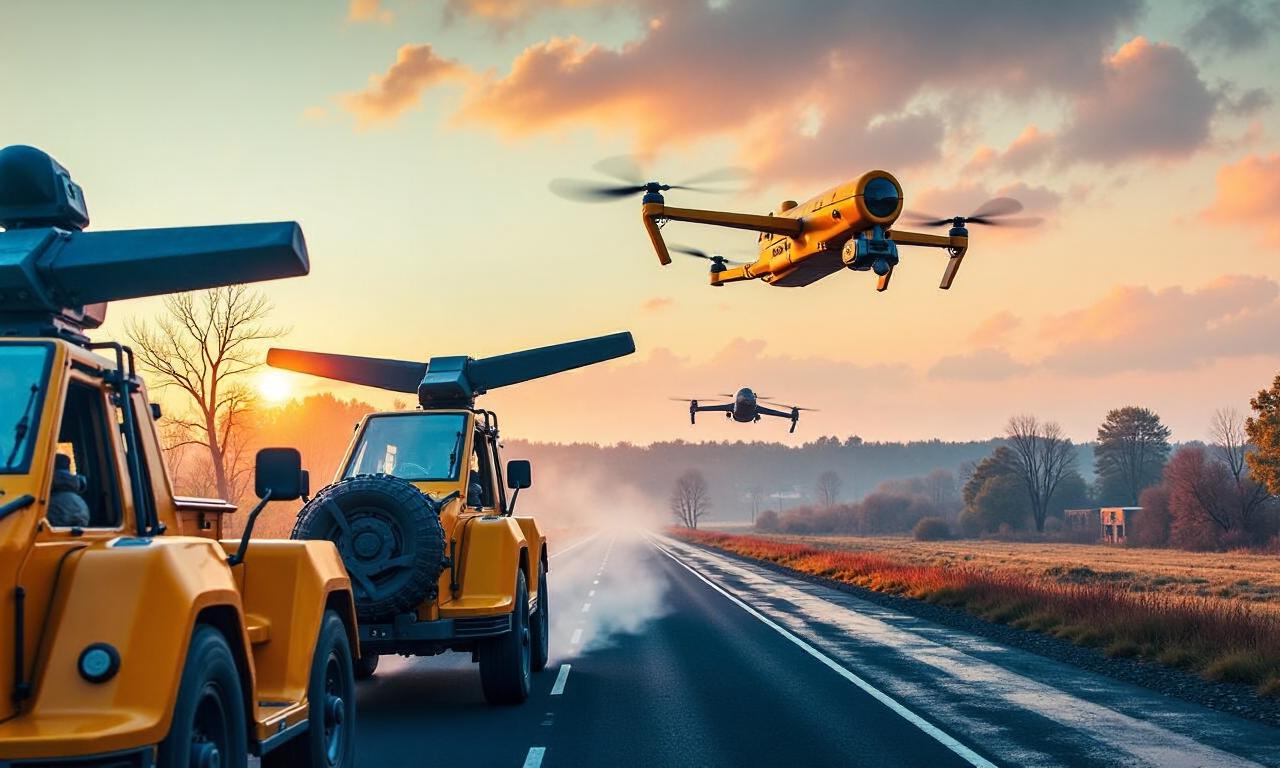
Ukraine Using AI Drones to Target Russian Supply Convoys
Drone Campaign Disrupts Critical Supply Lines
Samael.lol – According to military analysts, Ukraine’s armed forces are intensifying efforts to dismantle supply convoys transporting essential resources to Russian troops in occupied regions. BBC Verify has validated recent footage showing at least 14 incidents in the past week where vehicles carrying food, fuel, and ammunition were struck along vital routes linking Russia to Crimea and southern Ukraine. These strikes, enabled by advanced AI drone systems, are reshaping the dynamics of the conflict by targeting logistics hubs and transportation networks that sustain Russian operations.
Strategic Shift in War Efforts
For the first time since 2023, Ukraine is reportedly gaining more territory than it loses, according to the Institute for the Study of War (ISW). This reversal comes after over four years of war, during which neither side achieved significant territorial gains. The introduction of AI-driven drone technology, such as the Hornet system, has allowed Ukrainian forces to strike Russian units at greater distances with enhanced precision, disrupting supply chains that were once considered invulnerable.
Impact on Russian Logistics
Experts note that the effectiveness of these drone strikes has forced Russia to adjust its logistics strategies. Convoys are now being shortened to mitigate damage, as described by Cristian Vlas of the Acled conflict monitoring group. He emphasized that Ukraine’s focus extends beyond merely damaging equipment; the goal is to undermine Russia’s operational capabilities by targeting command centers, communication towers, and critical supply depots. These assets, he explained, are essential for maintaining frontline units and supporting long-range missile strikes from occupied territories.
“Ukraine’s strategy is not just about destroying vehicles—it’s about crippling the infrastructure that keeps Russia’s forces moving and resupplying.”
Technology Behind the Strikes
According to Nick Brown, a weapons expert at Janes defense intelligence, Ukraine’s Hornet drones are equipped with AI-targeting systems trained on thousands of hours of footage of Russian military assets. This training has enabled the drones to autonomously identify and engage targets, even when operating at extended ranges. Additionally, the drones leverage Starlink satellite networks, which provide a more resilient communication link and reduce vulnerability to Russian jamming tactics.
Expert Analysis on Operational Challenges
Robert Tollast, a land warfare specialist at the Royal United Service Institute, highlighted the scale of resource demands facing Russian troops. He estimated that some brigades require up to 1,000 tonnes of supplies daily, including fuel, food, and ammunition. The recent drone strikes, he noted, represent a significant escalation in Ukraine’s ability to strike at key logistical nodes, making it harder for Russia to sustain its operations. “Cutting resupply lines at 100km from the front is a game-changer,” Tollast explained.
“By targeting supplies deep behind the front, Ukraine is forcing Russia into a defensive posture, reducing the capacity of its forces to launch sustained offensives.”
Reinforcing the War’s Momentum
George Barros of the ISW argued that Ukraine’s technological innovations are breaking the stalemate in the conflict. The use of loitering munitions—drones that linger over areas before striking—has allowed Kyiv to conduct tactical maneuvers previously deemed impossible. These strikes not only disrupt supply lines but also pressure Russian commanders to reposition their forces, weakening their ability to conduct infiltration missions.
Specific Strikes and Their Significance
Footage analyzed by BBC Verify and GeoConfirmed analysts reveals multiple instances of burned-out military vehicles along a key supply corridor in southern Ukraine. At least 10 attacks were recorded between Russia’s border and the occupied city of Mariupol, with one notable strike located southwest of Melitopol. This route, vital for moving supplies to Crimea and the front lines, has become a focal point for Ukrainian countermeasures.
“The destruction of these vehicles is a clear indicator of Ukraine’s growing ability to strike deep into Russian logistical networks.”
Analyst Perspectives on Scale and Strategy
Clément Molin, an analyst at the Atum Mundi think tank, confirmed that over 150 vehicles have been destroyed more than 20km from the front line. However, he estimated this figure likely represents only half of the total incidents, suggesting the actual number of attacks could be even higher. “The frequency and precision of these strikes are unprecedented,” Molin stated, underscoring the strategic value of the drone campaign.
Evolution of Ukrainian Tactics
Ukraine’s use of AI drones marks a pivotal shift in its approach to the war. Previously, long-range strikes were limited to specific targets, but the integration of AI has expanded the scope of operations. This technological edge allows Ukrainian forces to focus on critical infrastructure while reducing reliance on human operators for real-time targeting. The result is a more efficient and scalable method of disrupting Russian supply efforts.
“AI is transforming the way Ukraine attacks, making it possible to strike with confidence even in complex environments.”
Future Implications for the Conflict
As the war continues, analysts predict that Russia’s ability to sustain its military operations will face increasing challenges. The pressure on supply routes is forcing Moscow to reevaluate its logistics strategy, with commanders seeking to minimize exposure to Ukrainian strikes. Meanwhile, Ukraine’s persistent use of technology is not only reclaiming lost ground but also altering the balance of power on the battlefield. “The war is no longer a static contest—it’s a race to control the flow of resources,” Barros observed.
With the Hornet system and other AI-driven tools, Ukraine is demonstrating that it can adapt and innovate in real-time, even as Russia struggles to maintain its foothold in eastern and southern Ukraine. This technological advancement has profound implications for the war’s outcome, as it targets the very lifelines that sustain Russian military strength. The next phase of the conflict may depend on how effectively Kyiv can leverage these tools to further disrupt Russian operations and reclaim territory lost over the years.