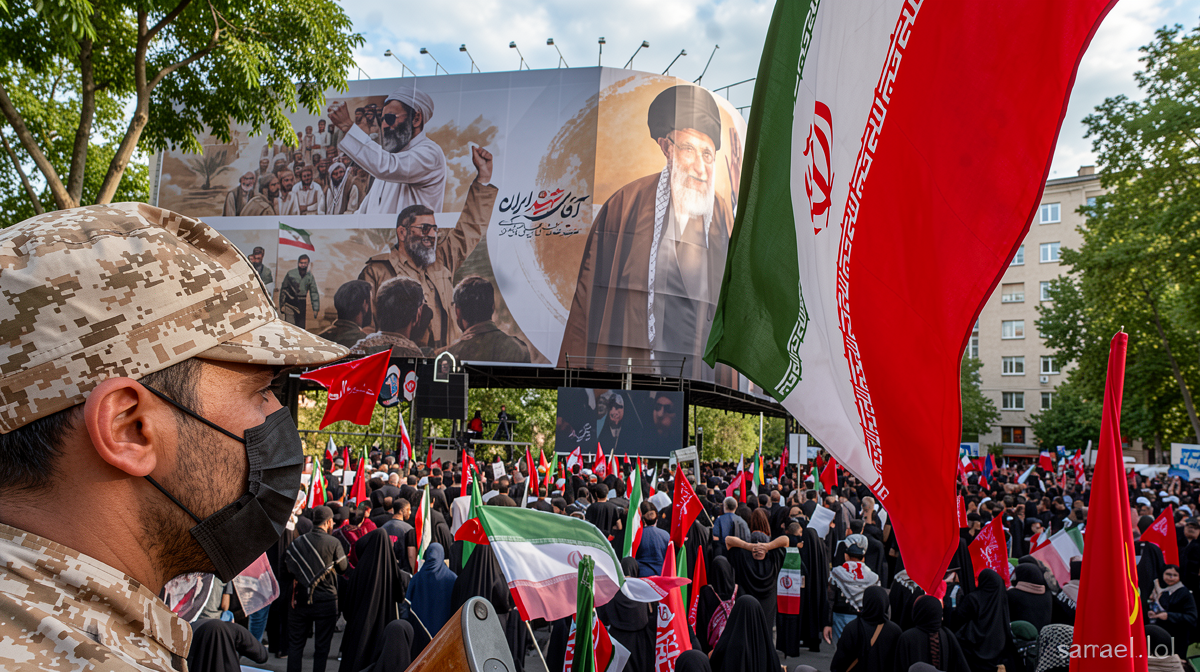
Who is making decisions in Iran?
Samael.lol – Since the start of Iran’s conflict with the US and Israel, a central question has lingered over Tehran: Who holds the reins of power? Officially, the answer is straightforward. Mojtaba Khamenei assumed the role of supreme leader after the death of his father, Ali Khamenei, on 28 February, the first day of the war. In the framework of Iran’s Islamic Republic, the supreme leader’s role is constitutionally pivotal. The leader is expected to wield decisive authority over critical matters, including military actions, foreign policy, and national strategy.
A Fractured Leadership?
Yet the situation on the ground reveals a different reality. Donald Trump, in a recent statement, characterized Iran’s leadership as “fractured,” suggesting the US is awaiting a cohesive plan from Tehran. This perception has gained traction as Iran’s leaders sought to project unity. On Thursday night, they circulated a message to citizens via mobile networks, declaring, “There is no such thing as a hardliner or moderate in Iran—there was just one nation, one course.” The message aimed to unify the populace, but it also underscored the internal confusion.
“There is no such thing as a hardliner or moderate in Iran—there was just one nation, one course.”
Mojtaba Khamenei, now supreme leader, has been largely absent from public view since ascending to power. His influence is evident in written statements, such as one asserting the Strait of Hormuz remains closed. However, these communications lack the dynamic presence that defined his father’s leadership. The absence of Khamenei’s public engagement has created a vacuum, with Iranian officials admitting he was injured in the initial strikes but offering sparse details. The New York Times, referencing Iranian sources, reported this week that his injuries may have impacted his ability to speak clearly, further complicating his role.
Authority and Influence
In Iran’s governance model, authority isn’t just institutional—it’s also symbolic. Ali Khamenei, the late leader, communicated intent through public appearances and strategic mediation between political factions. His successor, Mojtaba Khamenei, has not yet replicated this balance. The lack of visible arbitration has led to uncertainty about his control. Some analysts argue that his sudden elevation to supreme leader has not given him time to assert authority. Others question whether his injuries have hindered his capacity to manage the crisis effectively.
Meanwhile, the diplomatic track has also seen shifts. While formal responsibility for talks lies with the government, Foreign Minister Abbas Araghchi continues to represent Tehran in negotiations under President Masoud Pezeshkian. However, both appear to lack strategic direction. The delegation’s leadership now falls to Mohammad-Bagher Ghalibaf, the Parliament Speaker, a former Revolutionary Guard commander. His visibility in recent days contrasts with the opacity of decision-making. Araghchi’s brief confusion over Hormuz’s status—first claiming traffic had resumed, then retracting the claim—highlighted the disconnect between military actions and diplomatic messaging.
Operational Autonomy and Ambiguity
Control over the Strait of Hormuz, a key strategic asset, remains in the hands of the Islamic Revolutionary Guard Corps (IRGC), led by Ahmad Vahidi. This places real decision-making power in the hands of actors who operate behind closed doors. Unlike previous crises, where a singular figure often dominated strategy, the current situation reveals a more decentralized approach. Actions precede messages, and the latter are not always aligned.
Political and diplomatic responses now seem reactive rather than proactive. The stalled second round of talks in Islamabad exemplifies this trend. Even when communication channels are open, the system appears hesitant to commit. This suggests a temporary expansion of the IRGC’s operational autonomy, at least until political factions resolve their internal disputes.