Five ‘Fouls’ in One Move – Breaking Down Premier League Corner Chaos
Samael.lol – The irony of Arsenal’s latest triumph over West Ham is striking, especially considering the Gunners have mastered the art of set-piece theatrics this season. Their victory hinged on a VAR decision that ruled out a goal by Pablo for a foul on keeper David Raya, a moment that felt both inevitable and ironic. The Premier League has been a theater of set-piece drama this year, not just in terms of goals scored but also in the relentless physicality and tactical maneuvering that define these moments. The chaos reached its peak in February, when over a dozen Manchester United and Everton players crowded the penalty area, creating a tangle of bodies and calls for penalties before the ball even reached the field. It was a spectacle of control and confusion, with defenders and attackers engaging in a battle that blurred the lines between legitimate play and questionable fouls.
Everton manager David Moyes captured the frustration of many when he remarked,
“You get the feeling now that referees really don’t want to get involved in any of it.”
This sentiment reflects a broader trend in the league, where set-pieces have become a battleground for decisions that shape match outcomes. While the debate isn’t confined to Arsenal’s strategies, it has certainly taken center stage this season. BBC Sport recently had the opportunity to speak with Roberto Rosetti, head of Uefa’s referees, who emphasized the importance of analyzing goalkeeping pressure during set-pieces. Rosetti pointed to Arsenal’s dominance in this area, as they have consistently used their numerical advantage to overwhelm goalkeepers, creating space and scoring through well-executed routines.
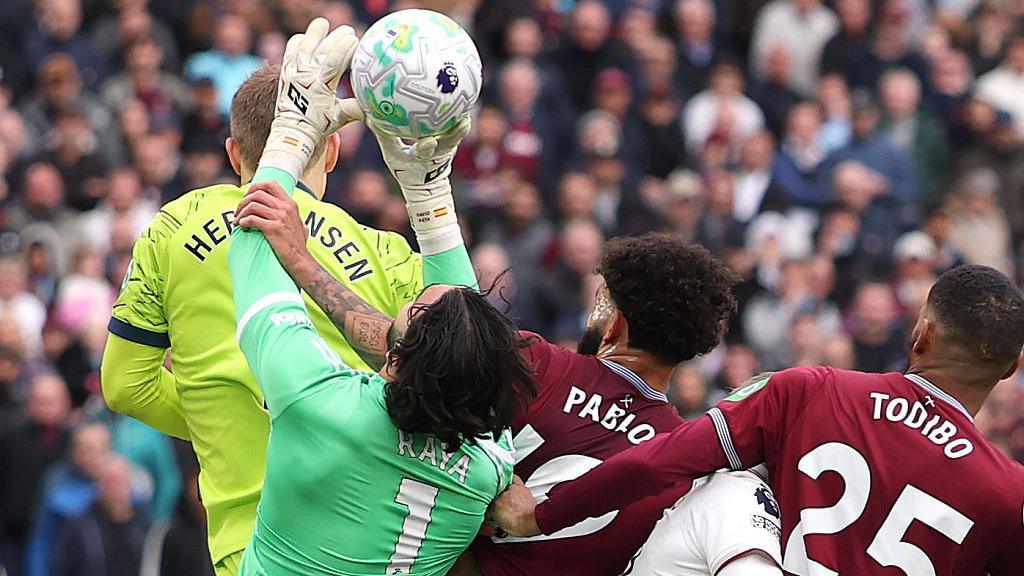
By Sunday’s match, the VAR’s intervention had become a defining moment. Arsenal’s narrow 1-0 win over West Ham not only bolstered their title aspirations but also left the Hammers scrambling to maintain their Premier League status. The game was a microcosm of the season’s set-piece chaos, with players engaged in a chaotic dance of pushing, pulling, and wrestling for advantage. At the heart of it was Pablo, who was penalized for a foul on Raya, only for the VAR to overturn the decision. This moment highlighted the precision and scrutiny required in such scenarios, as the video assistant referee, Darren England, meticulously reviewed a sequence of five potential fouls.
Let’s dissect the incidents step by step. The first occurred when Tomas Soucek and Kai Havertz collided near the near post. As the ball was in the air, Havertz fell under Soucek’s weight, a move that seemed to test the referee’s patience. The VAR would have considered whether Soucek’s actions were deliberate or accidental, noting that Havertz wasn’t obstructed in his path to the ball. The goalkeeper’s ability to play the ball was not compromised, so the decision to allow the play to continue was logical. The second incident involved Martin Odegaard and Jean-Clair Todibo, who engaged in mutual holding. Both players were in a position of equal culpability, with Odegaard’s arm around Todibo’s waist and the latter’s arm around Odegaard’s shoulder. This symmetry in the foul made it difficult to assign blame, leading to a fair outcome for neither side.
The third event unfolded as Leandro Trossard and Pablo clashed just outside the six-yard box. Initially, both players were locked in a tussle, but Pablo broke free, attempting a run toward goal. Trossard, positioned with his back to the play, grabbed Pablo around the waist. While this action could have been interpreted as a foul, the VAR deemed it insufficient for a penalty. Pablo was able to move toward the ball, indicating that the contact was not enough to warrant a stoppage. However, this moment caught the VAR’s attention, as it set the stage for the next critical incident.
Enter Pablo and David Raya. After being pressured by Trossard, Pablo moved into the six-yard area and engaged Raya in a confrontation. The key detail here was the way Pablo’s arm blocked Raya’s movement, effectively impeding the goalkeeper’s ability to reach the ball. Raya’s left arm was held by Pablo’s right biceps, restricting his reach and mobility. The VAR’s analysis revealed that Pablo’s actions directly hindered Raya’s capacity to play the ball, making the foul a clear violation of the rules. While Tobido also pulled on Raya’s shirt, the primary offense was Pablo’s arm across the goalkeeper’s body, which left Raya unable to make a decisive play.
VAR’s involvement in this match was more than just a single decision. The five fouls that emerged from one move were a testament to the complexity of modern refereeing. Each incident required careful evaluation, balancing the intent of the players with the impact on the game. The VAR’s ruling on Pablo’s foul on Raya was a pivotal moment, as it not only changed the outcome of the match but also sparked discussions about the role of technology in officiating. For Arsenal, the decision reinforced their set-piece dominance, while for West Ham, it was a setback in their fight for survival.
Despite the VAR’s meticulous review, the decision was not without controversy. The sheer number of potential fouls in the penalty area made it challenging for the referee to make a split-second call. England, the video assistant referee, had to navigate a sea of bodies and conflicting interpretations, ensuring that the most impactful incident was addressed. This moment underscored the tension between tactical advantage and fair play, a theme that has permeated the Premier League this season. As the league continues to evolve, the role of set-pieces and VAR will remain central to the narrative, with each decision adding another layer to the drama.
In summary, the Arsenal vs. West Ham match was a microcosm of the Premier League’s set-piece challenges. From Soucek’s near-post collision to Pablo’s direct foul on Raya, the sequence of events revealed the fine line between legitimate tackles and excessive pressure. The VAR’s intervention, while controversial, highlighted the increasing reliance on technology to resolve these moments. As the season progresses, fans and analysts alike will continue to debate whether such decisions are enhancing the game or complicating it further. One thing remains clear: set-pieces are no longer just about scoring—they’re about control, chaos, and the occasional controversial call.