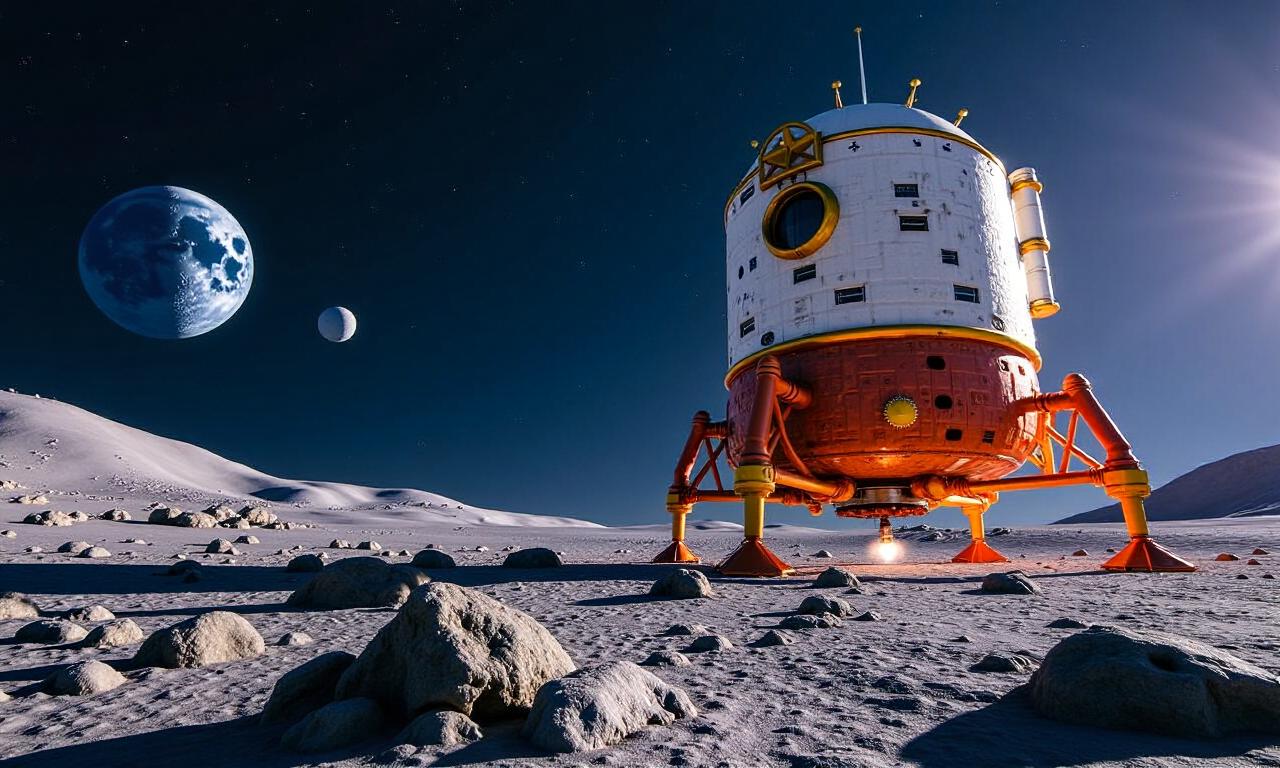
Nasa unveils next steps to build permanent Moon base
Samael.lol – As the United States ramps up its lunar ambitions, NASA has outlined a series of robotic missions designed to lay the groundwork for a sustained human presence on the Moon. These initiatives include advanced landers, autonomous drones, and transport vehicles, all of which are key components in achieving the agency’s goal of establishing a permanent base by the early 2030s. Among the companies contributing to this effort is Blue Origin, the space venture founded by Amazon’s Jeff Bezos, which has been selected alongside Intuitive Machines and Astrobotic to develop the technology required for these lunar operations.
A Lunar Race Against China
While NASA’s plans are ambitious, they come with a sense of urgency. The space agency aims to return American astronauts to the Moon before President Donald Trump’s term ends in 2029, a deadline that has added political momentum to its goals. However, this mission is not without competition. China has been steadily advancing its own lunar programs, with the country on track to land humans on the Moon by 2030. The recent launch of the Shenzhou-23 spacecraft, which delivered a crew to China’s Tiangong space station, underscores the nation’s progress in space exploration.
Dr. Simeon Barber, a lunar scientist at the Open University, highlighted the challenges NASA faces in this race. “It would not surprise me at all if China gets there first,” he told BBC News, pointing to the agency’s difficulties in securing a reliable spacecraft capable of human lunar landings. The pressure to demonstrate leadership in space has intensified as China’s progress becomes more visible, with experts noting that the US must not only keep pace but also innovate to maintain its position.
Phases of the Ignition Moon Base Program
According to NASA’s Ignition Moon Base program, the path to a permanent lunar presence will unfold in three distinct stages. The first phase focuses on robotic exploration, with landers and drones tasked to map the Moon’s rugged terrain and gather critical data. These unmanned systems will also transport scientific instruments and communication equipment, essential for future human missions. The second phase involves the deployment of power infrastructure, including nuclear and solar energy facilities, to support long-term operations. The final phase envisions the establishment of semi-permanent habitats, enabling sustained human activity and deeper research.
Key to this strategy is the development of robust transport systems. NASA has contracted Blue Origin to build its lunar lander, Endurance, which will be equipped with precision landing capabilities and autonomous navigation systems. Meanwhile, Astrobotic’s Griffin-1 lander is scheduled to touch down near the South Pole’s Nobile Crater, a location of scientific interest due to its potential for frozen water. This water could be vital for producing oxygen and supporting life-support systems, making the South Pole a strategic target for future colonization efforts.
Carlos García-Galán, the Moon Base programme executive, emphasized the scale of the robotic phase. “The robotic exploration is set to conclude by 2029, with 25 launches and 4 metric tonnes of cargo landed on the Moon,” he stated. These missions will serve as a foundation for human activities, ensuring the Moon’s surface is well understood before the first astronauts arrive. The data collected will inform everything from resource extraction to the design of habitats that can withstand the harsh lunar environment.
Challenges and Realistic Timelines
Despite the excitement surrounding NASA’s lunar ambitions, many experts question whether the agency’s timeline is feasible. The Artemis II mission, which successfully sent four astronauts on a circumlunar journey in April, was a significant milestone, but it does not guarantee the readiness of human landing systems by 2029. The Starship Human Landing System, developed by Elon Musk’s SpaceX, remains a critical piece of the puzzle. However, the project has encountered delays and technical hurdles, raising concerns about its ability to meet deadlines.
Dr. Barber reiterated that the success of NASA’s mission hinges on overcoming these challenges. “The limiting step is getting the astronauts down onto the surface,” he explained. This statement reflects the broader uncertainty about whether the US can secure the necessary technology in time. While the agency has made progress in assembling a coalition of private contractors, the competition with China’s advanced lunar program adds complexity to the timeline.
Some analysts argue that the political drive behind NASA’s mission is as important as the technical achievements. The US government’s investment in the $20 billion programme underscores a commitment to lunar exploration, but it also highlights the need for public and political support to sustain long-term efforts. As NASA prepares for the next phase of its mission, the focus will shift from robotic exploration to the integration of human-capable systems. This transition requires not only technological innovation but also international collaboration and resource allocation.
The Moon’s South Pole, with its permanently shadowed regions, is a focal point for NASA’s strategy. These areas are believed to hold water ice, which could be harvested for drinking water and fuel production. Such resources would significantly reduce the need for costly resupply missions from Earth, making long-term habitation more viable. However, the success of this initiative depends on the reliability of the transport systems that will deliver astronauts and equipment to these remote locations.
With the robotic phase set to conclude by 2029 and the human phase targeting 2032, NASA faces the dual challenge of innovation and execution. The agency’s ability to secure and develop the necessary technology will determine its success in this new space race. While China’s progress is a reminder of the stakes, NASA’s recent announcements signal a determination to establish its foothold on the Moon. As the plan unfolds, the hope is that these steps will not only solidify the US’s presence on the Moon but also pave the way for deeper space exploration, such as missions to Mars.
Conclusion and Future Prospects
NASA administrator Jared Isaacman has stated that the current initiatives mark a pivotal moment in the agency’s history. “The US will never give up the Moon again,” he declared, reflecting the importance of these missions to national prestige and scientific discovery. Yet, the path ahead is fraught with uncertainty. The lunar base’s potential to support scientific research and resource utilization is clear, but whether the timeline can be met remains to be seen.
As the robotic phase progresses, the success of each mission will be closely monitored. The 25 launches and 4 metric tonnes of cargo are just the beginning of a larger effort. With companies like Blue Origin and Astrobotic contributing to the project, the hope is that the technology will mature in time to support human exploration. However, the competition with China’s lunar program means that every delay or setback could impact the US’s position in this high-stakes race. The future of lunar colonization hinges on the ability to navigate these challenges and achieve the goals outlined in the Ignition Moon Base programme.