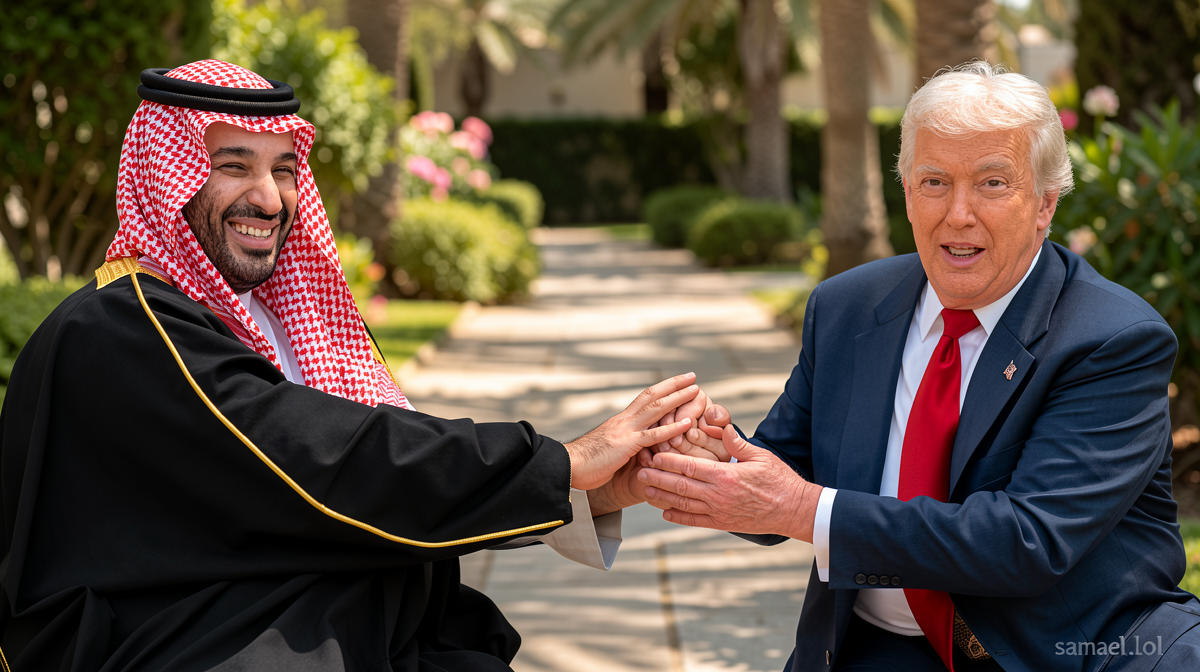
Trump Links Saudi Nuclear Agreement to Israel Recognition
Samael.lol – The landmark nuclear cooperation agreement between the United States and Saudi Arabia hinges on Riyadh’s participation in the Abraham Accords, which formally recognize the State of Israel, according to President Donald Trump. The American leader emphasized that Saudi Arabia’s ability to enrich uranium would be restricted under the terms of this new arrangement.
In a statement published on Truth Social, Trump outlined the conditions surrounding the Civil Nuclear Deal. He noted that the agreement, which covers exclusively non-military applications, would receive approval contingent upon Saudi Arabia’s membership in the Abraham Accords. The president described the accords as both “very respected and successful” in his post.
“The Civil Nuclear Deal (There will be no enrichment of material!)… which pertains only to non-military use… will be approved, but is totally subject to Saudi Arabia joining the very respected and successful Abraham Accords,” Trump wrote.
Regional Implications and Expert Concerns
Trump’s announcement follows mounting criticism from nuclear experts who have warned that the deal might contribute to future nuclear proliferation across an already volatile Middle Eastern region. The potential for regional arms competition has been a persistent concern among policymakers and analysts.
Saudi Arabia has maintained a consistent position that it will not establish formal recognition of Israel until a Palestinian state is created. This condition has been a cornerstone of Saudi diplomatic policy for years, reflecting broader Arab and Islamic world sentiments regarding Palestinian statehood.
The Abraham Accords, brokered by Trump in 2020, represented a historic breakthrough in Middle Eastern diplomacy. The agreement normalized relations between Israel and two Arab nations—the United Arab Emirates and Bahrain. Since that initial signing, Sudan, Morocco, and Kazakhstan have also joined the accords, expanding the framework of regional cooperation.
Responses and Uncertainties
As of the time of Trump’s statement, Saudi Arabia had not issued an official response. It remained unclear whether the requirement to join the Abraham Accords was explicitly written into the deal’s text—which has not been publicly released—or whether this was a condition Saudi Arabia had separately agreed to or might be compelled to accept.
Israeli officials welcomed Trump’s clarification. Prime Minister Benjamin Netanyahu’s office posted on X that Saudi Arabia’s potential accession to the accords “would be an historic leap forward for peace in the Middle East.” Notably, this statement did not reference the nuclear agreement directly.
Israeli Economy Minister Nir Barkat had previously indicated that Israel “can manage it” if Saudi Arabia develops nuclear capabilities for peaceful purposes. Israel itself is widely believed to possess nuclear weapons, though the country maintains a policy of neither confirming nor denying this status.
Deal Details and Congressional Review
The US-Saudi agreement, with its signing announced on Wednesday, has been characterized by the US Energy Department as a “peaceful nuclear co-operation agreement.” The deal promises “great access for American companies in the Saudi nuclear energy programme,” potentially opening significant commercial opportunities for US firms.
The nuclear dimension has been central to the months-long US-Israeli confrontation with Iran. Crown Prince Mohammed bin Salman, Saudi Arabia’s de facto ruler, told CBS News in 2018 that his country had no plans to acquire nuclear weapons but would “follow suit as soon as possible” if Iran developed a nuclear bomb.
Earlier reports from US media suggested the deal might permit Saudi Arabia to enrich uranium in the future—a capability that serves dual purposes as both fuel for power plants and a potential pathway to nuclear weapons production. However, Trump’s recent remarks appear to contradict this possibility.
The agreement will now proceed to the US Congress for review. Lawmakers from both major political parties are anticipated to voice opposition to certain aspects of the deal. Nevertheless, Trump’s Republican Party currently controls both chambers of Congress, and opponents do not seem to possess sufficient votes to prevent the agreement’s ratification.