Smart sleepers could be the glow-up night trains need
Smart sleepers could be the glow-up night trains need
Europe’s growing interest in night trains faces challenges
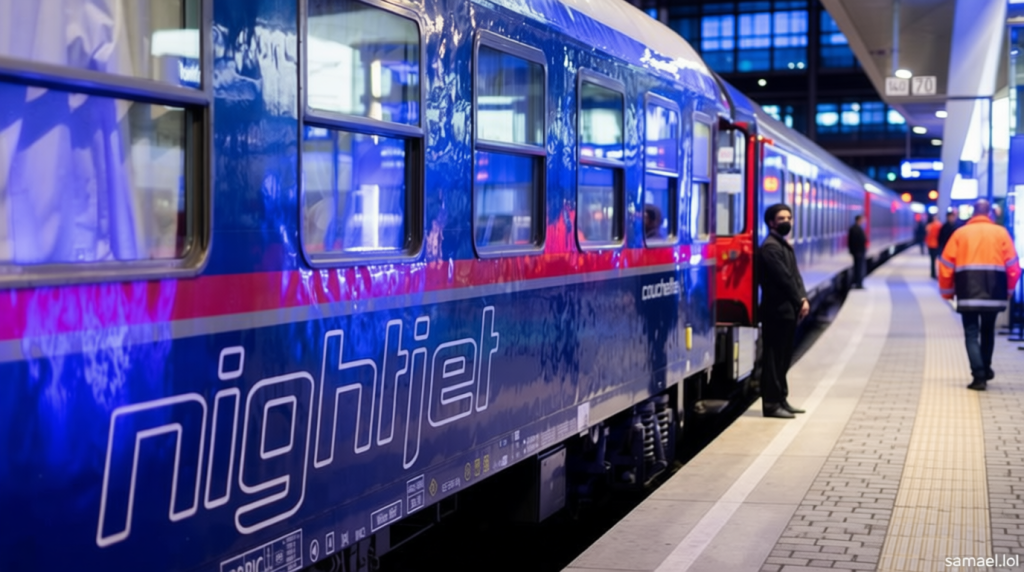
Travelers across Europe are rekindling their passion for overnight journeys, but the availability of sleeper trains remains limited. A Berlin-based initiative is aiming to reshape this landscape by introducing smart cabins that blend comfort with efficiency. On this Friday evening, a Nightjet train bound for Zurich is expected to reach Berlin’s main station. Meanwhile, a group of demonstrators, including Anne and Juri, stands on platform 13 in vibrant pyjamas, not to board the train but to protest for more night train routes.
Activists from 12 European cities, spanning from Lisbon to Helsinki, are rallying tonight to push for expanded overnight travel networks. One protester emphasizes environmental concerns, stating,
“I don’t want to fly anymore because I know the damage it does. But I still want to travel.”
Anne’s daughter adds,
“You sleep very well because you are constantly rocked back and forth.”
Juri highlights the appeal of simplicity, noting,
“I get on the night train in one city, sleep and get off in the other city.”
A historical decline and recent revival
Night trains once thrived across Europe, peaking in popularity during the mid-20th century. Their decline began with the rise of highways, which offered faster and more flexible travel options. The 1980s saw air travel become affordable, further reducing demand for overnight trains. Today, only a handful of routes exist, catering to those who still cherish the old-school experience.
However, a 2023 revival brought hope. Austria’s state railways (ÖBB) reintroduced routes from Paris to Berlin and Vienna, sparking renewed interest. This momentum was short-lived, as France’s budget cuts forced the service to halt after two years. European Sleeper, a Belgian-Dutch operator, now takes over the route, adding Brussels as a stop. Meanwhile, Sweden’s national railroad recently withdrew from the Berlin-Stockholm connection, which launched just two years ago.
Innovative designs to address capacity issues
The struggle for viability centers on space. Night trains accommodate far fewer passengers than standard compartments, with the ÖBB Nightjet carrying 254 versus Deutsche Bahn’s ICE 4 high-speed train, which holds up to 918. Finland’s equivalent manages 500. These numbers have kept night trains from becoming a mainstream choice.
Anton Dubrauhe, founder of Luna Rail, is tackling this with a new approach. His startup’s prototype, unveiled at the Technical University of Berlin, features individual cabins that transform into beds with a button press. Each cabin includes a table, storage compartments, coat hooks, and a shelf. The design allows for dual use—workstations by day and beds by night—targeting both leisure and business travelers. Dubrauhe envisions 60 cabins per compartment, stacked on two floors, without requiring new trains. Decommissioned vehicles could be retrofitted to maximize space.
Economic hurdles and future potential
Despite efforts, profitability remains a hurdle. In 2024, Felix Berschin, a transport expert, found that sleeper cars often fail to cover costs. Night surcharges boost staff expenses, while limited seating reduces passenger numbers. The 2023 Swedish study underscores this, revealing price sensitivity among travelers. Current night train fares are seen as steep, with 1,000 kilometre journeys often costing more than alternatives.
Dubrau’s concept could redefine affordability. By integrating privacy and comfort without sacrificing capacity, the smart cabins might revive night travel’s appeal. Whether this innovation can sustain Europe’s dwindling overnight train network remains to be seen. For now, the movement continues, fueled by idealists and a longing for the simplicity of rail travel.