The EU’s recipe for trade deals : easy on beef, tough on wine
The EU’s Trade Strategy: A Duality in Agreements
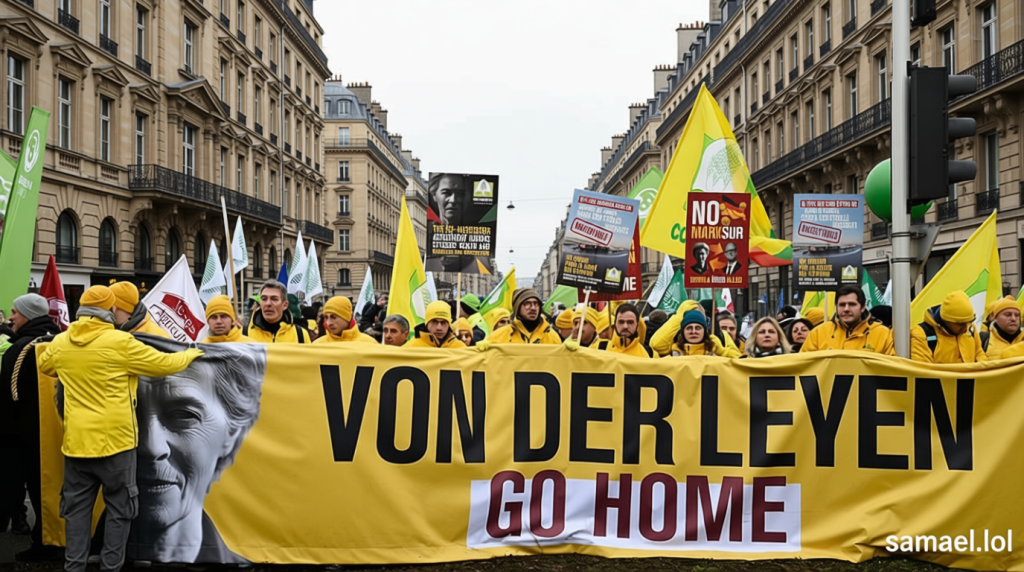
Three major trade agreements were finalized this week with three distinct regions: Mercosur, India, and Australia. While the European Commission praised the Australia deal as a strategic breakthrough, European farmers remain vocal in their criticism, particularly regarding the Mercosur agreement. The backlash against the deal with Argentina, Brazil, Paraguay, and Uruguay has not deterred the Commission’s consistent approach in negotiations.
The Commission’s strategy appears to balance flexibility and rigidity. On lower-value agricultural goods like beef, it has made substantial concessions, whereas high-value products such as wine, geographical indications, and cars face stricter conditions. “The EU possesses the capability to become a dominant agri-food force,” said Luc Vernet of Farm Europe, a Brussels-based think tank focused on exports. “A broader strategy is needed, encompassing all sectors and product quality levels, since the European model is renowned for its excellence in premium goods.”
Concerns over unfair competition from meat imports have fueled resistance to the Mercosur agreement, leading to a legal challenge that delayed its ratification. The deal granted annual quotas of 99,000 tonnes of beef, 25,000 tonnes of pork, and 188,000 tonnes of poultry. Despite adjustments in the Australia agreement, EU farmers argue that import volumes continue to rise across multiple deals. Over eight years of talks with Australia, the world’s second-largest beef exporter, the EU allowed 30,600 tonnes of beef annually, with phased-in access for sheep meat and rice.
Quotas and Safeguards
Brussels imposed conditions on all quotas, reflecting lessons learned from Mercosur. Beef imports must originate from grass-fed cattle, with a 10-year transition period. Sheep and goat meat will follow a seven-year phase-in, while rice will be phased over five years. Sugar imports are tied to a sustainability certification scheme, and safeguard clauses will protect against market shocks for seven years, extended to 15 for beef, 12 for sheep, and 10 for rice.
“Our experience with safeguards shows they are hard to trigger because the burden of proof lies with us, the farmers,” remarked a representative from the agricultural sector.
The India agreement, by contrast, faced fewer disputes. New Delhi resisted opening its market, especially for dairy products, allowing EU sensitive goods to remain protected. Wine, however, was a central focus of Brussels’ efforts, securing tariff reductions from 150% to 20% for premium wines and 30% for mid-range products over seven years. Car tariffs also dropped from 110% to 10%, though under a 250,000-vehicle annual quota. By the time this quota is fully implemented, Chinese manufacturers are expected to have gained a stronger foothold.
In the Australia negotiations, the EU pushed for wine access but met fierce domestic opposition. The final deal safeguards over 1,600 European wine geographical indications, along with more than 50 new ones from 12 member states. Prosecco, for instance, will still permit Australian producers to use the term domestically for grey grape varieties, as long as it’s linked to an Australian GI. This designation will be discontinued after a decade. The EU also protected 165 agri-food GIs and 231 spirit drink GIs, but failed to eliminate Australia’s luxury car tax, instead securing preferential treatment for electric vehicles.