Germany hosts Syria’s Al-Sharaa despite human rights issues
Germany hosts Syria’s Al-Sharaa despite human rights issues
A controversial meeting in Berlin
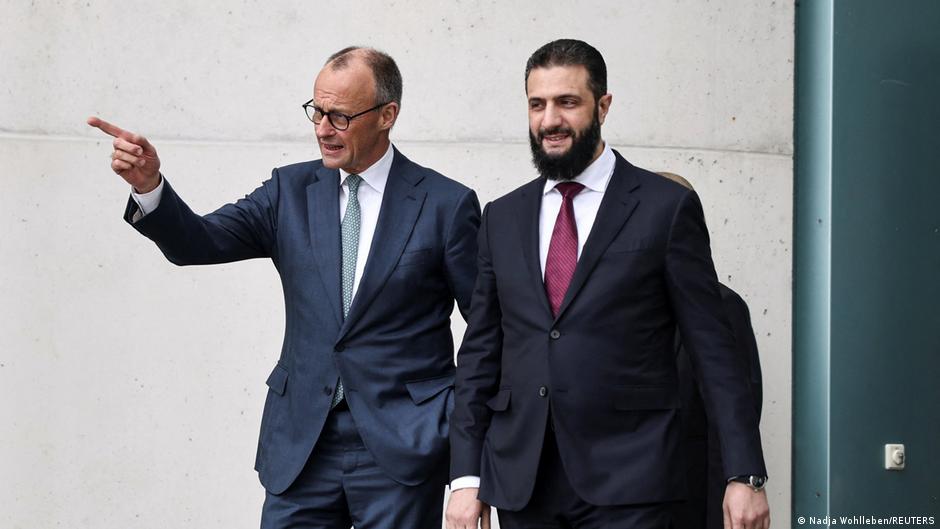
This Monday, Syria’s interim president, Ahmed al-Sharaa, was welcomed in central Berlin by Chancellor Friedrich Merz and President Frank-Walter Steinmeier. The event, held in a government district temporarily sealed off for security, underscored Germany’s efforts to promote Syrian refugee repatriation. However, the visit sparked debate, with some observers calling it the most contentious state engagement of the year.
Bild, Germany’s top-selling tabloid, highlighted the controversy, noting al-Sharaa’s stay at a luxury hotel and the enthusiastic greetings from his supporters upon arrival. The newspaper’s headline criticized the visit as a symbol of Germany’s ongoing commitment to a leader linked to human rights abuses. These allegations date back to the pre-Assad era and extend into the aftermath of the civil war.
Despite his controversial past, al-Sharaa is regarded by the German government as a key figure in Syria’s political transition. His former command of the al-Nusra Front, an affiliate of al-Qaeda, has not overshadowed his role as a current interlocutor. Officials argue that his presence is vital for advancing regional stability and addressing the refugee crisis.
Political divisions over repatriation
Chancellor Merz emphasized that Syria’s situation has “fundamentally improved” since the fall of Assad, framing the country as a viable destination for returning refugees. He proposed a joint task force and a German delegation to visit Syria “in just a few days.” Yet, this stance has drawn pushback from other factions. German Foreign Minister Johann Wadephul, a CDU member, recently described Syria as resembling Germany in 1945, suggesting its conditions remain dire.
Wadephul’s remarks were met with sharp criticism from fellow conservatives. Meanwhile, NGOs supporting Syrian refugees have voiced concerns about deportations. Despite al-Sharaa’s controversies, these groups acknowledge the strategic value of his visit. Sophie Bischoff of “Adopt a Revolution” noted that civil society still faces challenges: “Even after Assad’s regime collapsed, repression has persisted.”
Rebuilding trust and a call for inclusivity
Farhad Ahma, leading “PEL-Civil Waves,” urged Germany to play a role in Syria’s reconstruction and advocate for minority rights, such as Kurdish protections. “Syria’s future depends on it becoming a land for all its people,” he stated. The organization also advised Syrians to evaluate their homeland firsthand before deciding to return. “Many have lived in exile long enough to understand the reality on the ground,” Ahma added.
With over 1 million Syrians currently residing in Germany, the issue of repatriation remains contentious. Around 700,000 are recognized as asylum seekers, while others face pressure to return. Merz’s administration argues that those who violate German laws should consider Syria as a home again. However, the debate over human rights and stability continues to shape Germany’s approach to the crisis.