Germany’s Pistorius in Asia warns of a frayed global order
Germany’s Pistorius in Asia Warns of a Frayed Global Order
Germany’s Defense Minister Boris Pistorius recently concluded a series of high-profile visits to Japan, Singapore, and Australia, aiming to strengthen ties with regional middle powers while signaling concerns about the weakening of global stability. During his eight-day trip across the Indo-Pacific, Pistorius repeatedly underscored the fragility of the existing international system, which relies on established norms and agreements to maintain cooperation. His hosts in these nations echoed his sentiments, highlighting the critical role of these shared principles in shaping global interactions.
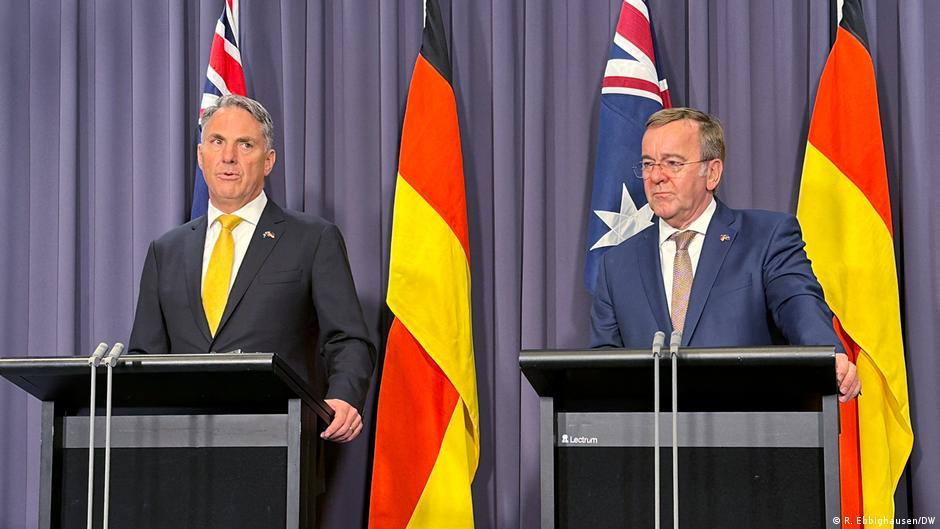
In Canberra, Australian Defense Minister Richard Marles joined Pistorius in emphasizing the importance of common values between their countries. “We respect the rule of law, both nationally and internationally,” Marles stated during a joint press conference in Parliament last Thursday. “The rules-based order is deeply important to both of our countries…” This alignment reflects a broader regional consensus on the need to preserve foundational frameworks that have supported global collaboration over many years.
Pistorius also stressed the growing interdependence between the Indo-Pacific and Europe, noting that conflicts and challenges now transcend borders. “Today’s world is becoming more and more networked — day by day, whether we like it or not,” he remarked. “A crisis in one part of the globe can originate from another, faraway region, and its impact is felt everywhere.” His remarks highlight the interconnected nature of modern geopolitics, where events in one area ripple across the world.
However, Pistorius’ focus on a rules-based order reveals a deeper anxiety about the erosion of long-standing international stability. While new systems are emerging, they remain untested, and leaders are increasingly aware of the shifting dynamics. During his tour, Germany’s challenge in navigating this transition became apparent, as it seeks to move beyond its traditional reliance on the United States for security. President Donald Trump’s efforts to destabilize the NATO alliance have underscored this uncertainty.
In a Q&A session, Pistorius acknowledged the necessity of superpowers in maintaining international order. “An international order needs the superpowers,” he said. “Those that already are — and those that aspire to be — must not only participate but also help define its direction.” Yet, he argued that the priorities of this system need to evolve. “It remains to be seen whether the big players are willing to adapt,” he added, calling for greater resilience and initiative from all nations.
Pistorius has also criticized the tendency to view international relationships through a narrow lens. “Those who focus solely on their opponent or partner never act sovereignly. They are manipulated by fear. And decisions based on fear are always wrong,” he stated. This perspective frames the current global landscape as a fragile alliance, where middle powers like Japan, Singapore, and Australia could play a pivotal role in shaping new partnerships. He suggested that such collaborations might include nations from the Global South, aiming to amplify their influence.
While countries like Indonesia, South Africa, and Turkey have long advocated for a more inclusive international order, the extent to which nuclear-armed India shares Germany’s vision remains uncertain. India, traditionally aligned with Russia, has positioned itself as a “trustee of the Global South,” according to a recent study by the German Institute for International and Security Affairs. This role underscores its desire to balance regional and global interests, though its alignment with Pistorius’ goals is yet to be fully clarified.