60 years after Indonesia’s killings: Is the Cold War back?
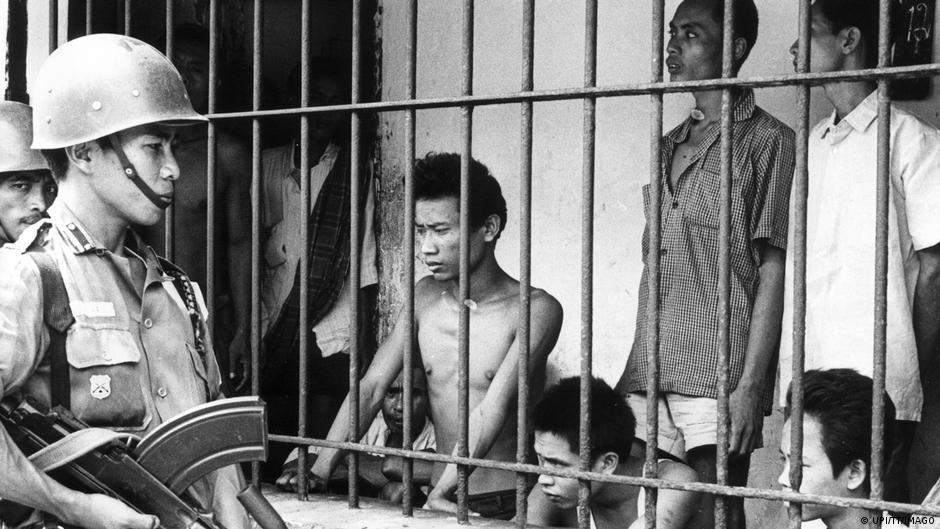
Six decades after helping the Indonesian army crush one of the biggest communist parties in the world, the US is once again meddling in countries it considers a thorn in its flesh. Is history repeating itself? Jakarta , October 1965.
After a failed coup attempt, the Indonesian army and its allies killed, tortured and imprisoned hundreds of thousands of Indonesians they suspected to be communists, many of them of Chinese descent. But almost a year before that, in December 1964, the British Foreign Office had already written in an internal memo: "A premature PKI [Communist Party of Indonesia] coup may be the most helpful solution for the West – provided the coup failed.” Today, some historians see the memo as evidence of a broader Cold War strategy. "Provoke the PKI into taking action against the army – or create the impression that it has – then blame the PKI and use that as a pretext to crush them", says Geoffrey B.
Robinson, a historian and expert on Western involvement in the Indonesian mass killings. On the night of September 30, 1965, a group calling itself the "September 30 Movement" kidnapped and killed six senior Indonesian generals. The then commander of the Indonesian Army Strategic Reserve, Major General Suharto, and his allies quickly blamed the PKI, using the incident to justify mass persecution and killings.
But historical research has cast doubt on the narrative that the killings of the generals were a communist plot. A declassified document from November 1965 describing a meeting between US Embassy staff and a Polish diplomat suggests that the idea for the kidnappings of the generals originated outside the PKI. What followed was a coordinated campaign against the PKI, supported by the West.
The US and its allies – in particular the UK, and Australia – supported the Indonesian army with intelligence, military, financial, and political assistance. Many documents that prove Western involvement in the Indonesian mass killings have since been declassified under the US' Freedom of Information Act. Several show that Washington provided the Indonesian army with lists of alleged PKI members, offered "assistance wherever we can", and was eager to "spread the story of the PKI's guilt, treachery and brutality." "If it hadn't been for that encouragement on different fronts from the West, the violence would have never reached the scale that it did," says Robinson.
Guatemala, Cuba, Nicaragua, Cambodia, Angola, Vietnam, Congo, Chile, Brazil, Argentina, Iraq, Lebanon and Iran are some of the countries that suffered direct or indirect US involvement during the Cold War. For many, decades of dictatorships or military regimes followed. "If you look at the history of these interventions, the one thing which is clear is that they don't work.
What they do achieve is the acceleration of social and political conflict, massive violence and failed states, ruining the lives of millions of people along the way," says Robinson. "We see the consequences of those interventions still playing out today, for example in Iran," he adds. 60 years after the Indonesian mass killings, the US and its allies are once again meddling in other countries: Earlier this year, US President Trump threatened Mexico and Colombia with military action, after repeatedly proposing to annex Greenland.
In January, the US captured Venezuelan President Nicolás Maduro. In February, the US and Israel attacked Iran , killing its Supreme Leader Ali Khamenei. In Brazil, where elections are scheduled for October this year, President Lula da Silva has voiced fears of US intervention after Washington considered classifying organized crime groups as "terrorists." In March, US President Trump threatened to "take" Cuba amid a humanitarian crisis triggered by a US oil blockade, saying that he could "do anything" he wanted with it.
Robinson sees echoes of the past: "I think we are back at a new kind of Cold War. The US logic is very much reminiscent of the 1950s and 60s: We have the power, and we want people to behave in a certain way, and we can achieve that by use of force," he says. He acknowledges that some governments targeted by the US and its allies have long records of human rights abuses.
"But the question is: if you're actually against bad government, why are you not going against far-right governments? Why are you not taking action against Israel or Russia? The double standard is recognizable," Robinson says.
In Indonesia, 60 years after the mass killings, memory remains distorted. There has been no formal state apology, no criminal trials, and no official memorial for the victims. Previous Indonesian President Joko Widodo has acknowledged the events as "gross human rights violations" and called them "regrettable" but offered no official state apology.
Communism remains stigmatized and banned until today – not just the communist party, outlawed in 1966, but also organizations and ideologies linked to communism, such as Marxism. During his 32-year rule, former dictator Suharto shaped how the public perceives the past until today, building monuments and museums honoring the army, influencing school education and culture. In 2025, Suharto was declared a national hero by his ally, Indonesia's current President Prabowo Subianto.
"If those who commit the genocide get to write the history, then that history is obviously going to be very distorted," Robinson says. Labeling the 1965-66 killings in Indonesia as 'genocide' is also contested. Some bodies and scholars use it, arguing that the systematic persecution of a group should fall under that category, but no national government has officially recognized it as such.
The UN Genocide Convention defines it as any of five "acts committed with intent to destroy, in whole or in part, a national, ethnic, racial or religious group." But in Indonesia's case, the targeted group was mainly political – communists and their alleged sympathizers. The killings in Indonesia were never formally investigated by the UN. Most investigations were done by independent scholars and journalists, survivors, and civil society.
Across Indonesia, civil society groups continue to preserve the memory of the victims with digital archives and informal memorials. On the island of Bali, which witnessed the worst of the violence in 1965-66, the son of a victim built the Taman 65 memorial ("65 Park") to challenge the government's silence. Since 2007, families of survivors of human rights violations, including the 1965 events, have organized a weekly silent protest in front of the Merdeka Palace in Jakarta, demanding accountability and recognition for the victims.
Robinson laments that the UN Genocide convention disregards political groups in its definition. "What happened in Indonesia, the number of people killed, the fact that most victims had committed no crime, is in almost every respect the same as what happens in a genocide. So perhaps we need to be calling it a genocide," he says.
Edited by: Sarah Hofmann, Algadri Muhammad and Brenda Haas