Germany news: Lufthansa cabin crew to strike on Friday
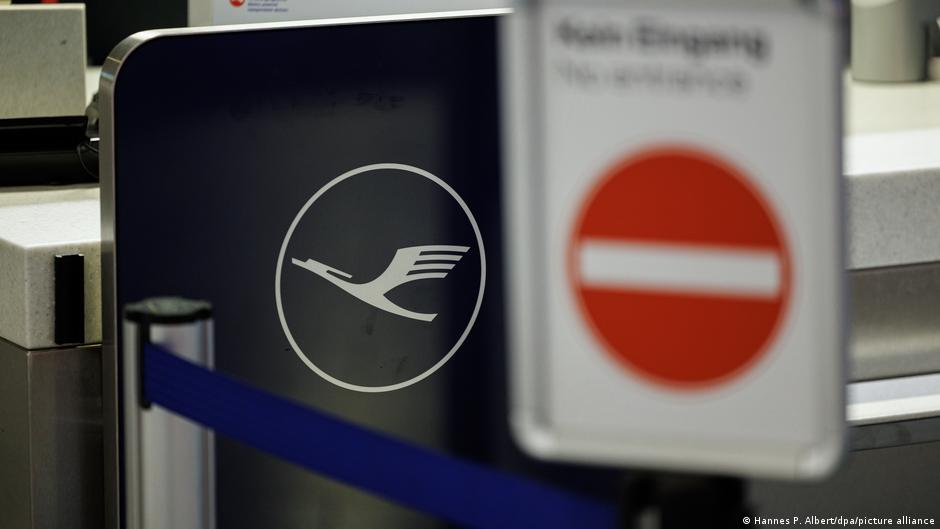
The latest strike to hit Germany's flagship carrier hails from the cabin crew union UFO. Meanwhile, Berlin is walking back a contentious plan about young men seeking permission to go abroad for long periods. DW has more.
Here are the latest headlines from Germany on Wednesday, April 8, 2026: The UFO trade union has called on Lufthansa cabin crew staff to a one-day strike this Friday. The trade union said on Wednesday that it was urging its members both with Lufthansa and its Cityline regional subsidiary to down tools from midnight until 10 p.m.. The Lufthansa strike would hit all departures from Germany's two busiest airports, Frankfurt and Munich.
Meanwhile, Cityline cabin crews at nine German airports should down tools in the same time window. The move follows a members' vote in late March when the large majority voted in favor of strikes amid failed negotiations. The talks center around issues including working conditions for 19,000 members working for Lufthansa and social provisions for the 800 members working for Cityline, which faces a phase-out amid restructuring.
"This situation could have been avoided, the responsibility lies with Luftansa, which so far has not even managed to present an offer worthy of negotiation," UFO's Joachim Vazquez Bürger said as he announced the strike. Several other strikes , mainly involving pilots but also crew , have made headlines for Germany's flagship airline in recent months. Freiburg 's Matthias Ginter has been fined €15,000 (roughly $17,500) for losing his temper after the stoppage-time Bundesliga defeat to Bayern Munich last Saturday.
Freiburg led 2-1 at home after 90 minutes, but utlimately lost 3-2, with the last goal falling after an unusually lengthy nine minutes of stoppage time. After the full time whistle, when referee Daniel Siebert and his team were already in the match officials' changing room, the German Football Association (DFB) says that Ginter let out a cry and kicked against the outside of their door. The veteran defender, part of the 2014 World Cup-winning Germany team, apologized to the match officials afterwards.
He also preemptively accepted the findings of the DFB's sporting tribunal in hopes of a milder punishment, meaning he and SC Freiburg will not appeal the decision. Freiburg sit 8th in the table, still in the hunt to qualify for European competition next season. Saturday's turnaround has not helped their chances, however.
German startup Isar Aerospace will try its delayed second test flight on Thursday, after delays to earlier dates. The Munich-based company said the new launch window from the Andoya Spaceport in northern Norway opens at 2000 GMT/UTC, and that the attempt would be broadcast live on YouTube. The Spectrum rocket is meant as a means to deliver small satellites into low-earth orbit, a critical capability in the modern age where Europe currently relies on US companies like Elon Musk's SpaceX and Jeff Bezos' Blue Origin.
Spectrum completed its first test flight in March 2025. The company hailed the launch as a success, even though the rocket then exploded around 30 seconds after liftoff, saying it had been able to collect valuable data. In January, the company had to call off its second launch because of a valve malfunction.
The latest attempt, in late March, had to be aborted becuase a local fisherman's trawler was in the exclusion zone near the launch site and could not leave before the launch window closed. Europe is currently lagging behind the US, China, Russia and India in the space sector. In a sign of the strategic importance of the project, German Chancellor Friedrich Merz and Prime Minister Jonas Gahr-Store visited the spaceport to inspect the project during Merz's visit to Norway in March.
To view this video please enable JavaScript, and consider upgrading to a web browser that supports HTML5 video Ship transit through the Strait of Hormuz must remain toll free in accordance with international law, a German government spokesperson said on Wednesday. Leading up to yesterday's ceasefire, multiple reports have indicated Iran planned to charge tankers the equivalent of $2 million for transiting the Strait, with payments to be made in Chinese yuan. bypassing the US petrodollar.
A spokesman for the Foreign Office in Berlin noted on Wednesday that the Strait of Hormuz is not only part of Iran's waters, but subject to UN maritime treaties. "And that is why it is essential that, when operations resume, free, safe and toll-free maritime traffic is guaranteed," he said. "That is the German position, which is derived from the applicable international law." Opening the strait was a key part of the ceasefire agreement, but fuel prices are likely to remain high at least in the short term.
"We need to be realistic in several respects," said German deputy government spokesman Sebastian Hille. "Reopening the Strait of Hormuz will take time and will not immediately restore the situation to what it was in February." Despite the agreement, vessels in the Persian Gulf on Wednesday reported continued threats from the Iranian military. Iranian Foreign Minister Abbas Araghchi said shipping in the area would go ahead only in coordination with Iran's armed forces, "and with due consideration of technical limitations," according to a post by Iran's national broadcaster IRIB on X.
To view this video please enable JavaScript, and consider upgrading to a web browser that supports HTML5 video What does the German government think about the US-Iran ceasefire agreement? What does Chancellor Friedrich Merz think? Media representatives in the German capital, Berlin, wanted to get answers to these questions on Wednesday.
Despite the fear of another massive escalation in the Middle East, which had been palpable in political circles in Berlin just a few hours earlier, the official reactions were almost void of any emotion. Just before 8:00 a.m., the Federal Press Office had sent out a short statement from the chancellor reading, among other things: "The goal now must be to negotiate a lasting end to the war in the coming days. This can only be achieved through diplomatic channels." That was also the message given in the Federal Press Conference a few hours later: Deputy government spokesman Sebastian Hille tried to disclose as little as possible.
There were no details on what it actually means when Germany offers to "contribute in an appropriate manner to ensuring freedom of navigation in the Strait of Hormuz." There was also no comment on the rumor that the German Navy could send mine-clearing vessels into the Strait of Hormuz. French President Emmanuel Macron has reportedly announced that 15 states will gather to actively work towards keeping the faint hope for peace alive. Is Germany among them?
"Intensive discussions are underway," government spokesperson Hille said. But surely Germany must say something about the fact that just a few hours ago, US President Donald Trump openly threatened Iran with the annihilation of an entire civilization? Wasn't that a blatant announcement of war crimes?
"I'm not going to offer any textual analysis of past events," government spokesman Hille stated tersely. And so, the German government's only message was that Germany had by no means remained passive on the sidelines during the recent developments in the Gulf. Hille and the spokesman for the Foreign Office, Martin Giese, explained that Chancellor Merz had been in constant contact with all "relevant parties" over the Easter weekend, and Foreign Minister Johann Wadephul had spoken by telephone with his Israeli counterpart.
To view this video please enable JavaScript, and consider upgrading to a web browser that supports HTML5 video Germany's anti-discrimination commissioner has called for greater recognition of the Sinti and Roma minorities on World Roma Day. Michael Brand said the minority is a valuable part of society whose voices and contributions must become more visible. He said Sinti and Roma shape the country culturally, socially, and politically, describing their role as indispensable.
At the same time, Brand warned that anti-Roma discrimination remains a serious issue in Germany. Many people still face exclusion and prejudice, and some choose not to reveal their identity out of fear of rejection. He said society must not ignore the problem and should take stronger action against discrimination.
The Central Council of German Sinti and Roma on Tuesday said it sees a growing and violent antagonism against the minorities in Europe. "Anti-democratic parties in Europe are once again exploiting the public's fears for the future and stoking hatred against Sinti and Roma in their election campaigns," the council said. In Germany alone, attacks on the groups have increased by 40% since 2023.
To view this video please enable JavaScript, and consider upgrading to a web browser that supports HTML5 video A humpback whale that has been stranded and ill in the Baltic Sea off the port city of Wismar for more than a week is still alive. The situation remains unchanged, a spokesperson for the water police confirmed on Wednesday. "The whale has several health issues that are affecting it and will ultimately lead to its death," Bianca König of Whale and Dolphin Conservation Germany told the DPA news agency.
"The whale has several health issues that are affecting it and will ultimately lead to its death." It could happen this evening, but it could also take three days. The whale not breathing for an hour would be taken as a sign that it is dead. The main problem is the animal's weight and the shallow water: "Whales need the weightlessness of the water; the weight will continue to press on its organs, leading to organ failure and circulatory collapse," said König.
"It depends on how much buoyancy it has in the water and its overall condition." The option of euthanasia is off the table because too little is known about its practical application with such large mammals. A day earlier, experts, together with Mecklenburg-Western Pomerania's Environment Minister Till Backhaus, presented the latest findings on the whale's condition. The animal will neither be rescued alive nor will it be able to swim free on its own.
German national rail operator Deutsche Bahn (DB) has reported a slight boost to the punctuality of its long-distance express trains in March. DB's provisional monthly figures put the punctuality of IC (Inter-City) and ICE (Inter-City Express) trains at 62.1%, compared to 59.4% in February and 52.1% in January. The rail operator said this modest improvement came despite more maintenance and repair works around the rail network.
"The frost- and snow-laden start to the year delayed numerous work sites," Bahn said. "In the milder March temperatures, our construction teams caught up on lots of jobs and, in parallel, made a start on planned assignments. As a result, March's construction activity was well above February's." To be classified as late, a long-distance train has to be more than 6 minutes later than scheduled.
DB's long-distance passenger punctuality rate, in other words, the share of passengers reaching their destination on time rather than the share of locomotives, was slightly higher, at 68.1%, indicating somewhat better performance on the busier routes and services. The monthly tracking of DB's punctuality drew headlines during the last year in particular , with 60% becoming a fairly unimpressive badge of honor for the rail operator. Since June of last year, long distance trains have only maintained a punctuality rate above 60% twice, last December and now this March.
October 2025 (51.5%) was the low point. Short-distance, regional trains meanwhile have a much more stable punctuality rate, this figure rose marginally in March to 88.8% from 88.1% the previous month. To view this video please enable JavaScript, and consider upgrading to a web browser that supports HTML5 video A World War II bomb found in the Rhine has been defused in the western city of Koblenz after a large-scale evacuation.
Authorities said the 500-kilogram (1,100-pound) unexploded bomb was discovered during bridge construction work on a dredging vessel and was safely defused on Wednesday. Around 1,100 people were affected by evacuation measures as bomb disposal experts secured the site. The vessel carrying the device had been moved to part of the Mosel River on the city’s southwestern edge, where specialists carried out the operation.
Officials said relocating the bomb further was considered too dangerous. A one-kilometer evacuation zone covered parts of the Lay district, as well as a campsite, a railway line, and several federal roads. The German motoring organization ADAC has accused authorities of inaction as fuel prices continue to climb.
ADAC transport chief Karsten Schulze said it was incomprehensible that the Federal Cartel Office was not using its expanded powers and remained in an observer role. The criticism comes after Germany introduced a rule allowing fuel stations to raise prices only once per day at noon — the so-called "Austrian model." Despite this, diesel prices have continued to rise, hitting new daily average records in recent days. A cartel office spokesperson said a dedicated team is monitoring the market with high priority, stressing that rising prices alone do not constitute a violation.
Authorities are assessing whether price movements reflect oil market trends or potential competition issues. ADAC, Europe's largest automobile association, says companies are pricing fuel beyond what crude oil costs would justify. "The mobility club's fears have been confirmed: that oil companies are reacting to the lack of flexibility in price adjustments with significant risk premiums," ADAC said.
"Without strong intervention by the Federal Cartel Office and the state authorities," the Austrian model will therefore remain "toothless," the club added. To view this video please enable JavaScript, and consider upgrading to a web browser that supports HTML5 video Germany's benchmark DAX stock market index has jumped sharply after a ceasefire agreement in the Iran war. The index rose nearly 5% at the open to just above 24,100 points before easing slightly, while other European markets also posted strong gains.
France's CAC 40 climbed 3.68%, Italy's main index in Milan gained 3.93%, and London stocks rose 2.51%. Oil prices have since fallen sharply following the ceasefire announcement, after previously surging on supply concerns. German Chancellor Friedrich Merz has welcomed a ceasefire agreement between the US and Iran and the reopening of the Strait of Hormuz.
"The goal must now be to negotiate a permanent end to the war in the coming days," said Merz, who thanked Pakistan for mediating the agreement. "This can only be achieved through diplomatic channels." "Such negotiations serve to protect the Iranian civilian population and ensure security in the region; they can avert a severe global energy crisis," the chancellor said. Merz said Germany supports the diplomatic efforts and was in close contact with the US and other partners.
"Germany will contribute in an appropriate manner to ensuring freedom of navigation in the Strait of Hormuz," he added. Foreign Minister Johann Wadephul also welcomed the news, adding that "the consequences of the war continuing would be incalculable." One player has been singled out for particular praise after Bayern Munich secured a 2-1 away win at Real Madrid on Tuesday night, ending a long winless run at the Bernabeu and taking control of their Champions League quarter-final tie. Club CEO Jan-Christian Dreesen praised goalkeeper Manuel Neuer after the match, calling him the team's "X-factor" and highlighting his standout performance.
The 40-year-old delivered a series of key saves as Bayern claimed their first victory at the stadium in 25 years. Goals from Luis Diaz and Harry Kane put the visitors ahead before Kylian Mbappe pulled one back for Madrid. After the match, Neuer said the team is enjoying its football and believes "everything is possible," while coach Vincent Kompany said the win should strengthen belief ahead of the return leg.
Despite the advantage, Bayern stressed the job is not done. Neuer called the first leg only a "first step," warning there is still "hard work" to come in Munich. Neuer finished with nine saves, frustrating attackers including Mbappé and Vinícius Júnior, and said simply that stopping such chances is "what I’m there for." German Finance Minister Lars Klingbeil has invited business leaders and unions to a summit on the energy price crisis.
The news magazine Der Spiegel says the meeting is set for Friday at the Finance Ministry, bringing together representatives of major unions and employer groups. Participants are expected to include leaders from the IG Metall and IGBCE unions, as well as executives from Federation of German Industries and Confederation of German Employers' Associations. The talks will focus on how to ease the burden of rising fuel costs on households and businesses, as well as broader economic and fiscal policy responses under discussion by the coalition government.
Energy markets have been under pressure since the start of the Iran conflict, with the Strait of Hormuz effectively closed by Iranian forces. The route typically carries about one-fifth of global oil and liquefied natural gas (LNG) shipments, and recent attacks on oil facilities and tankers have pushed prices sharply higher. To view this video please enable JavaScript, and consider upgrading to a web browser that supports HTML5 video Germany’s domestic intelligence agency has warned of a cyber campaign targeting internet routers worldwide.
The Federal Office for the Protection of the Constitution said the Russian-linked hacker group APT28 had infiltrated vulnerable routers made by TP-Link. Authorities said the aim was to gather military, government, and critical infrastructure information. The warning was issued alongside partner agencies, including the Federal Intelligence Service and the Federal Bureau of Investigation.
The APT28 group, also known as "Fancy Bear," has previously been linked to major cyberattacks, including the 2015 German Bundestag hack, an attack on the Social Democratic Party of Germany headquarters in 2023, and a breach of the company in charge of German air traffic control in 2024. The agency said several thousand TP-Link devices were targeted globally, with about 30 vulnerable devices identified in Germany. Operators have been notified since mid-March, and in some cases compromises were confirmed, with devices replaced or secured against further manipulation.
To view this video please enable JavaScript, and consider upgrading to a web browser that supports HTML5 video