Hungary: US dispatches JD Vance to aid Orban reelection bid
Hungary: US Sends JD Vance to Back Orban’s Re-election Campaign
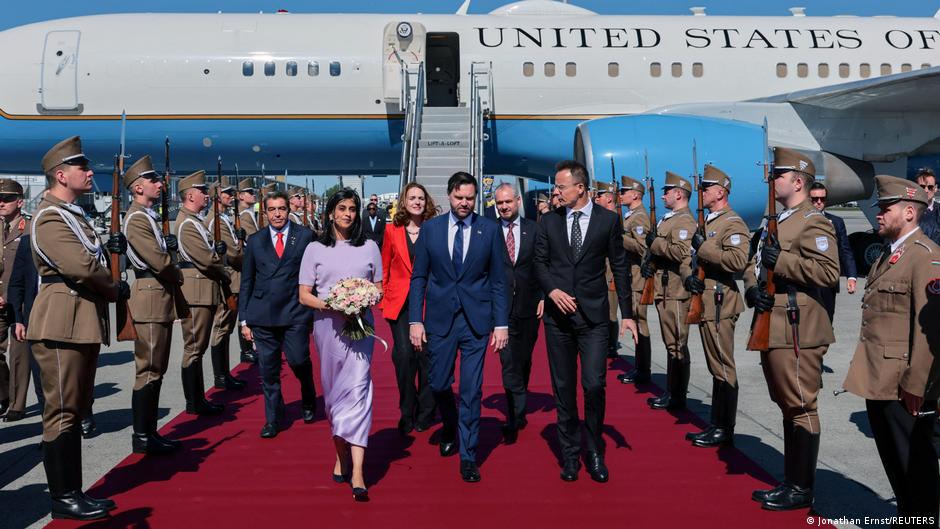
The United States has sent Vice President JD Vance to Hungary to bolster Viktor Orban’s bid for a fifth term as prime minister. Orban, a long-standing leader in the nation, faces significant challenges in the upcoming April 12 elections. Despite his dwindling poll numbers, he remains a key figure for the global far-right, often cited as an influence on Donald Trump’s political strategies.
Orban’s Influence and US Support
Orban, who has governed or held power since the late 1990s, has positioned Hungary as a model for “illiberal” democracy. His alignment with Russian President Vladimir Putin and resistance to Ukraine’s defense have placed him at odds with much of the European Union. Nonetheless, the Trump administration has framed Hungary as a success story, prioritizing its policies over concerns about governance.
“This visit clearly shows that there is a new golden age in US-Hungary relations,” stated Hungarian Foreign Minister Peter Szijjarto, welcoming Vance and his wife Usha to Budapest. The duo will address migration, security, and economic cooperation during their discussions.
Vance’s arrival coincides with Orban’s campaign against center-right contender Peter Magyr. The incumbent has also faced scrutiny over alleged ties to Russia and accusations of monitoring political rivals. Despite these issues, Trump and his MAGA movement applaud Orban’s stance on immigration, gay rights, and press freedom, labeling his approach as a defense of “Western Christian values.”
Global Far-Right Solidarity
Orban’s leadership has drawn admiration from far-right figures worldwide. Recent campaigns by leaders like Marine Le Pen of France and Argentina’s Javier Miliei have echoed his vision, with some appearing in his promotional videos. The Trump administration has also rewarded his assertiveness, exempting Hungary from sanctions on Russian energy imports.
Traditionally, the US has avoided direct interference in foreign elections, but Vance’s visit just days before the vote marks a notable exception. Orban, while appreciative of American backing, has criticized EU members for commenting on the election, viewing it as a threat to Hungary’s sovereignty.
Though Hungary ranks as the EU’s most corrupt country and among its poorest, the Trump administration continues to support Orban’s efforts. In February, Secretary of State Marco Rubio affirmed Trump’s commitment: “President Trump is deeply committed to your success, because your success is our success,” he said during a meeting with Orban in Budapest.
Orban’s reelection campaign has been a focal point for Trump’s global far-right allies, with the former president calling him a “fantastic guy” and endorsing his policies wholeheartedly. This partnership underscores the shifting dynamics in international politics, as the US seeks to align with leaders who share its ideological stance.