Iran war: Hegseth declares ‘historic’ victory for US
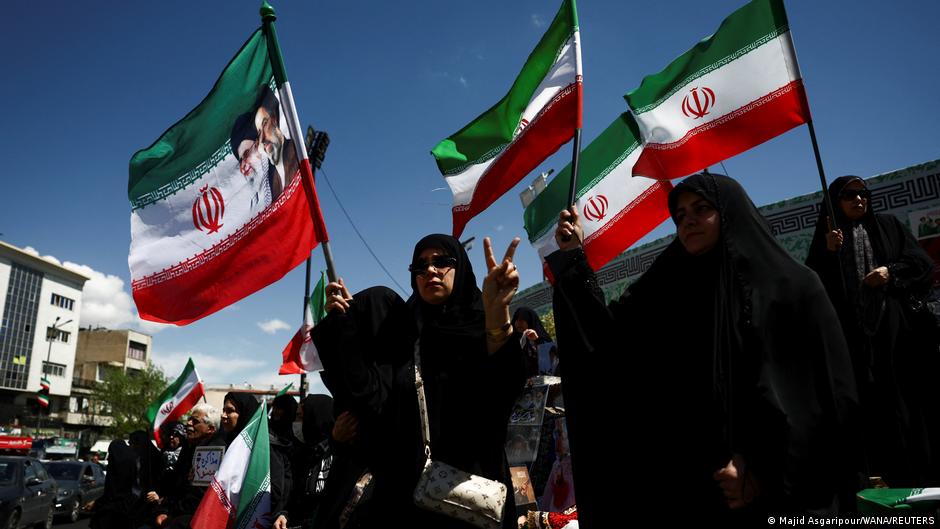
Donald Trump has pulled back from threats to destroy Iran and agreed to a two-week ceasefire after receiving a 10-point proposal from Tehran. His defense secretary said US forces are "not going anywhere." Follow DW. Welcome to DW's coverage of the conflict in Iran and the Middle East on Wednesday, April 8: US Defense Secretary Pete Hegseth declared the US had won its war with Iran several hours after a two-week ceasefire came into place.
"Operation Epic Fury was a historic and overwhelming victory on the battlefield," Hegseth told a press conference, using Washington's official term for its military campaign. "Iran begged for this ceasefire and we all know it," Hegseth said. He claimed that Iran could "no longer build missiles" due to the damage wrought to its military industry by US strikes.
Hegseth said that the US would have proceeded to destroy Iranian bridges and energy infrastructure had Tehran not agreed to the two-week ceasefire deal. He said that US forces would stay in the region to ensure that Iran complies with the terms of the deal. "We'll be hanging around, we're not going anywhere," Hegseth said.
Under the terms of the Pakistan-brokered deal , the US and Israel are to halt their attacks on Iran and Tehran is to reopen the Strait of Hormuz. US President Donald Trump has said a 10-point Iranian proposal to end the war — which includes multiple points likely to be highly contentious to Washington, including reparations, a US military withdrawal from the Middle East and recognition of Iran's nuclear enrichment program for civilian purposes — is a "workable" basis for further talks. Hegseth said that the US expected Iran to hand over its enriched uranium stocks, saying: "They will give it up and we will take it." Meanwhile, top general Dan Caine said at the same press conference that US forces remained ready to renew attacks against Iran.
"Let us be clear, a ceasefire is a pause, and the joint force remains ready, if ordered or called upon," Caine said. What does the German government think about the US-Iran ceasefire agreement? What does Chancellor Friedrich Merz think?
Media representatives in the German capital, Berlin, wanted to get answers to these questions on Wednesday. Despite the fear of another massive escalation in the Middle East, which had been palpable in political circles in Berlin just a few hours earlier, the official reactions were almost void of any emotion. Just before 8:00 a.m., the Federal Press Office had sent out a short statement from the chancellor reading, among other things: "The goal now must be to negotiate a lasting end to the war in the coming days.
This can only be achieved through diplomatic channels." That was also the message given in the Federal Press Conference a few hours later: Deputy government spokesman Sebastian Hille tried to disclose as little as possible. There were no details on what it actually means when Germany offers to "contribute in an appropriate manner to ensuring freedom of navigation in the Strait of Hormuz." There was also no comment on the rumor that the German Navy could send mine-clearing vessels into the Strait of Hormuz. French President Emmanuel Macron has reportedly announced that 15 states will gather to actively work towards keeping the faint hope for peace alive.
Is Germany among them? "Intensive discussions are underway," government spokesperson Hille said. But surely Germany must say something about the fact that just a few hours ago, US President Donald Trump openly threatened Iran with the annihilation of an entire civilization?
Wasn't that a blatant announcement of war crimes? "I'm not going to offer any textual analysis of past events," government spokesman Hille stated tersely. And so, the German government's only message was that Germany had by no means remained passive on the sidelines during the recent developments in the Gulf.
Hille and the spokesman for the Foreign Office, Martin Giese, explained that Chancellor Merz had been in constant contact with all "relevant parties" over the Easter weekend, and Foreign Minister Johann Wadephul had spoken by telephone with his Israeli counterpart. To view this video please enable JavaScript, and consider upgrading to a web browser that supports HTML5 video The prime minister of Canada and multiple European leaders and officials support the two-week ceasefire between the United States and Iran and would like to see further diplomatic efforts to end to the war, according to a joint statement. "We strongly encourage quick progress towards a substantive negotiated settlement," the statement read.
"The goal must now be to negotiate a swift and lasting end to the war within the coming days. This can only be achieved through diplomatic means." "Our Governments will contribute to ensuring freedom of navigation in the Strait of Hormuz," they said. The joint statement was issued by Canada, Germany, France, Italy, Spain, Denmark and the Netherlands.
It was also signed by EU Commission President Ursula von der Leyen and EU Council President Antonio Costa. US President Donald Trump said that Washington would work with Iran to remove nuclear material buried in the country. "The United States will work closely with Iran, which we have determined has gone through what will be a very productive Regime Change!" Trump said in a post on his Truth Social platform.
"There will be no enrichment of Uranium, and the United States will, working with Iran, dig up and remove all of the deeply buried (B-2 Bombers) Nuclear 'Dust,'" Trump said, adding that the US was keeping the fallout under satellite surveillance. The United States struck Iranian nuclear sites during a brief war in June 2025 and declared that the facilities had been "obliterated." "Nothing has been touched from the date of attack," Trump said in an apparent reference to the June 2025 conflict. Tehran maintains that its nuclear enrichment serves exclusively civilian purposes.
Trump also said that the US was discussing removing some tariffs and sanctions from Iran. "We are, and will be, talking Tariff and Sanctions relief with Iran;" he said, while claiming that Tehran had already agreed to some of the US' demands. In a separate post, he said that countries that supply weapons to Iran will face 50% US tariffs.
Iranian state television said drone and missile strikes on Wednesday targeting Kuwait and the United Arab Emirates were a response to airstrikes that hit oil facilities on Iran's Lavan island, located to the north of the Strait of Hormuz, earlier in the day. The exchanges of fire come despite the US and Iran announcing that they had agreed to a ceasefire earlier on Wednesday. The report said the strike on the oil facility happened at 10 a.m.
without specifying who launched the attack, which caused a fire but no injuries. The Iranian Oil Ministry's news outlet, Shana, called it an "enemy attack." Explosions were also reported on Iran's Sirri island in the Persian Gulf off the coast of Dubai, according to Iran's Mehr news agency. The Kuwaiti military said 28 Iranian drones, some targeting power stations and oil facilities, were intercepted in the wave of attacks on Wednesday.
Damage to infrastructure and desalination plants was reported. The United Arab Emirates also said air defenses were intercepting Iranian missile and drone attacks. Separately, Iran's Revolutionary Guards said Wednesday they attacked US and Israel-linked energy complexes and oil lines overnight, along with striking oil facilities in Saudi Arabia's Red Sea export hub, Yanbu.
Fawaz Gerges, a professor of Middle Eastern politics and international relations at the London School of Economics, has told DW that US President Donald Trump had seriously miscalculated in launching the war with Iran. "I think [the war] will be seen in history … as one of the greatest miscalculations by an American president," Gerges said. "President Trump not only has undermined his own credibility as a negotiator, he has undermined America's standing in the world," he said.
Gerges said Trump "was desperate to find an off-ramp" and was offered one by the Iranian leadership in accepting a two-week truce. He said that Iran's 10-point peace proposal was essentially a "wishlist" and multiple points were likely to be contentious for Washington. Gerges argued that Trump had reduced his objectives over the course of the war, saying that the US president initially emphasized regime change but later focused largely on opening the Strait of Hormuz.
"All he cares about is opening the Strait of Hormuz for shipping, even though the Strait of Hormuz was open for shipping before the war," he said. "One of the results of the war was that Iran was able to block the Strait of Hormuz." "Iran, from the beginning, was willing to negotiate. It was the United States and Israel that pre-empted the diplomatic process and attacked Iran," he said.
He said that the United States and Israel's war on Iran has "strengthened and emboldened the Islamic Republic domestically." "The war has come at the expense of the Iranian people," he said, pointing to civilian deaths and damage to infrastructure from the US-Israeli bombing campaign. He said it was likely that the US' Gulf Arab allies would "try to diversify their relations," as they were "disappointed" with Trump's handling of the war. "A new security architecture will have to be created to ensure stability in the Gulf," he said.
"The old system has been shattered to a million pieces." He said that he believed Israel would also "emerge much weaker" from the war and that Gulf states would not seek to deepen their ties to the country. Speaking during a visit to Budapest on Wednesday, US Vice President JD Vance welcomed the ceasefire with Iran, but warned that it was being misrepresented in Iran. "You have people who are lying about even the fragile truce that we’ve already struck," Vance said, without sharing further details.
"If the Iranians are willing in good faith to work with us, I think we can make an agreement," said Vance, who is in Hungary this week to endorse Viktor Orban's reelection bid. "I think if they negotiate in good faith, we will be able to find a deal. That's a big if.
And ultimately, it's up to the Iranians how they negotiate. I hope they make the right decision," Vance said. However, he warned that if Tehran does not come to the negotiating table, "they're going to find out that the President of the United States is not one to mess around.
He's impatient. He's impatient to make progress." Pakistan, which mediated the ceasefire , said that negotiations on a permanent end to the war could begin in Islamabad as soon as Friday. The United Arab Emirates' defense ministry said its forces have responded to Iranian attacks late Wednesday morning, hours after a truce between Tehran and Washington came into effect.
"The UAE's air defenses are currently engaging missile and drone attacks originating from Iran," the ministry said in a post on X. The notice was posted at 1:47 p.m. local time (1047 UTC).
The Kuwaiti military said its forces were responding to Iranian attacks early on Wednesday. "Since 8:00 AM (0500 GMT) today, Kuwaiti air defences have been engaging an intense wave of hostile Iranian attacks, dealing with 28 drones targeting the State of Kuwait," Kuwait's military said in a post on X. It said that some of the attacks caused "significant material damage to oil facilities, power plants and water desalination plants." The Iranian attacks have continued throughout Wednesday morning, even after Tehran and Washington said they had agreed to a two-week ceasefire.
Kremlin spokesperson Dmitry Peskov expressed Russia's approval of a ceasefire deal reached between the United States and Iran. "We, of course, welcomed this news of a ceasefire and welcome the decision not to continue down the path of armed escalation, especially not to strike civilian targets, including Iranian economic facilities. We consider this very important," Peskov said at a daily briefing.
He said that Russia — which is rich in oil and natural gas — stood to benefit from the shocks to global energy supplies brought about by the war. "Now that the world has confidently embarked on the path of a rather serious economic and energy crisis, which is growing day by day, the market and market conditions in the field of energy and energy resources have completely changed," he said, adding that Moscow was negotiating with potential customers in a way that "best suits our interests." He also expressed hope for new trilateral talks between Moscow, Kyiv and Washington on ending the war in Ukraine. Turkey called for all parties to fully comply with the two-week ceasefire agreement reached between the United States and Iran.
"We emphasize the necessity of the full implementation of the temporary ceasefire on the ground and express our expectation that all parties will adhere to the agreement," Turkey's Foreign Ministry said. Ankara also expressed its support for planned talks to be hosted by Pakistan, which brokered the truce. "We will continue to extend all necessary support for the successful conclusion of the negotiations to be held in Islamabad," the ministry said.
Turkey borders Iran and is also a member of the US-led NATO military alliance. Ukrainian President Volodymyr Zelenskyy has said Kyiv's military advisors would "continue to work" in Middle Eastern countries to "help further develop security capabilities," after a two-week truce was announced in the war between the United States and Iran. Ukraine's military has experience battling Iranian-produced Shahed drones which Russia has used in its war in Ukraine.
Kyiv has offered to share this expertise after Gulf states were targeted by Iranian drone strikes, with Tehran saying the attacks were in retaliation to the US and Israeli strikes on Iran. Zelenskyy said Kyiv supported the ceasefire agreement, adding: "Any threats to security and stability in the Middle East and the Gulf amplify challenges for the economy and the cost of living in every country." He also called for Russia to agree to a similar truce in Ukraine. "A ceasefire is the right decision that leads to ending the war," Zelenskyy said.
"Ukraine tells Russia once again: we are ready to respond in kind if the Russians stop their strikes." Arab states in the Gulf region have welcomed the announcement of a two-week ceasefire between the United States and Iran. Tehran attacked sites in several Gulf countries over the course of the war, saying it was in retaliation to the United States and Israel's bombing campaign in Iran. Saudi Arabia said it hoped the parties to the ceasefire would move toward a "comprehensive and sustainable de-escalation." "The kingdom hopes that the ceasefire will represent an opportunity to achieve a comprehensive and sustainable de-escalation, enhancing the security of the region, and that any attacks or policies that undermine the sovereignty, security and stability of the countries in the region will cease," Riyadh's Foreign Ministry said in a statement.
Qatar's foreign ministry said Doha welcomed the ceasefire announcement and stressed the need to ensure maritime security and freedom of navigation. It called for Iran to "immediately cease all hostile acts" in the region. Oman — which mediated talks between Tehran and Washington before the outbreak of the war — called for strengthened efforts to end the war.
"The Sultanate of Oman affirms the importance of intensifying efforts now to find solutions capable of ending the crisis at its roots and achieving a permanent cessation of the state of war and hostile acts in the region," the Omani Foreign ministry said. Anwar Gargash, an aide to UAE President Mohamed bin Zayed Al Nahyan, said that the United Arab Emirates had "triumphed" in the war. "The UAE triumphed in a war we sincerely sought to avoid, and we prevailed through an epic national defense that safeguarded sovereignty and dignity and protected our achievements in the face of treacherous aggression," Gargash said on X.
"Today, we move forward to manage a complex regional landscape with greater leverage, sharper insight, and a more solid capacity to influence and shape the future. Our strength, resilience, and steadfastness have reinforced the UAE's renaissance model," he said. Spain's government has criticized Israel for continuing its offensive in Lebanon despite agreeing to a two-week ceasefire deal with Iran.
In comments to Spain's SER radio station, Foreign Minister Jose Manuel Albares described the truce as having provided a "ray of hope", but said Spain considered it "unacceptable that Israel’s invasion of a sovereign country … continues." He also accused Israel of "indiscriminate bombing of the civilian population" in Lebanon's capital, Beirut, as well as of "attacks on United Nations peacekeeping forces." Spain contributes some 658 troops to the UN peacekeeping mission in Lebanon, known as UNIFIL. “We will spare no resources to support Pakistan’s mediation efforts and help diplomacy achieve a breakthrough. But it is still too early to know where they will lead," Albares said, while warning that a lasting peace was not yet close.
Also on Wednesday, Spanish Prime Minister Pedro Sanchez said in a post on X that Madrid would not "applaud those who set fire to the world because they show up with a bucket." Sanchez is one of Israel's fiercest critics among European leaders. Meanwhile, the Israeli military's Arabic-language spokesman, Avichay Adraee, stressed: "The battle in Lebanon continues, and the ceasefire does not include Lebanon." He told residents of southern Lebanon to move north of the Zahrani River, some 40 kilometers (around 25 miles) north of the border with Israel. with the area covered by the evacuation order equivalent to nearly a sixth of Lebanon's territory.
Jet fuel supply would take months to recover even if Iran were to open the Strait of Hormuz, the head of the International Air Transport Association (IATA), Willie Walsh, said on Wednesday. Jet fuel prices have more than doubled since the US and Israel launched their war with Iran on February 28, alongside broader energy shocks wrought by disruptions to the oil-rich Persian Gulf region. "If it were to reopen and remain open, I think it will still take a period of months to get back to where supply needs to be given the disruption to the refining capacity in the Middle East," Walsh told reporters in Singapore.
"I don't think it's going to happen in weeks," he said. He stressed that oil refinement capacity is too localized to be able to be swiftly restarted. "Even if you have the flow of crude start again, if you've had disruptions in refining capacity, then the problem continues for some time," Walsh said.
"I don't think everybody fully appreciated how concentrated the capacity was in certain parts of the world," he added. However, he stressed that he expected major airports in the Gulf — the site of international transit hubs such as Doha, Abu Dhabi and Dubai — to swiftly recover from reduced capacity after Iran launched strikes on countries in the region. "I fully expect the Gulf hubs to recover and recover quickly," he said, adding that "there's no way" other airlines can "replace the (entire) capacity that was provided by the Gulf carriers." He said that he expected airlines to respond to the crisis by increasing prices, calling such a move "inevitable." Walsh also emphasized that the disruptions caused by the war between the US and Iran have not been comparable to those of the COVID-19 pandemic in 2020-2023.
"This is not similar to COVID. This is not a crisis anywhere close to what we experienced (in COVID)," he said. "In COVID, capacity reduced by 95% because borders closed.
We're nowhere near that." He instead compared this year's war between the US and Israel and Iran with the shocks that accompanied the September 11, 2001 attacks on the United States and the 2008 economic crisis. "Post-9/11, the recovery took about four months. In 2008-2009 it was probably 10 to 12 months," he said.