Iran war: how farmers adapt as fertilizer crunch heats up
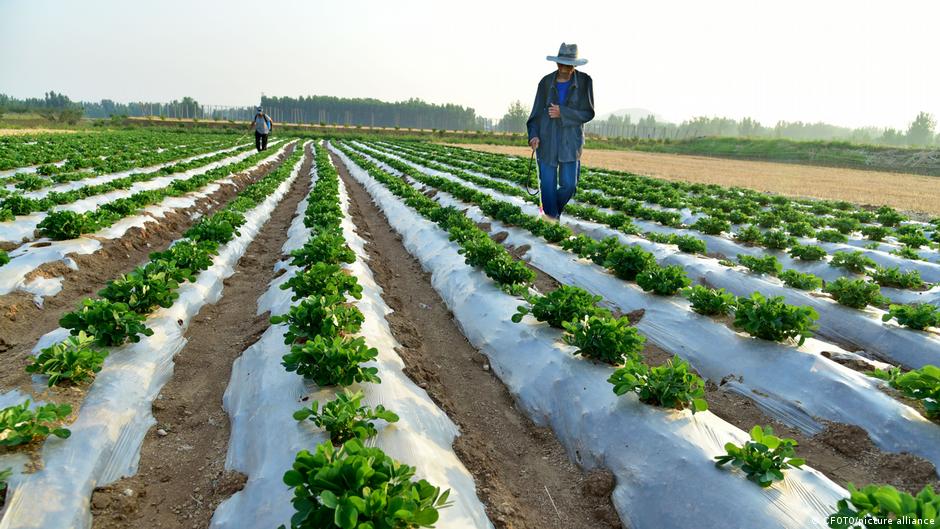
The war in Iran has sparked a global fertilizer shortage and is threatening food security. What are farmers around the world doing to save their crops? Choked off shipping in the Strait of Hormuz isn't just grinding oil tankers to a halt.
The Iran war is creating a one-two punch for the world's fertilizer supply, blocking both the export and one of its critical ingredients from leaving the Persian Gulf. It remains to be seen whether the temporary ceasefire reached on Tuesday will significantly ease that blockage. Nearly half of the world's traded urea, the most widely used nitrogen-based fertilizer, comes from the Gulf.
As does one-fifth of the world's liquified natural gas (LNG). A quick chemistry refresher: the century-old Haber-Bosch process combines nitrogen from the air with hydrogen (that's where the LNG comes in) to make ammonia, which you need to produce nitrogen fertilizers. "This is literally a step removed from the worst-case scenario," Josh Linville, who tracks global fertilizer markets for the commodities firm StoneX, told DW.
Fertilizer and LNG plants from Qatar to Bangladesh have already begun shutting down. What happens next depends on how quickly the strait reopens now that the two-week ceasefire deal has been reached. Between fuel shortages and fertilizer troubles , food prices are very likely to rise, with the world's poorest countries bearing the brunt.
In the meantime, governments and farmers alike face hard choices about how to adapt. The quickest solution is for governments to pull market levers to try to control supply or demand. India possesses large stockpiles of rice and wheat that the government can tap should supply decline.
China , the world's largest fertilizer producer, keeps massive stockpiles of fertilizer. As fertilizer prices increase, some governments can also absorb those costs, instead of passing them on to farmers. When Russia first invaded Ukraine in 2022 , triggering another major fertilizer supply shock, India raised its fertilizer subsidy by 233% above its original budget.
Countries can also limit how much they trade, keeping resources for their own populations, like China has done several times since 2021. The issue with any of these options is that they can often be zero-sum. When a country like China stockpiles fertilizer or chooses not to trade, it may help Chinese producers, but at the same time, it hurts farmers around the world.
And these options are only available to richer countries. While India can afford to subsidize fertilizer, nearby Bangladesh , Nepal and Sri Lanka likely cannot. Another option for farmers is to switch to crops that are less fertilizer-intensive.
Soybeans and other legumes have a natural ability to capture nitrogen from the air, requiring much less fertilizer than crops like corn. The US predicted soybean planting would increase by 4% from last year and corn would decrease by 3% in an agricultural report released at the end of March — and those predictions are based on surveys conducted slightly before the fertilizer crisis truly got underway. That choice isn't available to all farmers though.
In Asia, there's a limited number of crops that can sustain such heavy rains during monsoon season, and pivoting away from rice when it's such a dietary staple is just not realistic. To view this video please enable JavaScript, and consider upgrading to a web browser that supports HTML5 video "If you're a rice producer in Southeast Asia, you may not have that many cropping options," Joseph Glauber, former chief economist at the US Department of Agriculture who now works with the International Food Policy Research Institute, told DW. If they can't change what they plant, farmers can change how they tend to their fields.
Many farmers use far too much fertilizer to begin with. Estimates show that the world's crops use only about half of applied fertilizer effectively ; the rest leaches into groundwater or escapes into the air as nitrous oxide, a potent greenhouse gas. There are all sorts of technology that can help with application: drones, cameras, even AI.
It's an emerging field called precision agriculture that monitors crops closely and figures out when they need fertilizer and exactly how much. While helpful, these tools can be expensive and inaccessible in the short-term for farmers in poorer countries. Even more important than the method is motivation, according to Avinash Kishore, a food systems researcher at the International Food Policy Research Institute.
When fertilizer is subsidized, there's little incentive for farmers to be careful in their application. But when urea prices shot up in 2022 in Bangladesh, farmers were able to use less and rice production held steady. "There's a lot of room to use this resource efficiently," Kishore said.
"You don't need some sudden injection of very expensive or complex technology." There have also been attempts to try making fertilizer differently, so that shipping chokepoints around the world won't have as great an effect on farmers. Pivot Bio, an American startup, has developed a method to apply microbes to seeds that can naturally convert nitrogen from the air into a form plants can use. The company says its products were used across 5 million acres in the US in 2023, reducing reliance on LNG.
To view this video please enable JavaScript, and consider upgrading to a web browser that supports HTML5 video But just like precision agriculture tools, introducing new technology is a medium to long-term solution, not one that can solve a short-term crisis. What countries need first is for the supply of fertilizer to stabilize. "We are losing massive amounts of supply to an extent that we have never seen before," said StoneX's Linville.
To view this video please enable JavaScript, and consider upgrading to a web browser that supports HTML5 video