US Rebuilding WWII Pacific Airfields Amid China Threat
Samael.lol – As tensions rise in the Indo-Pacific region, the United States is revitalizing airstrips from World War II, including those on Tinian and Peleliu islands. These facilities, originally built to strike Japan near the war’s end, are now being restored to bolster American military readiness against China’s increasing assertiveness. The recent focus on these sites underscores a broader effort to reinforce strategic positions in the face of evolving regional dynamics.
China’s Military Activities
Beijing has been asserting its claims in the northern Pacific, engaging in frequent naval operations near South Korea and Japan. Simultaneously, the nation conducts large-scale military drills around Taiwan, emphasizing its goal of eventual unification with the mainland. Additionally, China’s territorial ambitions extend to the South China Sea, where it disputes much of the area despite a 2016 ruling by an international tribunal.
“China’s growing military presence in the Indo-Pacific has led the US to revive these old airfields,” said Dan Pinkston, a professor at Troy University’s Seoul campus and former US Air Force officer. “The goal is to position the US for potential escalation beyond the first and second island chains, ensuring unrestricted access to the Pacific,” he added.
Historical Significance
On Tinian Island, engineers have been reconstructing a 2,400-meter runway that once served as the departure point for the B-29 Superfortress Enola Gay, which launched the first atomic bomb on Hiroshima in 1945. Three days later, another B-29 from the same site dropped a second bomb on Nagasaki, accelerating Japan’s surrender. The airfield, once the world’s busiest, fell into disuse after 1947 and was overgrown by vegetation until 2003, when limited clearing began for exercises.
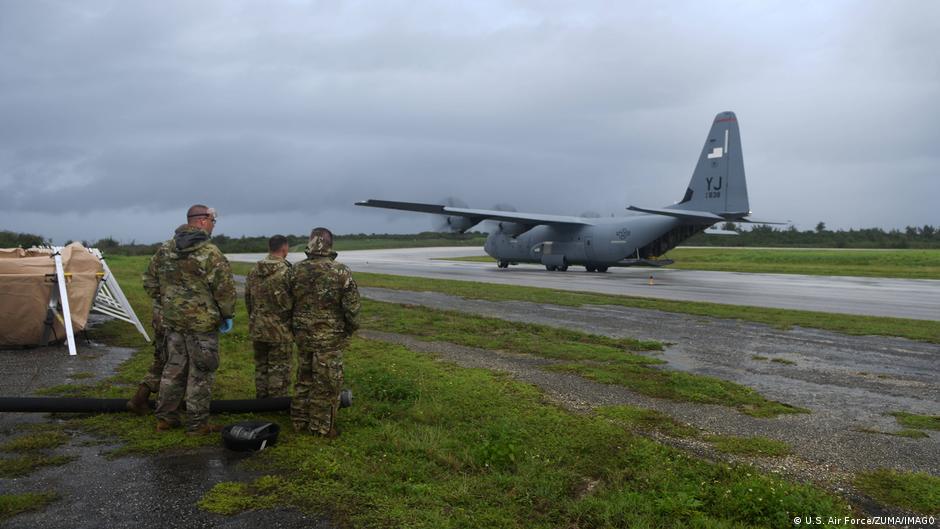
Peleliu, a southern island in the Palau archipelago, also features a 1,800-meter runway. Originally constructed before the island’s liberation from Japanese control, it supported US Pacific operations until the war’s conclusion. The site has since been used as a local airport for light aircraft but was only recently reopened in 2024 for full military use.
Infrastructure Upgrades
Rebuilding efforts on Tinian and Peleliu involve modernizing runway surfaces, taxi lanes, and aircraft hardstands to withstand the region’s humid climate and tropical storms. Ensuring reliable power and water supplies is another priority. Underground fuel storage and reinforced shelters for planes, weapons, and supplies are also being considered. The installation of radar systems and defensive weapons is expected to follow as groundwork progresses.
“Ten years ago, the US was heavily focused on re-evaluating its Middle East bases,” noted Garren Mulloy, an international relations expert at Daito Bunka University. “They now recognize how vulnerable their airfields are to attack, especially as China’s assertiveness in the Indo-Pacific has escalated significantly.” Mulloy highlighted that while China poses the primary threat, North Korea’s potential actions remain a key contingency.
In June 2024, a KC-130 tanker became the first aircraft to land at the recently restored Peleliu field. The US military has also initiated site surveys for Patriot anti-missile systems, though their deployment is yet to be confirmed. This move signals a shift toward enhanced regional defense capabilities as the strategic landscape continues to change.