Inside Israel’s Expansionist Ambitions
Samael.lol – Israel’s territorial ambitions have long extended beyond its current borders, with settlers and political leaders embracing a vision rooted in biblical geography. While the nation has never officially set its boundary lines, this idea of growth is now gaining traction in Israeli politics, fueled by ongoing conflicts in the Middle East.
A Vision of Divine Promise
Daniela Weiss, a prominent figure in the settler movement, once showcased a map titled “The Promised Land” during an interview with Australian media. She explained,
“This represents God’s covenant with the Jewish nation’s patriarchs.”
The map envisions a state that includes portions of Jordan, Lebanon, Egypt, Iraq, Syria, and Saudi Arabia, stretching far beyond the 1949 armistice line, or the Green Line.
Weiss, often called “the godmother of the Israeli settler movement,” refers to the concept as “Eretz Israel HaShlema,” meaning “Complete Israel.” This idea, popular among far-right factions, draws from biblical texts. Proponents like Bezalel Smotrich, Israel’s finance minister, and Itamar Ben Gvir, national security minister, see it not as a mere expansion but as fulfilling a divine mandate.
Biblical Foundations and Modern Politics
The biblical promise of land from the Nile to the Euphrates River, as described in Genesis 15:18-21, has influenced Zionist ideology. Thinkers such as Theodor Herzl and Ze’ev Jabotinsky referenced these boundaries in their works, framing them as a core vision for Jewish sovereignty.
Herzl praised the biblical homeland in his diary entries, while Jabotinsky’s song “The East Bank of the Jordan” reinforced the idea. The lyrics,
“The Jordan has two banks – this one is ours, and so is the other,”
became a symbol for Jabotinsky’s Revisionist Zionist youth movement, Betar. Benjamin Netanyahu’s father, Benzion Netanyahu, was part of this movement, carrying forward its legacy.
Recent Political Moves
Israel’s first prime minister, David Ben-Gurion, also considered the notion of “Greater Israel” but chose a pragmatic path. He focused on creating a sovereign Jewish state, leaving borders undefined in the 1948 Declaration. This strategic ambiguity has allowed later leaders to revisit the idea.
Since 2014, when Weiss first articulated the vision, it has resurfaced in political discourse. In March 2023, Smotrich sparked controversy by displaying a “Greater Israel” map at a Paris event, featuring Jordan. A year later, he declared to ARTE that “Jerusalem’s future lies in reaching Damascus.”
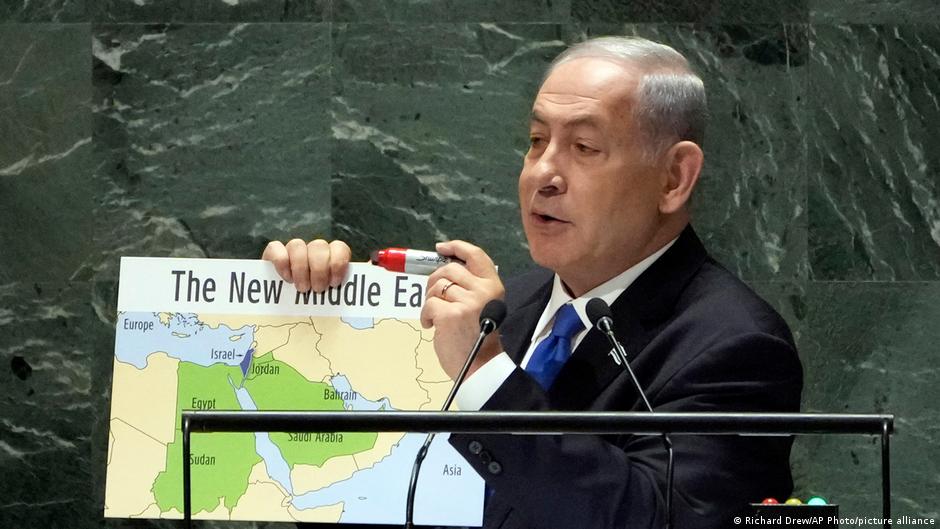
In September 2024, Prime Minister Benjamin Netanyahu unveiled a map annexing the West Bank. By August 2025, he had reaffirmed his connection to the broader vision, prompting Egypt and Jordan to seek explanations. Even recently, in February 2026, U.S. Ambassador Mike Huckabee suggested that Israel’s dominance across the entire Middle East would be acceptable.