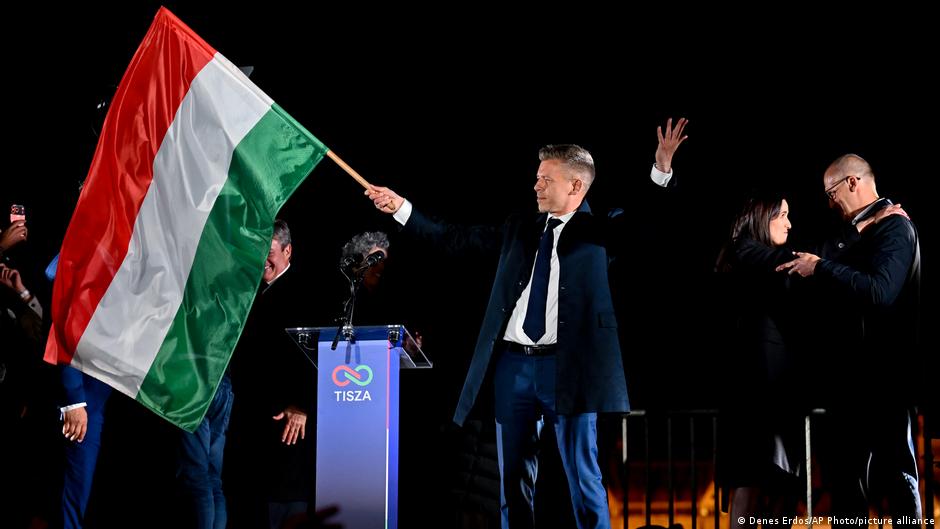
Hungary: Peter Magyar’s Election Signals Shift in EU Relations
Victory Marks End of Orban Era, New Hope for Brussels
Samael.lol – After 16 years of leadership by Viktor Orban, Hungary’s electorate delivered a decisive verdict on Sunday, choosing Peter Magyar as the next head of government. The pro-European candidate secured a sweeping win, signaling a potential realignment of the nation’s policies with the European Union. Magyar’s center-right Tisza party is projected to claim 138 parliamentary seats in a 199-member assembly, surpassing the two-thirds threshold necessary to enact sweeping reforms. This outcome contrasts sharply with Orban’s tenure, which saw Hungary drift toward authoritarianism and closer ties with Russia.
Despite Orban’s influence over state media and the manipulation of electoral districts—factors that required Tisza to outperform Fidesz by a margin of 5%—Magyar’s victory marked a record 80% turnout. The National Election Office reported the highest participation in post-communist Hungary’s history, reflecting widespread public discontent with the previous administration’s policies.
“The two-thirds majority will enable constitutional amendments to reestablish checks and balances,” Magyar declared in a speech to his supporters. “We will join the European Public Prosecutor’s Office and ensure our democracy thrives. Tonight, truth triumphed over lies. Hungarians chose to prioritize their homeland’s future, not its past.”
Magyar’s campaign focused on reversing Orban’s erosion of EU relations and combating systemic corruption. His pledges to align Hungary with Brussels and NATO have been met with cautious optimism, though analysts note the need for tangible progress before EU funds can be unfrozen. The new government aims to unlock billions in financial support, contingent on demonstrating reforms to address concerns about the rule of law and media freedoms.
While Magyar has expressed support for legal equality, his position on LGBTQ+ rights remains ambiguous. During the campaign, he avoided addressing the issue directly, a strategy analysts suggest was designed to retain conservative voters. Meanwhile, his stance on Ukraine—opposing rapid EU integration and sending arms to Kyiv—differs from Orban’s confrontational approach. The former leader frequently used his veto to block EU aid to Ukraine, maintaining strong ties with Russian President Vladimir Putin.
European Commission President Ursula von der Leyen praised Magyar’s victory on social media, stating, “Europe’s heart is beating stronger in Hungary tonight.” German Chancellor Friedrich Merz echoed this sentiment, calling for collaboration to “build a united Europe.” French President Emmanuel Macron also shared a message on X, highlighting the significance of the electoral shift.
The election results have sparked renewed hope for EU-Hungary relations, yet challenges persist. Public chants of “Ruszkik haza!”—a rallying cry from Hungary’s 1956 revolution against Soviet control—underscore the lingering anti-Russian sentiment. As Magyar prepares to lead, the focus will be on whether his reforms can restore trust in both domestic governance and European alliances.