Germany: Humpback Whale ‘Barely Moved,’ Reacting Less
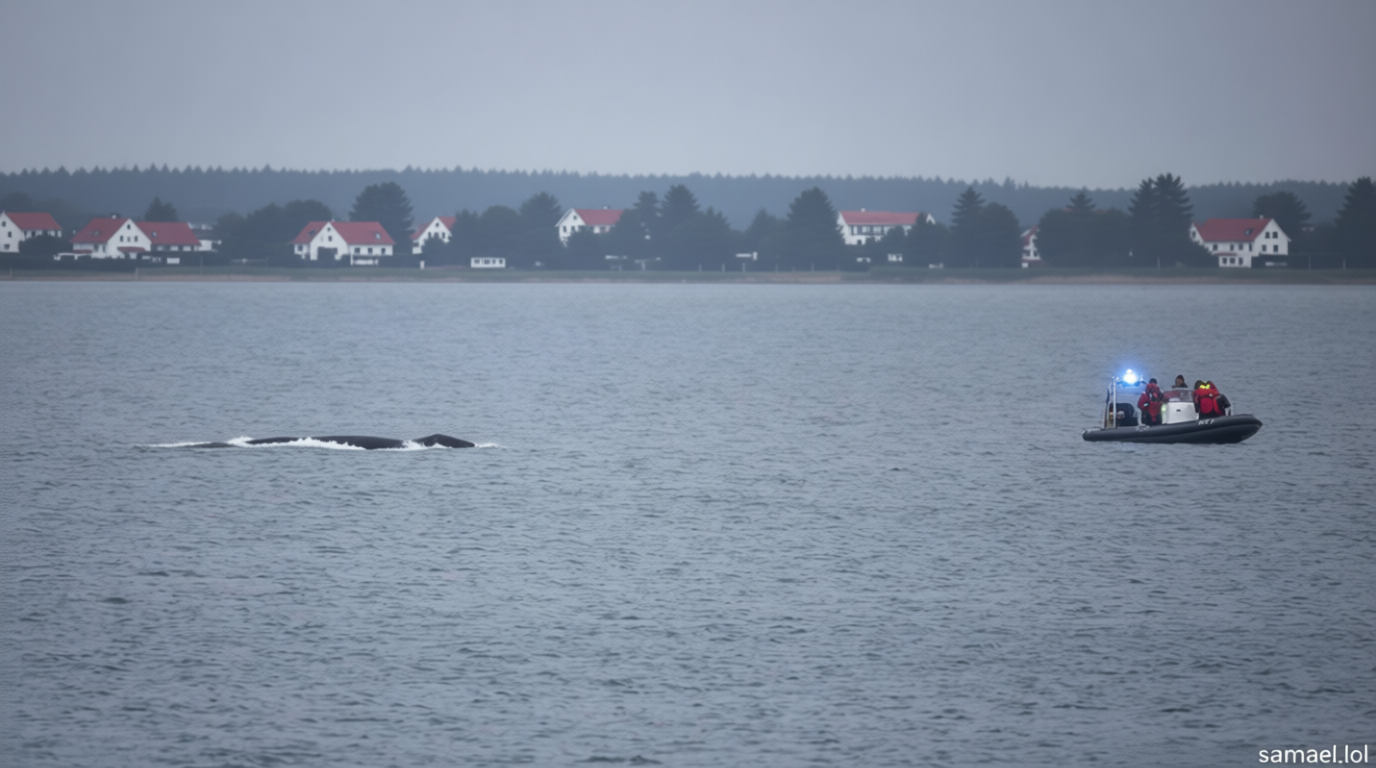
Samael.lol – Overnight, the stranded whale showed minimal movement, even as elevated water levels offered a potential escape route. Rescuers noted that the animal was less responsive to external stimuli and breathing with reduced frequency—a sign of declining health. This humpback whale, which had been trapped in two locations across the Baltic Sea for over a week, displayed worsening symptoms on Monday, according to officials and environmental experts.
“The whale is stationary, moving only a short distance. Its condition appears to be deteriorating,” stated Environment Minister Till Backhaus during a midday press briefing. He added, “Its breathing rate has dropped significantly, indicating a severe decline in strength.”
As water levels in Wismar Bay are anticipated to increase by approximately 30 centimeters on Monday, another opportunity to liberate the whale may arise. Rescuers plan to encourage movement by creating favorable conditions. “It could now take its chance to move forward,” Backhaus remarked.
Professor Burkhard Baschek of the German Oceanographic Museum described Monday as a “critical moment.” He emphasized that the whale’s ability to escape depends largely on its own initiative, with limited options for external intervention. The creature had advanced only 1 to 1.5 meters in the last 24 hours, despite the higher water levels.
“When we attempted to stimulate it by striking the water forcefully, it responded weakly,” said Greenpeace’s Franziska Saalmann. “It no longer emits sounds, and its lack of reaction to our presence suggests it is growing increasingly frail.”
Baschek warned that the whale’s breathing pattern, now once every four minutes, represents a major drop. He also highlighted the development of secondary infections on its skin, raising concerns about its survival. If the whale misses a straightforward chance to escape, euthanization might be considered to alleviate its suffering. “We haven’t reached that stage yet,” Baschek clarified.
The whale first became stranded on a sandbank near Timmendorf’s beach early last week. After several days of attempts to clear its path, it managed to move northward. However, while navigating shallow areas and natural bottlenecks toward the North Sea, it was caught again in Wismar Bay, veering eastward instead of continuing north.
A marine biologist from Schleswig-Holstein, Robert Marc Lehmann, criticized ongoing rescue efforts over the weekend. He mentioned being excluded from later operations and urged rescuers to use wet suits and wade into the water as he had. Backhaus acknowledged contact with Lehmann and emphasized collaboration over conflict. He also asked the public to support the experts from Mecklenburg-Western Pomerania.
Backhaus confirmed no shortcomings in the work of the German Oceanographic Museum and Greenpeace. The whale is believed to have entered the Baltic Sea in early March, losing its way and drifting into the region.
It’s considered likely that the whale first lost its way and veered into the Baltic Sea in early March.