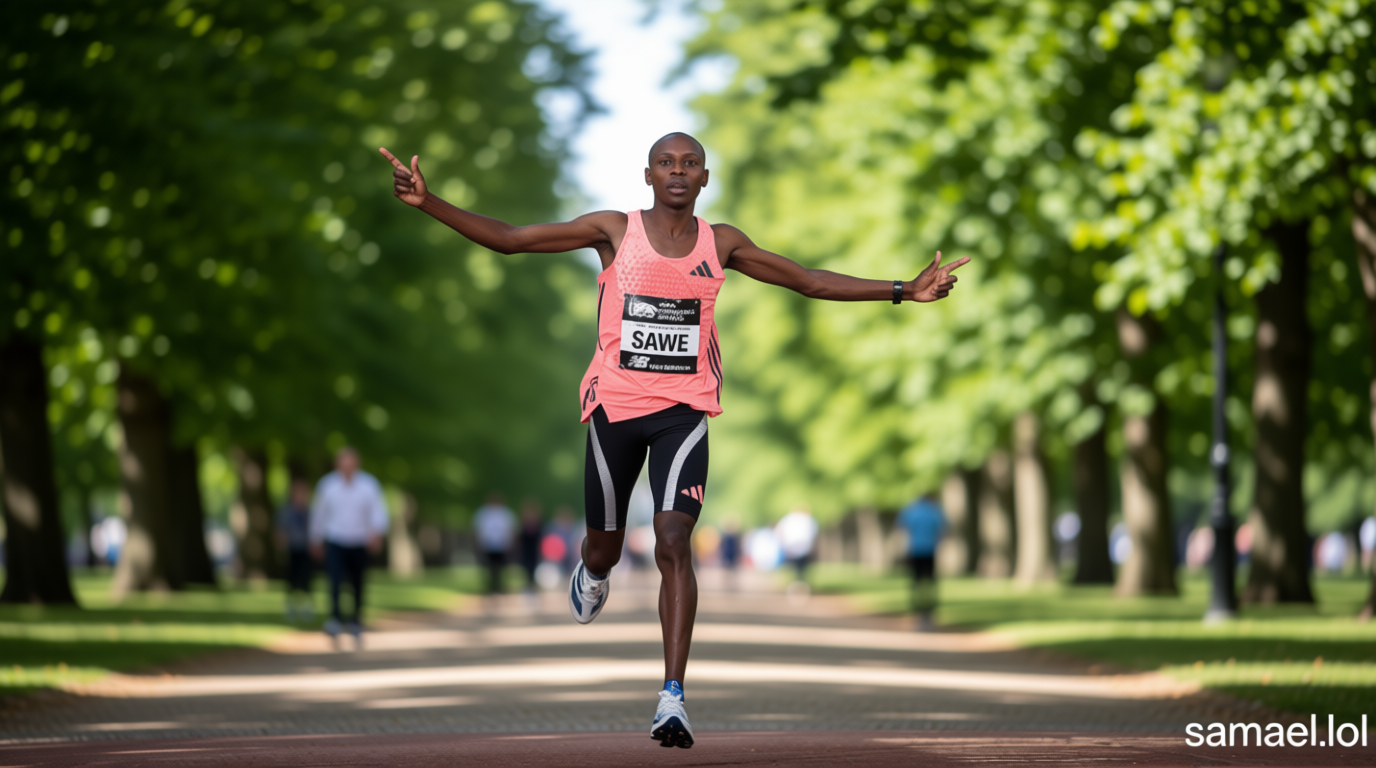
Sebastian Sawe Etches Name into Marathon History
Samael.lol – On a crisp April morning in London, Sebastian Sawe achieved what many had deemed unattainable. The Kenyan runner shattered the two-hour marathon barrier with a time of 1:59:30, becoming the first athlete to cross the finish line in under two hours during a competitive race. This historic feat, which occurred in the 2025 London Marathon, not only redefined the sport but also left the world in awe. Speaking to BBC Sport just hours after the race, Sawe described the accomplishment as a complete surprise, even to himself.
“It was not in my mind. I was well prepared for this year’s London Marathon, but what came surprised me because I was not thinking to run a world record,” he said.
Sawe, now 30, has always been a contender for unexpected triumphs. His journey to this moment began years before the record-breaking run, with a series of performances that hinted at his extraordinary potential. In 2022, he first made headlines by competing as a pacemaker in the Seville half marathon. Though he had never raced on the road, Sawe quickly dominated, finishing with a course record time that left his rivals stunned. His ability to adapt and excel in a new environment foreshadowed the breakthrough that would soon follow.
Two years later, in Valencia 2024, Sawe’s talent became even more apparent. He set a new personal best of 2:02:05, which was only 12 seconds slower than Kelvin Kiptum’s initial marathon time from 2023. Kiptum, who had already broken the two-hour mark in Chicago, was seen as the frontrunner for the sub-two-hour milestone. Yet, Sawe’s performance in Valencia suggested he was ready to challenge that legacy. “Even 1:58 is possible,” he claimed in the aftermath of his Valencia debut, underscoring his belief in his own capabilities.
From Rural Roots to Global Stage
Sawe’s story is one of resilience and determination. Born in Kenya’s Rift Valley, where his father worked as a maize farmer, he grew up in a community that values hard work and perseverance. Despite his rural upbringing, Sawe’s athletic promise was evident early on. However, his path to success was not without obstacles. In 2017, he moved to Iten, Kenya’s famed training hub, to pursue his running ambitions. Yet, the transition was difficult, and his results in the track events fell short of expectations.
It was during this challenging period that Sawe’s career took a pivotal turn. His uncle, Abraham Chepkirwok, a Ugandan 800m record holder, connected him with Claudio Berardelli, an Italian coach renowned for nurturing elite athletes. Berardelli, who described Sawe as a “special one,” recognized the runner’s unique physiology and unwavering attitude. Under his guidance, Sawe shifted focus from track to road, a decision that proved transformative. “He has a rare combination of physical gifts and mental strength,” Berardelli remarked, highlighting the athlete’s potential.
Sawe’s progress was rapid. By 2025, he had already secured victories in both London and Berlin, with times of 2:02:27 and 2:02:16 respectively. These results positioned him as a serious contender for the world record, though the 2025 London race offered an unexpected twist. The event, held in a city known for its challenging course, saw Sawe not only overcome physical setbacks but also redefine the boundaries of human endurance.
A Historic Achievement Amidst Adversity
Sawe’s sub-two-hour marathon in London was no simple feat. He battled a stress fracture sustained after the Berlin race and a back injury that left him “almost giving up” in January. These obstacles delayed his training until early February, yet he emerged stronger. The course itself, while slower than Berlin and Chicago, had not seen a men’s world record since 2002. This added to the significance of his accomplishment, as it proved that even in less-than-ideal conditions, the record was within reach.
The achievement was further amplified by the presence of other trailblazers. Yomif Kejelcha, a debutant, also crossed the two-hour threshold, while Jacob Kiplimo, the half marathon world record holder, beat Kiptum’s former record. This collective milestone marked a new era in long-distance running, with the once-impossible barrier now a reality. “Nobody thought that a sub-two-hour marathon under World Athletics conditions would be done in their lifetime,” said Hugh Brasher, the London Marathon race director. “This is an unbelievable day for sport. It is sport and history in the making.”
“We’ve witnessed history being made, but it is more than that. It is an iconic barrier that there has been this discussion over for a long time about whether it is even possible,” remarked former women’s marathon world record holder Paula Radcliffe.
For Sawe, the moment was a culmination of years of dedication. After years of uncertainty, he had finally reached the pinnacle of his sport. “It was a day to remember,” he reflected, expressing his gratitude for the journey that led to this milestone. The world record, which he achieved by 65 seconds over Kiptum’s previous time, stands as a testament to his natural ability and relentless drive.
Kipchoge, the man who first ran a sub-two-hour marathon in 2019, took to Instagram to celebrate the breakthrough. “Today is a historical day for marathon running!” he wrote. “The magic of two hours has been redefined!” Kipchoge’s own achievement, completed under controlled conditions, had set the stage for Sawe’s feat. Now, the bar had been lowered, and the race for sub-two-hour times had entered a new chapter.
Sawe’s performance in London has sparked renewed debate about the limits of human performance. While some argue that the record is now a benchmark, others believe it is just the beginning. “He is far from reaching his full potential,” Berardelli noted, emphasizing that Sawe’s career is still in its early stages. With only four races under his belt in the marathon distance, the coach’s confidence in his future is warranted.
As the world reflects on this milestone, the question remains: what’s next for Sawe? His words in the aftermath of the race hint at the answer. “Even 1:58 is possible,” he said, showing no signs of slowing down. For a sport that has long been defined by the pursuit of limits, Sawe’s achievement is more than a personal victory—it is a symbol of progress, innovation, and the unyielding spirit of athletes who dare to dream beyond the horizon.
The road to this moment was paved with challenges, but Sawe’s story is one of triumph. From a rural village to the global spotlight, his journey underscores the power of perseverance, the importance of mentorship, and the impact of a supportive network. As the record stands, it is a reminder that the boundaries of human potential are continually being tested and redefined. For now, the world will pause to celebrate a new era in marathon running—one that began on a perfect April morning in London.