How China’s Propaganda is Spinning the Iran War
Samael.lol – Chinese state media has been reshaping the narrative of the Middle East conflict to resonate with domestic audiences. A recent AI-generated video, featuring a Persian cat and an eagle, transforms the war into a martial arts fantasy. This animated short, which circulated widely, garnered nearly a million likes in hours and filled comment sections with fervent reactions.
The video presents a symbolic clash: “Persian cats” seeking retribution against the “white eagle,” which rules a desert domain dubbed the “golden flow valley.” The eagle enforces resource exchanges through “black iron essence,” requiring “white eagle gold tickets” for trade. After the eagle eliminates the cat leader, an unbalanced war unfolds, with expensive “anti-air golden needles” targeting cheap “wooden birds.” Such imagery underscores Beijing’s portrayal of the US as a declining hegemon, while China is framed as a stable, peaceful rising power.
A Geopolitical Narrative in Popular Culture
According to Alicja Bachulska, a China analyst at the European Council on Foreign Relations, the video reflects a broader strategy. It integrates the Iran conflict into the “Wuxia” genre, blending martial arts tropes with political messaging. This approach, she notes, makes state narratives more relatable and engaging for local viewers compared to traditional TV formats.
“From the start, Chinese officials have emphasized the war as both unlawful and a threat to global stability. The image is of a consistent, diplomatic China in contrast to an aggressive, unpredictable United States,” said W.A. Figueroa, a history and international relations professor at the University of Groningen.
Figueroa highlights that the narrative serves political purposes. It counters Washington’s claims that China destabilizes regions, reinforcing the idea that China is a stabilizing force. “This allows them to showcase China’s progress and assert its role as a global leader,” he added.
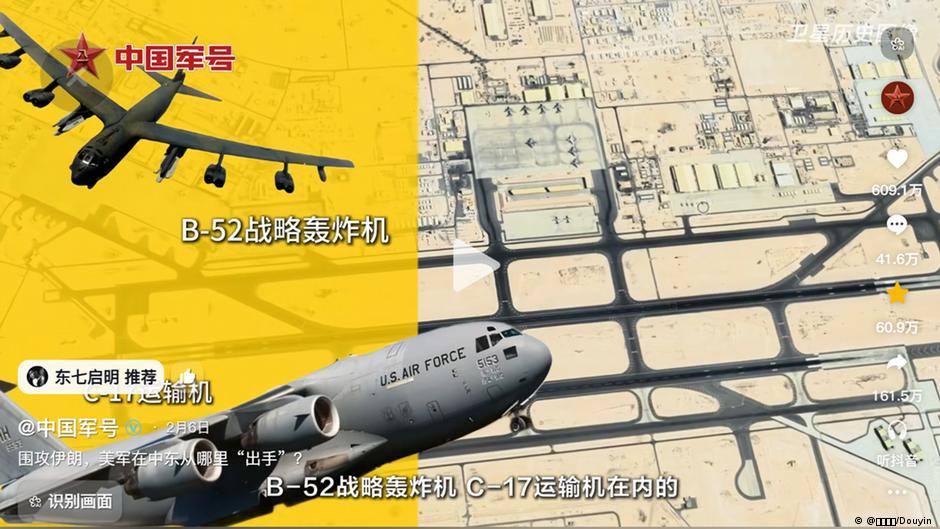
Domestic platforms like Douyin amplify these themes. Influencers such as “Jing Si You Wo” distill geopolitical tensions into nationalistic content, celebrating Iran’s resolve against US aggression. The Chinese military’s official account on the app also released a video analyzing US Gulf deployments using high-definition satellite imagery, amassing over 6 million likes. This engagement suggests public interest in dissecting US strategies through a Chinese lens.
Bachulska points out that Chinese political elites view global events through an existential rivalry framework. They frame every development as a chance to bolster the narrative that the US is a neo-imperial power. The “cat and eagle” animation concludes with a message of Chinese martial arts philosophy: “The ultimate essence of martial arts lies…”