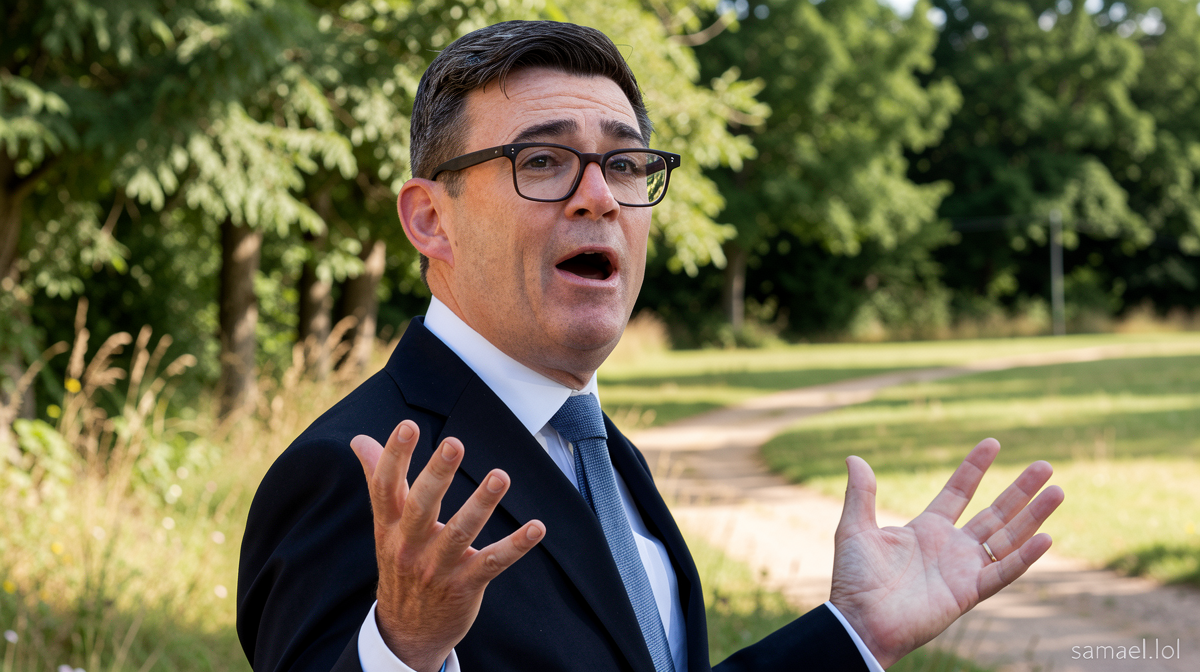
Andy Burnham’s Early Policy Decisions Signal His Vision for Leadership
Samael.lol – While Andy Burnham has maintained considerable silence regarding the specific policies he intends to implement upon assuming the role of prime minister, recent developments have shed light on his priorities and the type of leader he aspires to become. His inaugural declaration—delivered even before stepping through the threshold of Number 10—centered on tackling homelessness among those sleeping rough. In a message circulated to Labour party members shortly after his address, Burnham articulated his ambition with characteristic determination: “We are going to end rough sleeping in this country at the first opportunity.”
“People have told me it would take decades. Some say it’s impossible. I’m not having that.”
This bold commitment, communicated to both party members and supporters, serves as a window into the government he envisions leading. It represents a practical application of the “Manchesterism” philosophy he has championed throughout his political career. During his tenure as mayor of Greater Manchester, which began in 2017, eliminating rough sleeping became one of his central objectives. Although his target of completely eradicating the problem by 2020 remained unfulfilled, statistics demonstrate a substantial reduction compared to figures from a decade prior.
A Return to Authentic Labour Values
Beyond the practical implications, this announcement carries significant symbolic weight. It reinforces Burnham’s pledge to be “authentically Labour” by demonstrating his willingness to champion the interests of society’s most disadvantaged citizens. The policy is expected to resonate particularly strongly with Labour’s left wing, though it may also find support across the party spectrum. Notably, in 2023, former Labour leader Jeremy Corbyn disclosed similar intentions to make a comparable announcement on his hypothetical first day as prime minister.
Looking ahead to later in the week, Burnham is anticipated to modify the government’s approach to oil and gas extraction, with a newly appointed energy secretary now in position. While this shift may concern Labour MPs worried about electoral competition from the Green Party, many others will be monitoring whether this adjustment might weaken the government’s dedication to achieving net zero emissions.
Cost of Living and Economic Restructuring
Another significant commitment involves addressing the ongoing cost of living crisis, with additional details expected regarding the “breathing space” being offered to struggling households. Extending Manchester’s £2 bus fare cap represents a concrete policy measure that distinguishes Burnham’s approach from the £3 cap established under Keir Starmer and Rachel Reeves. Given that energy prices are climbing once more, further interventions in this sector appear likely.
Miatta Fahnbulleh, the former minister who has dedicated recent weeks to developing policy alternatives, brings valuable experience from her leadership of the New Economic Foundation think tank. This organization advocates for more ambitious cost of living interventions, ranging from implementing rent controls to providing completely free bus travel for individuals under the age of twenty-five.
“This, he tells Labour members and supporters, ‘shows you exactly what kind of government I intend to lead’.”
The critical question now concerns whether Burnham will transcend mere policy announcements to present a comprehensive vision. His speech suggested he would clarify the funding mechanisms for cost of living measures. He may also advance his broader argument—previously expressed in a Times interview—that income taxation remains excessively high while wealth taxation falls short. This could involve raising tax thresholds for basic rate taxpayers alongside increasing capital gains tax rates.
Burnham has committed to maintaining Rachel Reeves’s fiscal rules, which constrain both debt accumulation and borrowing capacity. Consequently, the approach will likely emphasize re-prioritising existing expenditure rather than introducing fresh financial resources. Nevertheless, this strategy communicates important information about his intended governance style.
On a broader scale, Burnham has deliberately avoided setting overly ambitious expectations. He has committed to nothing less than establishing a fundamentally new economic framework, moving away from the prevailing era characterised by centralisation, privatisation, and de-industrialisation. Just as the rough sleeping initiative signals his position to party members, he will soon need to introduce symbolic policies that reveal—simultaneously to voters and financial markets—the substantive economic reality underlying his radical rhetoric.
As Burnham prepares to become the first individual with his surname to occupy Number 10, his journey to this position has spanned decades of political service. His early policy choices suggest a leader determined to combine practical solutions with principled commitments, balancing immediate relief for struggling families with longer-term structural transformation.