I Survived a Missile Strike in the Strait of Hormuz, But My Friend Has Not Been Found
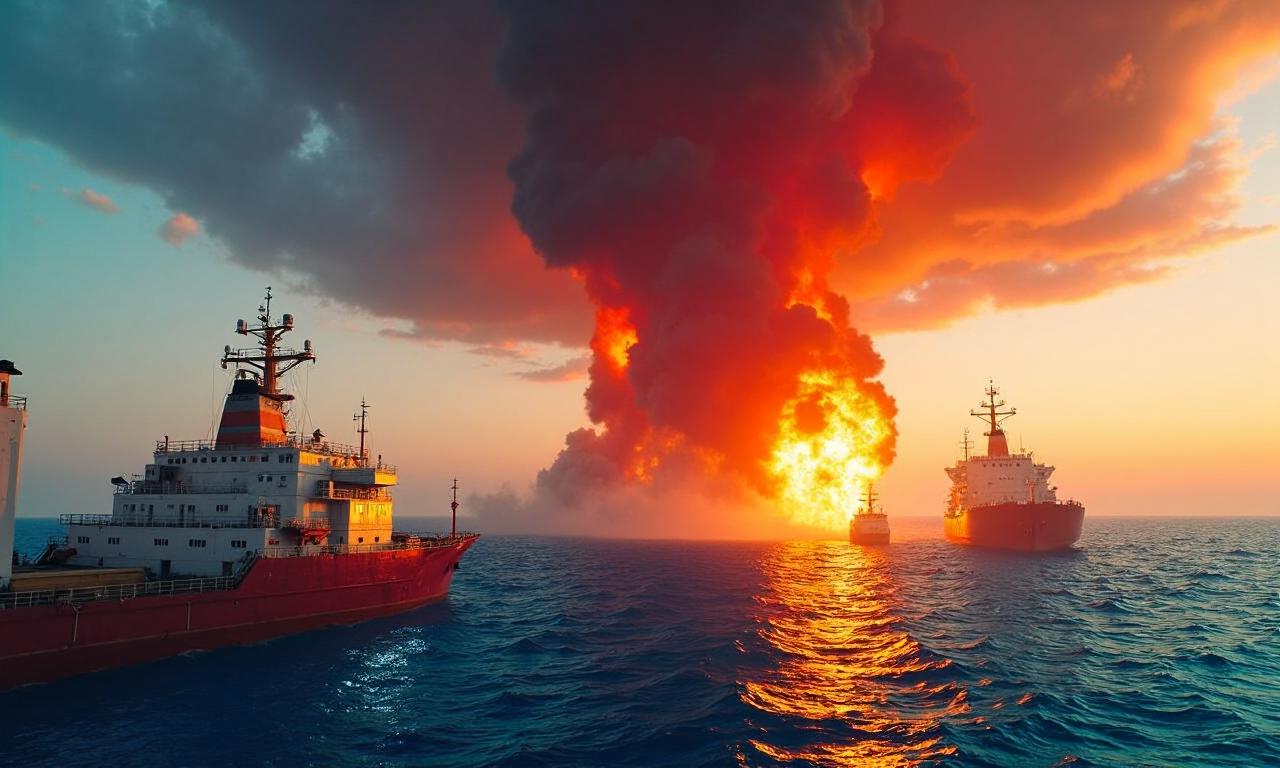
Samael.lol – On the early morning of 1 March, a missile strike shattered the calm of the Strait of Hormuz, a vital chokepoint for global maritime trade. Sunil Puniya, a 26-year-old seafarer, was working his first voyage at sea when the explosion rocked the oil tanker *Skylight*. At first, he thought the ship had suffered an engine failure, but as he stepped into the open air, another detonation confirmed the reality of the attack. The vessel, sanctioned by the United States, had departed from Dubai and was en route to the strategic waterway. This incident marked the first time a commercial ship was targeted in the region following the recent US-Israeli conflict with Iran.
The missile struck the engine room, igniting a fire that quickly engulfed the *Skylight*. Sunil, who was asleep in his cabin on the third floor, awoke to a scene of pandemonium. “There was a total blackout, and smoke filled the air like a storm,” he recalled in a statement to BBC Verify. “Everyone was struggling to breathe, and panic spread faster than the flames.” He described how sailors from South India, including himself, were overcome by fear. “Some were crying and dialing home frantically, but I told them to pause and help others move to the deck,” he said. Despite his efforts, the fire was already advancing when they reached the surface. “Oil spilled everywhere, and the flames were closing in,” Sunil added. “We had no choice but to leap into the sea.”
“As soon as I realized Dalip wasn’t with us, I felt the weight of the moment hit me,” Sunil said. “I kept wondering how I’d explain this to his family.” Dalip Rathore, 25, had joined the *Skylight* just a day before the attack. The two men were from nearby villages in Rajasthan and had become close friends. Sunil described Dalip as a calming presence, especially during the chaotic moments of the strike. “He was like a brother to me. In those stressful hours, he stayed by my side,” Sunil said.
Hours before the strike, Dalip had taken over Sunil’s watch in the engine room, the very area hit by the missile. Both Dalip and the ship’s captain, Ashish Kumar, perished in the blast. While some fragments of the captain’s remains were recovered, Dalip’s body remains missing. This tragedy highlights a growing pattern in the strait, where maritime conflicts have disrupted the flow of oil and gas. The attack on the *Skylight* was not an isolated event; according to maritime intelligence firm Kpler, 38 commercial vessels have been struck in and around the Strait since the conflict began. Of these, 24 were targeted by Iran, four by the US, and the rest are under investigation.
Stranded seafarers now face a new set of challenges. Over 20,000 crew members are reportedly trapped in the Gulf, according to the International Maritime Organization. The conflict has forced many ships to halt operations, leaving crews without clear paths to safety. Under maritime law, shipowners are legally obligated to ensure the well-being and repatriation of their workers. However, in practice, this responsibility often falls short. When owners fail to act, the burden shifts to the vessel’s flag state and, eventually, to port authorities.
The International Transport Workers’ Federation (ITF) has emerged as a critical lifeline for those in distress. The organization has received over 2,000 calls since the war escalated, detailing the struggles of seafarers stuck in the region. Issues range from unpaid wages to disputes over contracts, and from difficulty returning home to shortages of basic necessities like food and water. Mohamed Arrachedi, the ITF’s network coordinator for the Arab world and Iran, shared voice notes from three seafarers anchored on a small boat off Oman’s coast. In the recordings, the men pleaded for assistance, stating they had run out of provisions and hadn’t heard from their employers in months.
Arrachedi described the situation as a “cancer” affecting the industry, emphasizing how the abandonment of crews has become a recurring problem. The ITF defines abandonment as a scenario where shipowners desert their workers, leaving them without pay or essential resources. Last year, 6,223 seafarers were abandoned across 409 vessels. While this number may seem small compared to the 100,000-strong maritime workforce globally, it underscores a systemic failure in crisis management. For those stranded in the Strait of Hormuz, the consequences are dire. Without access to fuel or supplies, many ships are forced to remain anchored for extended periods, their crews enduring uncertain conditions.
As the conflict continues, the psychological toll on seafarers grows. Sunil, who narrowly escaped with his life, now carries the guilt of losing his friend. “I can’t stop thinking about Dalip. How will his family cope without him?” he asked. His words reflect a broader sentiment among those affected by the war. The Strait of Hormuz, once a symbol of maritime stability, has become a theater of unprecedented disruption. For every ship that manages to reach safety, others remain in limbo, their crews fighting for survival in a sea of uncertainty.
Maritime law, while designed to protect workers, has proven insufficient in the face of escalating tensions. The responsibility of ensuring crew welfare has become a shared burden, but the system is strained by the scale of the crisis. As the ITF and other organizations work tirelessly to assist stranded seafarers, the question remains: how long will this situation persist? For Sunil Puniya, the answer is still unclear. His friend Dalip Rathore’s fate, like that of hundreds of others, hangs in the balance as the world watches the Strait of Hormuz become a battleground for both nations and the men who navigate its waters.