Not a Robot – Sinner Had ‘No Energy’ in Shock Defeat
Samael.lol – Italian tennis star Jannik Sinner faced one of the most astonishing early exits at the French Open in recent memory, falling to Juan Manuel Cerundolo in the second round. The 24-year-old world number one, who had been in scintillating form on clay, was unable to recover from a sudden physical slump, handing the Argentine a surprise victory that rattled the men’s draw. Sinner’s loss marked the first time since the 2023 French Open that he had failed to advance past the first week of a Grand Slam, a rare stumble in a season that had seen him dominate the ATP circuit with a 30-match winning streak.
The Heat’s Role in the Setback
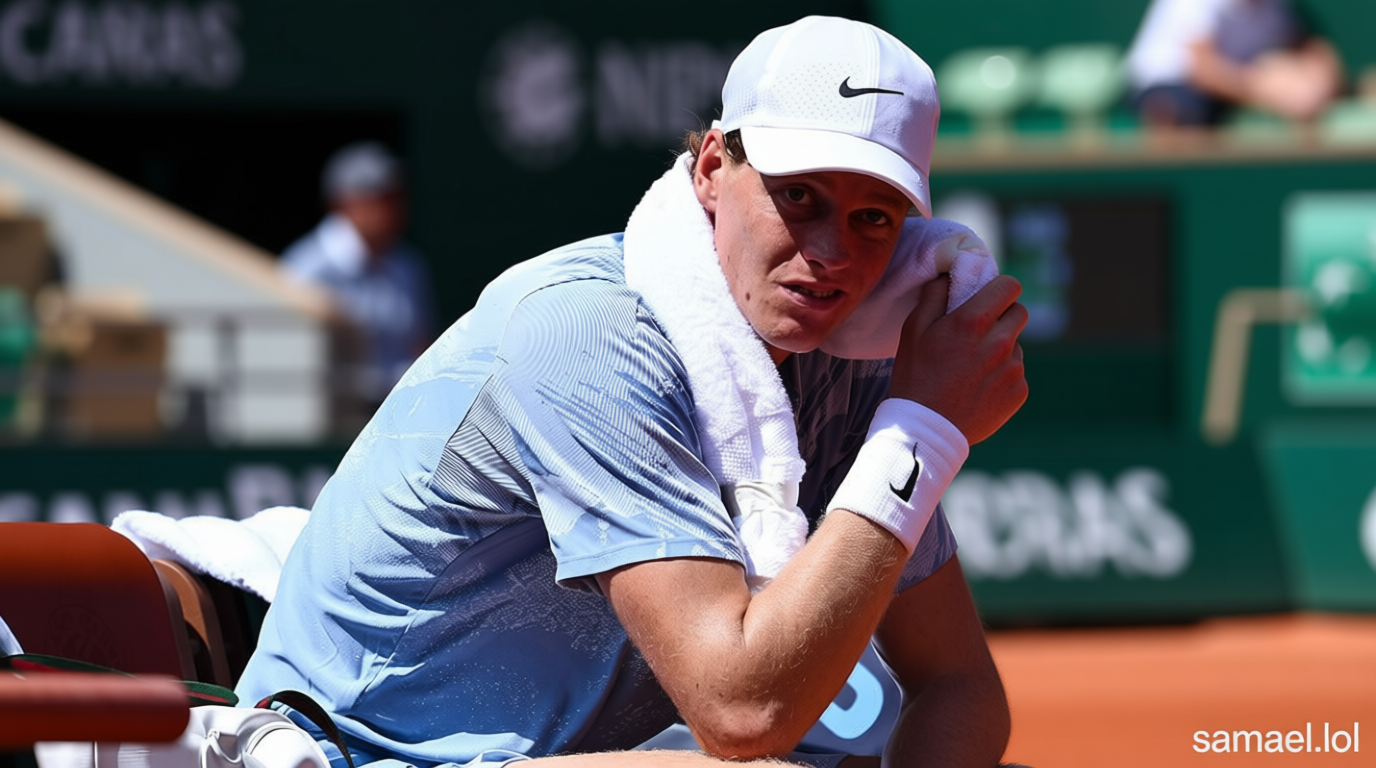
Paris’s sweltering temperatures, which hit a peak of around 34°C during the tournament, had been a topic of discussion among players before the match. Some had cited the heat as a factor in their struggles, but Sinner dismissed this notion, insisting the conditions were not the primary cause of his performance decline. “I had no energy today. That can happen. Nobody is a robot,” he said after the match, reflecting on his physical state. His early morning discomfiture, he explained, had already hinted at the challenges he faced, leading him to focus on short, sharp points to conserve stamina.
“I woke up this morning, didn’t feel very well and tried to keep points very short. In the beginning I was hitting very clean, very good, and then I just hit a wall. I started feeling dizzy. Very low on energy. I tried to serve it out but I didn’t have a lot of energy.”
Sinner’s pre-match confidence was unshakable, having built a reputation as one of the most formidable players on clay. His 6-3, 6-2, 5-1 lead in the third set seemed to confirm that. But as the match progressed, the Italian began to falter, his movement becoming sluggish and his rhythm disrupted. By the fourth set, he had resorted to calling for the trainer, describing his symptoms as “dizzy” and “wanting to vomit.” The medical timeout, taken mid-game, left him visibly exhausted, and he was unable to regain his footing, ultimately conceding the match to a player ranked outside the top 100.
Sinner’s Response to the Shock
Despite the dramatic turn of events, Sinner remained composed in his analysis. “It was warm, but not crazy warm. I feel like it was quite OK to play,” he remarked, emphasizing that the issue was personal. The loss was not a direct result of the heat, he argued, but a culmination of a momentary dip in his physical and mental state. “It was just me today, but it happens.” This sentiment underscored his resilience, even as the result cast doubt on his ability to maintain peak performance in high-stakes matches.
Sinner’s prior struggles with extreme conditions had been noted, particularly during his third-round victory at the Australian Open against Eliot Spizzirri. Yet, this French Open defeat felt more profound, especially given the magnitude of the occasion. The Italian had arrived in Paris in untouchable form, having won all five ATP Masters 1000 events on clay since April. His dominance in Monte-Carlo, Madrid, and Rome had positioned him as a clear favorite for the title, and his early exit seemed to signal a significant shift in fortune.
A Historical Parallel
The shock of Sinner’s loss echoed the 2009 French Open, when Rafael Nadal, then a dominant force, was ousted in the fourth round by Robin Soderling. That defeat, Nadal’s first at Roland Garros in five years, had been a seismic moment in tennis history. Similarly, Sinner’s collapse against Cerundolo—his first loss in 2026 on clay—highlighted the unpredictability of Grand Slam tournaments. However, the comparison was more than symbolic. Cerundolo, who had yet to defeat a top-ten player in prior encounters, had become the heavy favorite with bookmakers since the absence of Sinner’s main rival, Carlos Alcaraz, due to injury.
The match itself was a masterclass in the underdog story, with Cerundolo capitalizing on Sinner’s fatigue to take control. After leading 5-1 in the third set, Sinner lost 24 of the next 27 points, a sequence that exposed his vulnerability. The Argentine’s ability to push through the Italian’s strong start demonstrated a tactical and physical brilliance that left fans and analysts stunned. Sinner’s first-serve percentage dropped to 47% in the fourth set, and he managed just 18 points in the final two sets, marking a stark contrast to his usual efficiency.
Consistency Under Fire
Sinner’s performance in the decider revealed a worrying trend in his consistency. This was his 12th defeat in 18 matches that had reached a fifth set, a statistic that highlighted his ability to grind out victories but also his fragility under pressure. The loss to Cerundolo added to a recent string of challenges, including a semi-final defeat to Djokovic in Australia and a French Open final where he squandered three championship points against Alcaraz. While the match against Cerundolo lasted three hours and 36 minutes, it marked his first four-hour encounter in seven attempts, raising questions about his endurance and focus.
The Italian’s physical condition had been a concern throughout the tournament. Though he had previously battled illness in the Australian Open, the current situation appeared more severe, with his energy levels plummeting to a degree that affected his ability to execute. His unforced errors soared, with 43 of the 64 mistakes occurring in the final three sets—a testament to the strain he was under. “It was nothing against the heat, nothing against the weather. It was just me today,” he reiterated, acknowledging the role of personal factors in his downfall.
For Sinner, the loss was more than an individual setback; it was a blow to his ambitions of completing the career Grand Slam. The Italian had been on a trajectory to challenge Nadal’s supremacy at Roland Garros, and the defeat left him with a mountain to climb. Yet, even as the shockwaves of the result rippled through the tennis world, Sinner’s words suggested a determination to learn from the experience. “I can’t say I was at my best. But I’m not done,” he added, hinting at the resilience that had carried him through previous trials.
The Road Ahead
Cerundolo’s victory over Sinner not only shook the men’s draw but also underscored the unpredictable nature of tennis at the highest level. The Argentine, once an outsider, had seized the moment with precision, while Sinner’s performance offered a glimpse into the challenges of maintaining peak form across multiple Grand Slam tournaments. As the French Open progressed, the Italian would need to address his energy issues and rebuild his confidence, a task that would test his mental fortitude as much as his physical readiness. The tournament, however, was far from over, with Sinner’s exit setting the stage for a new chapter in the men’s tennis narrative.
With the Italian’s absence, the draw opened up for other contenders to emerge, but Sinner’s defeat also served as a reminder of the importance of consistency. The 30-match winning streak was a remarkable achievement, yet it had been broken by a combination of factors—physical exhaustion, mental lapses, and the sheer pressure of the moment. As the tournament continued, the focus would shift to how Sinner would bounce back,