‘Mums thank me for changing the narrative’: How motherhood in rugby has evolved
Redefining Motherhood in Rugby: A Shift in Perspective
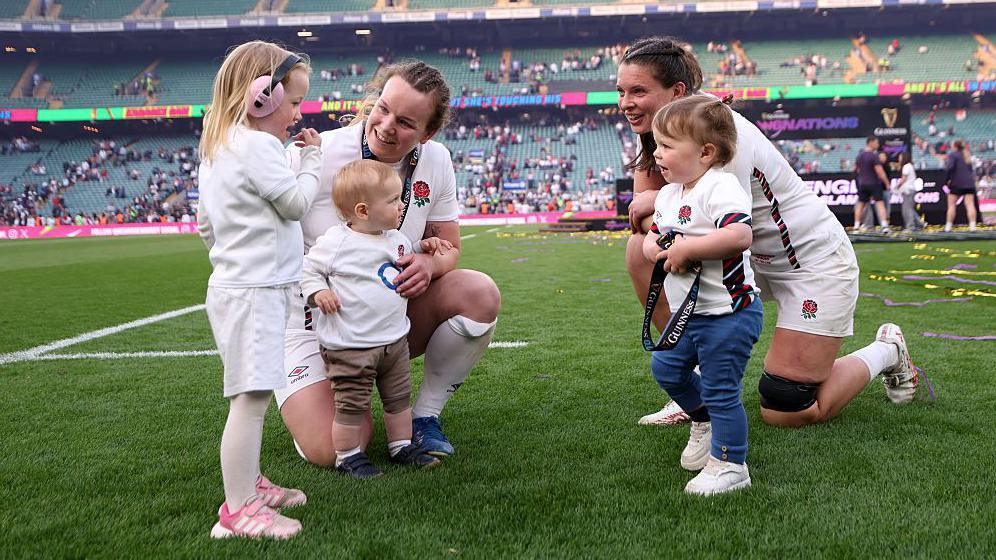
When Abbie Ward stepped onto the pitch at Allianz Stadium, cradling the Women’s Rugby World Cup trophy and her newborn daughter Hallie, it sparked a conversation among her teammates. Lark Atkin-Davies, a fellow player, recalled the moment as a pivotal one that reshaped her understanding of balancing motherhood with a professional rugby career.
Ward, a lock forward, is set to welcome her second child this year. Her return to international rugby in 2024 marked a milestone, making her the first England contracted player to resume competition after childbirth since the Red Roses transitioned to professionalism in 2019. At 33, she reentered the sport just 17 weeks postpartum, eventually playing a key role in the 2025 World Cup final. Her performance, including a crucial try, demonstrated that motherhood need not precede a rugby career.
Atkin-Davies, who became a parent in December 2025, cited Ward’s resilience as inspiration. “Witnessing Abbie’s journey with Hallie was the moment I realized it’s possible,” she shared. “I always dreamed of being a mum, but I didn’t know how it would coexist with rugby. Now, I’m eager to try it.” Both players aim to return to action this summer, reflecting a growing trend among female athletes in the sport.
The Evolution of Maternity Support in Rugby
Following the Rugby Football Union’s 2023 policy overhaul, players now receive 26 weeks of fully paid leave, with travel and accommodation expenses covered for their children within a year of birth or adoption. A “support person” can accompany them during games or training, and options exist for infants to stay home while parents attend matches. This shift has fostered optimism, with many mothers expressing gratitude for redefining expectations.
“The guidance has evolved from what it once was. Women can do so much more than people assumed,” Ward emphasized.
The new policy, shaped with input from the Rugby Players’ Association and players themselves, addresses past shortcomings. Vickii Cornborough, a former England prop, highlighted how the previous system was “not fit for purpose.” After giving birth to twins, the 74-cap player retired at 34, stating she wasn’t mentally prepared to return. Her experience underscored the need for better support structures, which the updated policy now provides.
A New Generation of Rugby Mothers
As the Women’s Six Nations tournament approaches, players like Ward and Atkin-Davies are proving that motherhood and rugby can thrive together. Their presence in training camps, alongside teammates, challenges traditional notions of career interruption. “Our normal is different from the average person’s,” Ward noted, “and that’s what makes it possible.” With growing confidence in their ability to manage both roles, more athletes are embracing this dual identity.
Scotland v England Women’s Six Nations match on Saturday, 18 April, kicks off at 13:30 BST at Murrayfield Stadium. Coverage will be available on BBC Two, iPlayer, and online, with updates on BBC Radio 5 Live and BBC Sounds. Live text and video highlights will also be posted on the BBC Sport website and app.