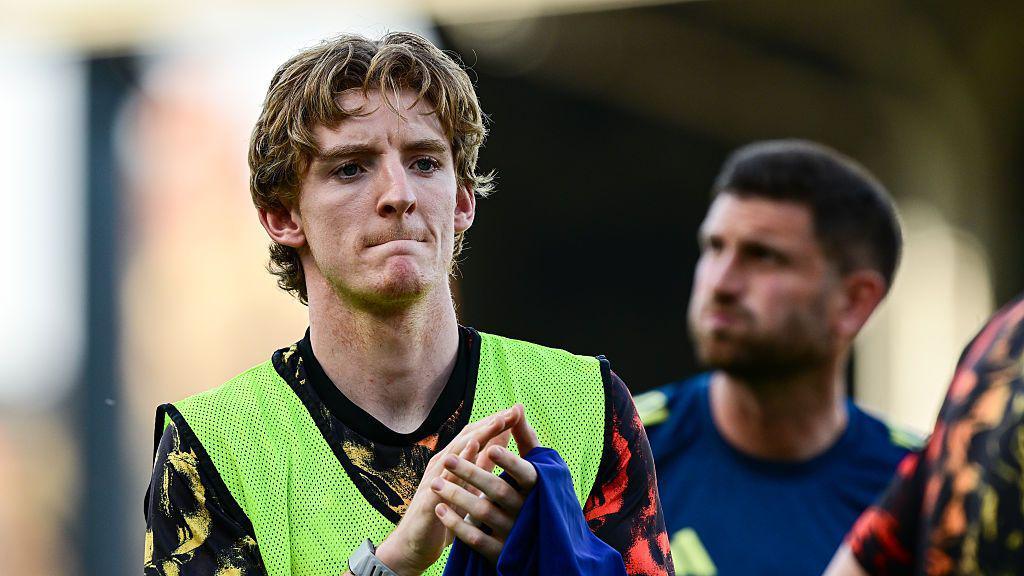
Were Arsenal right to be ‘fuming’ with refereeing after Atletico draw?
Samael.lol – Arsenal’s Champions League encounter with Atletico Madrid ended in a 1-1 draw, but the match was far from a straightforward affair. The game, played at the Rojas Stadium, became a focal point for debate over penalty decisions, with the Gunners’ manager Mikel Arteta expressing frustration at how a key moment was overturned by the video assistant referee (VAR). While the result may seem balanced, the narrative around the three penalties awarded during the tie revealed stark contrasts in officiating standards, leaving questions about the fairness of the decisions.
The first half saw Arsenal take an early lead through Viktor Gyokeres, whose penalty goal came after he was brought down in the penalty box by Atletico’s defenders. The second half then brought an equalizer for Atletico, awarded to Julian Alvarez following a handball incident involving Ben White. But the most contentious moment occurred in the closing stages when Eberechi Eze was penalized for a handball, only for the decision to be reversed after VAR review. This reversal left Arteta visibly irritated, as he argued the ruling had a decisive impact on the game’s outcome.
“There is no clear and obvious error,” Arteta said, shaking his head. “And this changes the course of the game. And at this level, I’m sorry but this cannot happen.”
The referee, Danny Makkelie, initially signaled a penalty for Eze after David Hancko made contact with his arm. However, upon reviewing the footage, VAR officials intervened, calling the decision into question. Arteta took issue with the lack of clarity in the explanation, suggesting that referees should have more confidence in their initial calls. “A very clear explanation of the decision and what happens for a period of time, a referee has to watch it 13 times,” he said. “What’s more clear than that? It’s impossible, and we are all fuming about it.”
Arsenal’s disappointment was not entirely unfounded. The incident echoed a similar one in their Premier League clash against Bayer Leverkusen, where a late penalty was awarded despite minimal contact. In that case, Noni Madueke went down under a challenge from Malik Tillman, and the England international’s arm was only slightly outstretched when the ball hit it. Uefa’s officials defended the decision, stating that the contact was sufficient to warrant a penalty under their rules. The parallels between the Leverkusen incident and the Atletico penalty raised concerns about consistency in handball rulings across competitions.
The difference in interpretation between the Premier League and Uefa became a central point of discussion. In the Leverkusen match, the contact was slight, yet the penalty was awarded. Conversely, in the Atletico game, the handball by Ben White was more obvious, yet the decision to award the penalty was reversed. This discrepancy highlights the nuanced nature of handball rules, particularly when the ball’s trajectory is altered by a deflection. Uefa’s criteria for a penalty include a clear change of direction, which they argue justifies the on-field decision. However, the Premier League tends to be more lenient in such scenarios, allowing referees greater discretion.
Arteta’s frustration stemmed from the belief that the VAR system should not override a referee’s judgment unless there is a glaring error. He pointed to the Madueke incident as an example of a case where the on-field decision was correct, yet the same logic was not applied to Eze’s handball. “If you are saying the Madueke decision should stay, then the same should apply to Eze,” he emphasized, suggesting that the standards for penalties in Europe are more rigid than in the Premier League.
The handball controversy has been a recurring theme in recent matches, with fans and analysts alike questioning the consistency of VAR interventions. In both the Leverkusen and Atletico games, the ball deflected off a player’s body before hitting their arm, creating a scenario where the natural direction of the ball was altered. While these situations are often flagged for penalties, the threshold for a clear error seems to vary depending on the competition. This variation has sparked debates about whether the rules are being applied fairly or if the system is becoming overly technical.
Arsenal’s defender Gabriel was another figure of discussion, as his missed penalty in a previous match against Newcastle highlighted the challenges of applying the same standards across different contexts. During that game, Gabriel’s arm was raised high as he slid into the ball, and the deflection off his body was minimal. If the same criteria were used in the Atletico game, a penalty should have been awarded. Arteta’s comments suggest that such instances are often overlooked, leading to frustration among managers and players.
The use of VAR in high-stakes matches has become increasingly polarizing. While its introduction was intended to reduce errors, it has also introduced new layers of scrutiny. In the Atletico game, the decision to reverse Eze’s penalty was met with mixed reactions, with some supporters arguing it was a necessary correction and others criticizing the lack of transparency. The question remains: how much leeway should referees have, and when does VAR’s involvement become a disruption rather than a benefit?
As the Premier League side prepares for the next leg of their Champions League campaign, the focus will remain on the balance between accuracy and fairness. The on-field decisions, though sometimes contested, are part of the game’s essence, and VAR’s role is to support them, not replace them. However, the Arsenal case has shown that even the smallest variations in handball interpretation can have significant consequences, particularly in knockout stages where a single moment can define a team’s fate.
The Debate Over Consistency in Penalty Calls
While the rules governing handball and deflection are standardized, their application can feel subjective. Uefa’s approach, which prioritizes a clear change of trajectory, is stricter compared to the Premier League’s more forgiving stance. This difference is evident in the Eze penalty case, where the arm’s position and the deflection’s impact were debated. If the Premier League had been in charge, the decision might have stood, underscoring the argument that referees should not be second-guessed so aggressively.
Arteta’s criticism reflects a broader concern about the pressure on officials in Europe’s top competitions. The expectation for perfection in penalty decisions has led to a situation where even minor doubts are amplified, resulting in overturns that may not always be justified. For Arsenal, this has been a painful lesson, as the VAR system’s intervention in their favor earlier in the season now appears to have left them on the losing end of a pivotal moment. The result of the first leg, though a draw, may ultimately be influenced by the decisions made in the second half, with the Gunners left to ponder whether the referee’s call or the VAR’s review was the correct one.
As the Champions League progresses, the scrutiny on refereeing decisions will only intensify. The contrast between the Leverkusen and Atletico cases serves as a reminder that the same rulebook can be interpreted differently, depending on the competition and the officiating body. For Arsenal, the fuming reaction is not just about a single missed penalty but about the broader implications of how decisions are made and reviewed at the highest level of European football. Whether the system is fair or not, it is clear that the Gunners are determined to challenge the interpretation of their fate in the second leg.