EU applauds Hungary’s election result
EU applauds Hungary’s election result
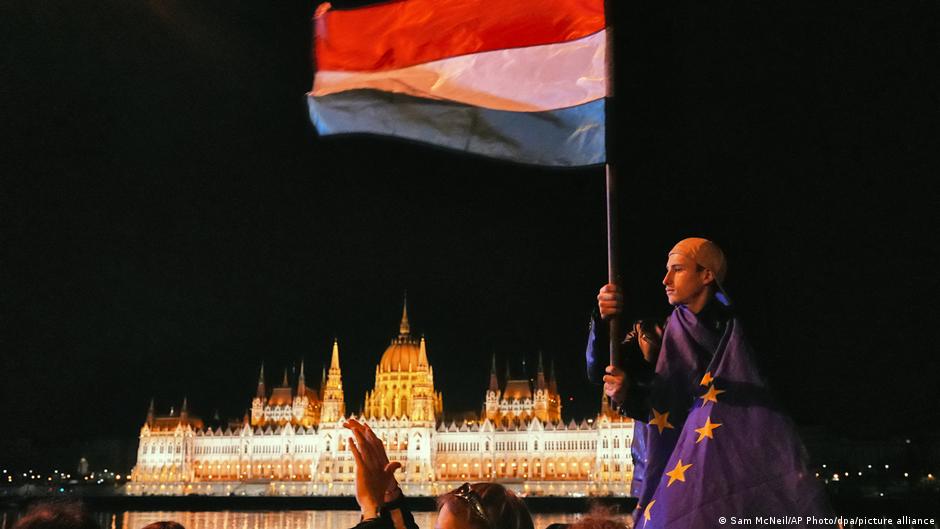
The opposition’s triumph in Hungary’s recent election has rekindled optimism in Brussels about a potential shift in the nation’s stance toward European integration. With Viktor Orban’s 16-year rule ending, the focus now turns to Peter Magyar as a new leader, signaling hopes that Hungary might move away from its previous resistance to EU policies. This change could strengthen the bloc’s cohesion, especially in light of past tensions over governance and foreign affairs.
A New Chapter for Hungary
European Council President Antonio Costa highlighted the significance of the election, calling the high voter turnout a reflection of Hungary’s “democratic spirit.” He expressed anticipation for “close” collaboration with Magyar to bolster Europe’s unity and economic strength. Similar praise followed from other EU leaders, including French President Emmanuel Macron, who noted the result underscored the Hungarian people’s commitment to “the values of the European Union.”
“Tonight, Ursula von der Leyen celebrated the shift in Hungary, declaring, ‘Europe’s heart is beating stronger in Hungary.’”
German Chancellor Friedrich Merz emphasized that the election demonstrated “no irreversible trend toward authoritarianism,” while Polish Prime Minister Donald Tusk shared his own joy, suggesting he might be even more elated than Magyar. Despite this, Italian Prime Minister Giorgia Meloni extended congratulations to Orban, referring to him as her “friend” and acknowledging his “intensive cooperation” over recent years.
The Czech and Slovak prime ministers, often aligned with Orban, also praised Magyar’s victory, though their support may not fully align with Brussels’ expectations. The election marks a pivotal moment in the EU-Hungary dynamic, which has been strained since 2015 when Jean-Claude Juncker famously dubbed Orban “hello dictator” during a summit.
Ukraine Loan and Future Stances
Magyar’s campaign promises include positioning Hungary as a dependable ally within NATO and the EU. His first challenge will be securing approval for the 90-billion-euro loan package for Ukraine, a decision the EU made in December 2026. Hungary, along with the Czech Republic and Slovakia, is exempt from financial liability. Officials in Brussels anticipate Magyar will facilitate the payments, though they remain cautious about his long-term alignment with Ukraine’s cause.
Julia Pocze, a rule-of-law expert at the Centre for European Policy Studies, noted that there is no evidence Magyar intends to obstruct the loan. She projected the package would be approved by late May, pending a transition period. However, analysts caution that Magyar’s position on Ukraine may not be entirely supportive, given his past opposition to arms deliveries.
“I am so happy,” said Donald Tusk, as he shared a video on X appearing to show him on the phone with Magyar. “He might be even happier than I am.”
Brussels is closely monitoring Magyar’s approach to Ukraine’s potential EU membership, recognizing his dual role as a European Parliament member and a conservative politician. While not openly pro-Russian, he could adopt a “neutral stance,” according to Pocze, avoiding direct opposition to EU and NATO backing without fully endorsing arms shipments. This balance may define Hungary’s future role in the bloc.