Why Brazil is in focus at Germany’s Hannover Messe?
Why Brazil is in focus at Germany’s Hannover Messe?
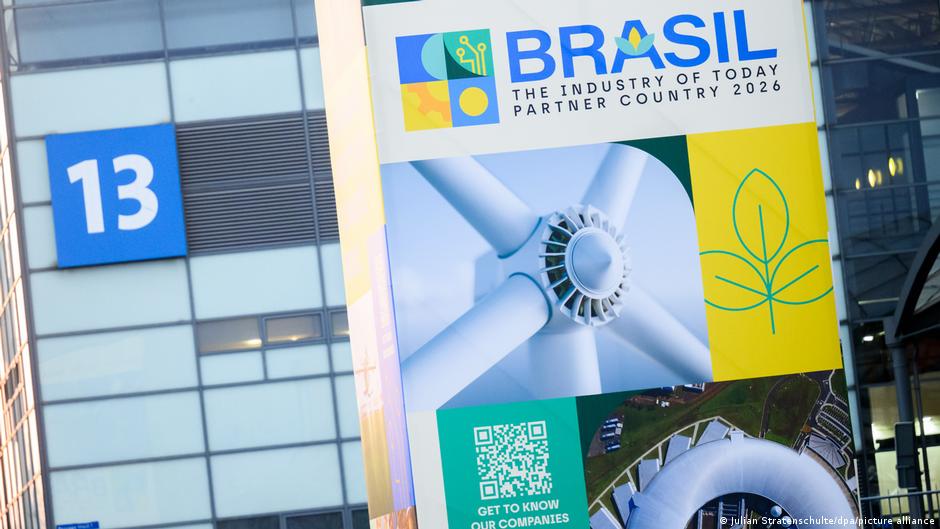
The Hannover Messe 2026, the world’s largest industrial trade fair, begins in Hannover, Germany, on April 20. This year, Brazil has been designated as the partner nation, aiming to showcase its technological advancements beyond traditional agricultural exports. With the war in Iran temporarily paused, the event underscores global priorities in energy and innovation.
“Our objective is to demonstrate Brazil’s dual role as a major agricultural producer and a key player in industrial technology,” said Patricia Gomes, representing the Brazilian Trade and Investment Promotion Agency. She emphasized the nation’s commitment to leading in green, digital, and resilient sectors such as renewable energy and electric mobility.
Brazil has already solidified its position as a leader in Latin America’s electric vehicle market, with smart charging infrastructure expanding rapidly. Last year, over 224,000 electric cars were registered, marking a 40% surge from the prior year. This growth aligns with the trade fair’s emphasis on energy efficiency and sustainable solutions.
“In light of current geopolitical dynamics, energy security and alternative solutions are taking center stage,” noted Onuora Ogbukagu, a trade fair spokesperson. She highlighted how the event reflects the increasing importance of stable energy systems.
Over 4,000 exhibitors from 60 nations will showcase innovations at the fair, featuring industry giants like Amazon Web Services, Bosch, Siemens, and Microsoft. Brazil’s participation includes more than 300 companies, reflecting its growing industrial footprint. The upcoming EU–Mercosur free trade agreement, set to take effect on May 1, is anticipated to further boost Brazil’s economic ties with Europe.
Despite optimism, the global economy faces uncertainty. A recent Ifo Institute survey revealed that 78.6% of German firms struggle to predict future growth, with 87.7% in manufacturing citing similar concerns. Amid this, only India has achieved growth above 6% in the five largest economies, while China’s expansion slows to around 4.5%. Brazil’s projected 1.6% growth for 2026 contrasts with these figures, yet its industrial progress remains notable.
Several Brazilian firms are leveraging the fair to highlight their advancements. Harting, a German company specializing in connectivity solutions, partners with Brazilian firms in electric vehicle infrastructure. SEW Eurodrive, a global drive technology leader, and WEG, a manufacturer of electric motors and charging systems, are also exhibiting. Brazil’s largest machine tool producer, ROMI, reported an 8% growth in 2025, with two of its 13 facilities now located in Germany following its 2012 acquisition of Burkhardt+Weber.
“I’m certain our German colleagues appreciate a touch of Brazilian flair,” remarked Luiz Cassiano Rosolen, ROMI’s head, referencing the company’s integration of the German firm. Back in Brazil, he added, the move is celebrated as a “Porsche of machine toolmakers” joining the ROMI team.