Taiwan Opposition Leader Makes Rare Visit to China
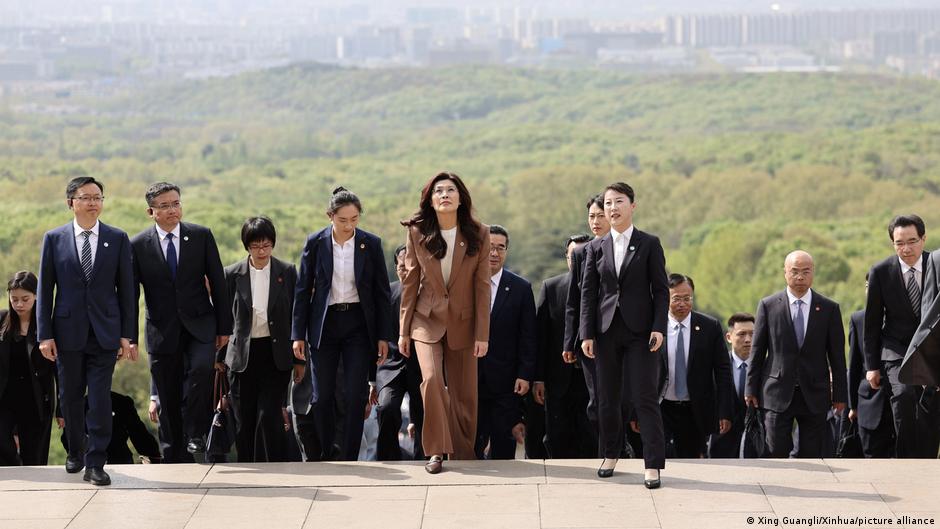
Samael.lol – Cheng Li-wun, the leader of Taiwan’s Kuomintang (KMT) party, embarked on a significant trip to Nanjing, a city steeped in historical importance. The visit, laden with symbolic meaning, included a stop at the mausoleum of Sun Yat-sen, the father of modern China. During her address there, Cheng emphasized the need for “reconciliation and unity” between Taiwan and Beijing.
Cheng’s journey to China followed an invitation from President Xi Jinping in March. She expressed hope for a meeting with Xi, though no official confirmation has been released. The KMT, historically advocating closer ties with mainland China, is the first of its leaders to set foot on the mainland in over ten years. This comes amid growing tensions with Taiwan’s ruling Democratic Progressive Party (DPP), whose leadership Beijing does not acknowledge.
Sun Yat-sen’s Legacy
At the mausoleum of Sun Yat-sen, Cheng highlighted his enduring significance. Revered in both Taiwan and the mainland, Sun is credited with toppling China’s last imperial dynasty in 1912, laying the groundwork for the revolutionary changes led by Mao Zedong. In Taiwan, he is officially recognized as the “father of the nation.”
“Likewise, on the mainland, we have also seen and witnessed progress and development that exceeded everyone’s expectations and imagination,” Cheng remarked, her words broadcast by Taiwanese media.
Military Tensions and Cross-Strait Dynamics
Since 2016, when the DPP’s Tsai Ing-wen won the presidency and openly challenged Beijing’s claims over Taiwan, high-level interactions between the two sides have ceased. Cross-strait relations have since worsened, with Xi Jinping’s administration not ruling out military action to unify the island under direct rule.
China conducts frequent large-scale military exercises near Taiwan, involving fighter jets and warships, often simulating a potential blockade. The National Security Bureau’s director, Tsai Ming-yen, warned that these maneuvers aim to instill psychological pressure on Taiwan’s population and destabilize the region.
“This is intended to make Taiwan’s society and public feel the psychological pressure and anxiety of a possible conflict,” Tsai said. “It aims to divide Taiwanese society internally, boosting the visibility of pro-China positions.”
The DPP’s spokesperson, Wu Cheng, criticized the KMT’s stance, arguing that stability across the strait requires action on defense spending. “Peace has never come from the charity of dictators; it must be safeguarded by Taiwan’s own strength,” Wu stated.
Lai Ching-te’s government has urged Cheng to convey to Beijing officials, including Xi, the necessity for China to halt its military aggression and respect Taiwan’s right to self-determination. Despite these calls, Cheng sought to temper the current climate of discord, asserting that war between the two sides is not inevitable.
“The two sides of the Taiwan Strait are not doomed to war, as the international community has feared,” Cheng said. “I hope that today we plant the seeds of peace not only for Chinese people on both sides of the Strait, but for all humankind.”