India Observes U.S.-Iran Peace Talks in Islamabad
Samael.lol – As the U.S. and Iran convene in Islamabad to discuss a potential truce, India’s political opposition is criticizing Prime Minister Narendra Modi’s administration for a perceived decline in the nation’s foreign policy. Meanwhile, Modi is campaigning in West Bengal, a region where his Hindu nationalist party has historically struggled to secure victories. The developments have sparked mixed reactions among Indians, with some viewing Pakistan’s role as a mediator as a challenge to India’s global standing.
Historical Rivalry and Tensions
India and Pakistan, once unified under British colonial rule, have maintained a contentious relationship since independence. Their rivalry has intensified over decades, marked by four major wars and multiple border skirmishes. A significant turning point occurred in May 2025 when an attack on civilians in Indian-administered Kashmir triggered cross-border missile and drone strikes, straining relations to their lowest point. India has consistently accused Pakistan of backing terrorism, a claim Islamabad has repeatedly contested.
Indian Foreign Minister S. Jaishankar previously labeled Pakistan’s military leadership as a ‘dalal,’ a term carrying negative implications. However, the current peace talks have positioned Pakistan’s Army Chief Field Marshal Asim Munir as a key figure for U.S. President Donald Trump, raising questions about the evolving dynamics between the two nations.
Domestic Political Climate
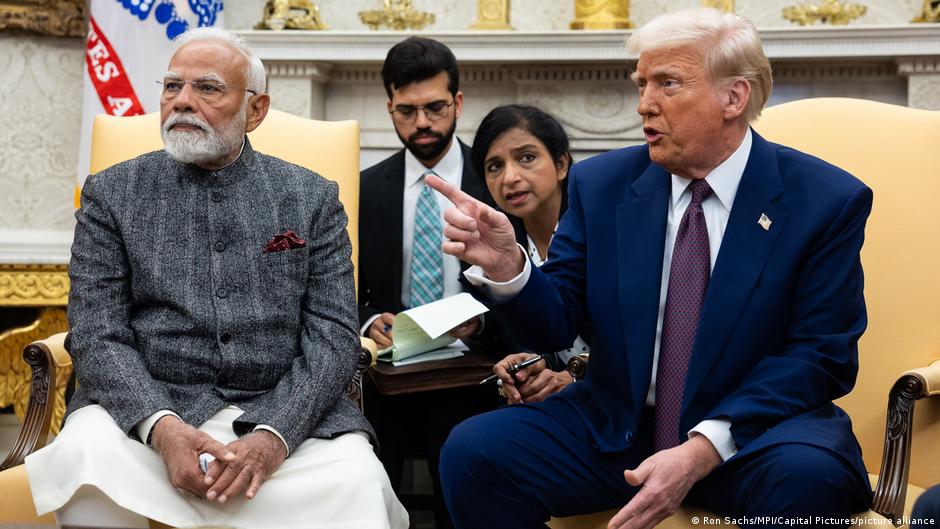
The discussions in Islamabad come amid a turbulent year for U.S.-India relations. Despite strong ties in trade, defense, and technology, recent diplomatic disputes—such as U.S. trade tariffs, Trump’s assertion of brokering peace between India and Pakistan, and New Delhi’s engagement with Russia—have impacted India’s reputation as a diplomatic leader. The Indian National Congress (INC), the country’s largest opposition party, has criticized Modi’s government, arguing that its policies have allowed Pakistan to gain influence in Asia’s great-power dynamics.
“The government’s incompetence has permitted Pakistan to assert itself as a critical mediator in the region, granting it leverage over India through third parties,” stated the INC in a recent press release.
Akhilesh Yadav, a prominent opposition leader, echoed similar sentiments, calling the BJP’s tenure “ruined our foreign policy.” “India was once poised to become the world guru, but Pakistan is now strengthening its international presence,” he remarked after the U.S. and Iran agreed to a temporary ceasefire.
India’s Strategic Position
Jaishankar, who has defended the government’s stance on Pakistan in previous meetings, remained silent on the mediator’s role in the current talks. A Foreign Ministry spokesperson, Randhir Jaiswal, acknowledged the ceasefire, emphasizing India’s support for deescalation and diplomacy. “Our advocacy for dialogue has always been central to resolving conflicts,” he said, without addressing Pakistan’s emerging diplomatic significance.
As the mercury rises in New Delhi after a month of cooler weather, India’s political landscape is also heating up. Two major states, including West Bengal, are preparing for crucial assembly elections in late April. Modi’s visits to the region highlight his efforts to bolster support despite his party’s historical challenges there.
With the focus on international diplomacy, domestic concerns such as irregular immigration and local governance issues remain unresolved. The upcoming polls will test the BJP’s ability to maintain momentum, even as tensions over Pakistan’s growing influence persist.