Germany’s Buchenwald: Remembering Nazi atrocities
Samael.lol – Buchenwald, one of Germany’s most significant concentration camps, marked its 81st anniversary of liberation this year. The event drew a mix of solemn remembrance and public dissent, with attendees reflecting on the horrors endured by prisoners and confronting modern political tensions. Among the speakers was Hape Kerkeling, a well-known comedian and author, who shared a deeply personal account of his grandfather Hermann Kerkeling, a Holocaust survivor.
A Family’s Legacy of Resistance
Kerkeling described his grandfather as a quiet yet determined figure—a carpenter from Recklinghausen who became a symbol of resilience. “He rarely spoke, yet his actions spoke volumes,” the actor noted, recalling Hermann’s role in distributing anti-Hitler leaflets shortly after the Nazis took power in 1933. This act of defiance cost Hermann twelve years of his life in the camp, where nearly 56,000 prisoners lost their lives by April 1945, succumbing to torture, murder, exhaustion, or despair.
“A leaden silence. That booming silence was like a glass wall surrounding his soul,” Kerkeling reflected, emphasizing the emotional weight of his grandfather’s unspoken grief.
The Buchenwald system, spanning the main camp on Ettersberg and over 50 satellite sites linked to wartime industries, held more than 250,000 individuals. Political dissidents, Jews, Roma, and others targeted by the regime were imprisoned there from 1937 until its liberation. On April 11, 1945, as U.S. tanks approached, prisoners organized a resistance that led to the capture of numerous SS soldiers, symbolizing both the camp’s end and the prisoners’ own liberation.
Decline of Survivors and Political Challenges
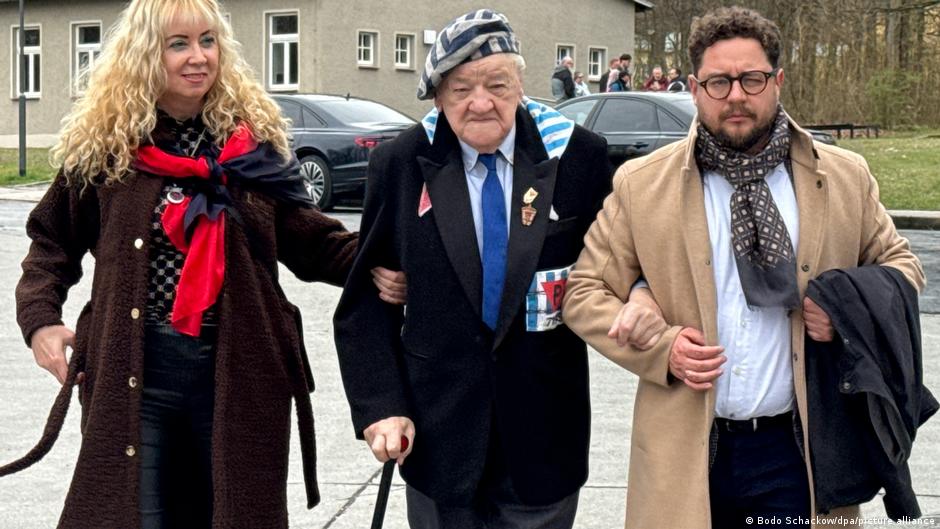
This year’s ceremony featured only two surviving prisoners: Alojzy Maciak from Poland and Andrej Moiseenko from Belarus, both aged 98 and 99 respectively. Unlike previous years, they chose not to speak, a contrast to the 80 survivors present in 2015, when the 70th anniversary saw a larger turnout. Now, only 15 remain to commemorate the event.
The memorial director, Jens-Christian Wagner, highlighted the growing threat to historical memory. “As fewer survivors remain to advocate for their experiences, memorial sites are increasingly weaponized for contemporary political agendas,” he stated during his address. Wagner criticized the rise of right-wing extremism, noting how groups like the far-right AfD exploit the culture of remembrance for self-promotion, particularly in Thuringia, where the party’s regional branch is classified as extremist.
“Left-authoritarian and, in some cases, antisemitic groups tried to hijack this day for their own political purposes,” Wagner added, underscoring the challenges faced by historical commemoration.
Amid these debates, the event also faced shadows from global conflicts. While the focus was on Buchenwald’s past, the Middle East tensions added a layer of complexity to the proceedings. One group, “Initiative Kufiyas,” planned to honor victims of genocide and fascism, yet its intentions were contested in the context of evolving political discourse.
To view the commemorative video, JavaScript must be enabled, and a browser supporting HTML5 is required. The ceremony thus served as a poignant reminder of both the enduring impact of the Holocaust and the fragility of its legacy in a rapidly shifting political landscape.