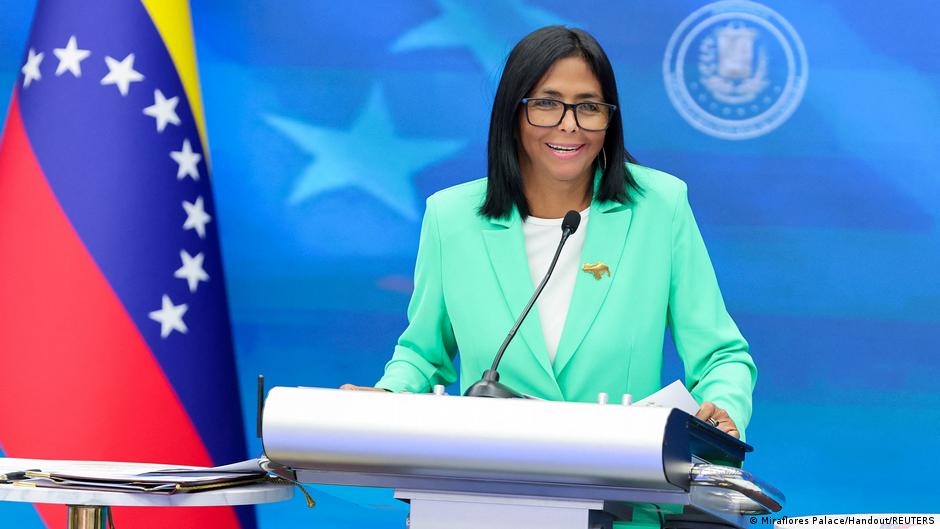
Venezuela: 100 Days with Acting President Delcy Rodriguez
Samael.lol – Following the ousting of Venezuelan leader Nicolas Maduro by U.S. forces, Washington proposed a three-part strategy to reshape the nation. As Delcy Rodriguez begins her 100th day in the interim presidency, the critical inquiry remains: will she enable elections? Initially, Rodriguez denounced the U.S. operation as a kidnapping, vowing to oppose American influence. However, her stance shifted rapidly. Just days after the event, U.S. President Donald Trump claimed confidence that Rodriguez was “essentially willing to do what we think is necessary to make Venezuela great again.”
Cooperation and Institutional Control
On January 5, with military and Supreme Court backing, Delcy Rodriguez swore an oath of office before the National Assembly, which her brother Jorge Rodriguez has led since 2021. Within weeks, she swiftly moved to secure authority over vital sectors. At least 12 senior roles were filled, consolidating her grip on the judiciary, military, and administration. A notable change occurred in March, when Foreign Minister Vladimir Padrino Lopez resigned, likely due to the fallout from Maduro’s capture. He was replaced by Gustavo Gonzalez Lopez, the former head of SEBIN, a security agency linked to past controversies.
Despite Caracas’ denials, the interim government appears to align with Rubio’s vision. Even the tone toward Washington has evolved. In an April interview with El País, National Assembly President Jorge Rodriguez acknowledged professional collaboration with the U.S. government, highlighting a shift from prior hostility. The United Socialist Party of Venezuela (PSUV), once critical of U.S. intervention, now advocates for cooperation, signaling openness to reforms.
Economic Reforms and Investor Interest
Rodriguez has taken steps to attract foreign investment, particularly in the oil industry. This move has generated optimism about economic stabilization, with Moody’s recently assigning a “stable outlook” to the country. In late March, she addressed an investor gathering in Miami, promoting opportunities in oil, construction, banking, and manufacturing. The event, requiring JavaScript for playback, underscored her efforts to engage international capital.
For over a decade, Maduro’s regime struggled to control inflation, which surged past 500% last year. By the time Maduro was removed, 100 bolivars from a January paycheck had lost half their value. While 64% of Venezuelans cited economic issues as their top concern in a mid-2025 Gallup survey, fewer than 15% listed political instability as their primary challenge. Juan Forero, WSJ’s South America Bureau Chief, noted that many Venezuelans welcomed Maduro’s departure, seeing it as a potential turning point for recovery.
Public Sentiment and Political Stability
Though the U.S. intervention shocked many, it did not ignite widespread protests. Forero observed that Venezuelans were hopeful about change after returning from the country in February. The Rodriguez administration, despite internal power dynamics, has maintained a stable footing. With key appointments and a cooperative stance, the interim leadership continues to implement Washington’s roadmap, marking a pivotal phase in Venezuela’s political transformation.