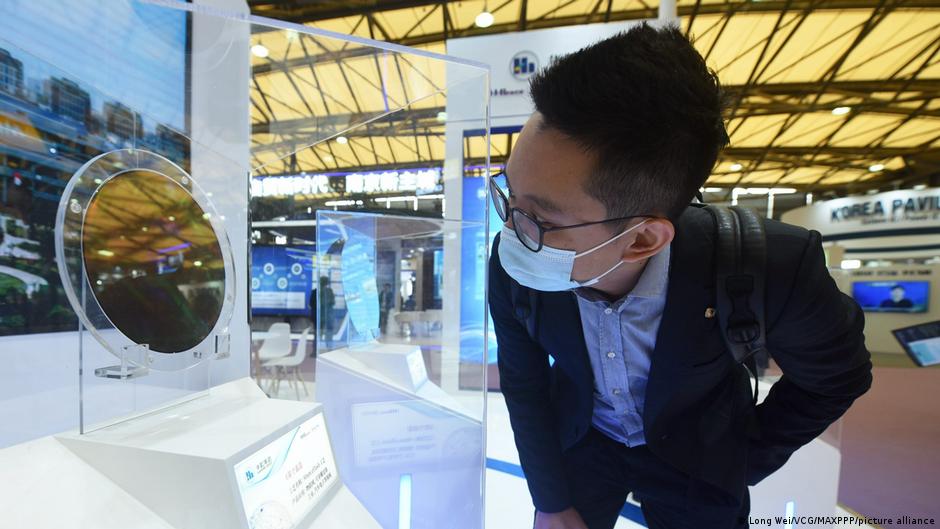
How China’s chip expansion puts pressure on global rivals
Samael.lol – Four years ago, the US government intensified restrictions on China’s semiconductor advancements, prompting the nation to prioritize building its own chip production infrastructure. While China remains behind in the most sophisticated technologies, its “good-enough” semiconductors are now fueling a significant portion of the global economy. These chips, though not the latest in innovation, are critical for vehicles, industrial machinery, and consumer electronics, and their mass production has raised alarms among international competitors.
Shift in Strategic Priorities
The Communist Party’s latest Five-Year Plan has adjusted its focus, emphasizing AI development over direct chip dominance. This document, spanning 141 pages, highlights AI more than 50 times and introduces a framework that integrates advanced chips into a broader computing ecosystem. Beijing is now steering efforts toward industry-specific, low-computing-power AI solutions, which align better with its current domestic capabilities.
China’s semiconductor growth has been driven by massive government investments, including subsidies and tax incentives. Companies like SMIC, a cornerstone of the self-reliance initiative, reported $9.3 billion in revenue last year. Meanwhile, HuaHong, the mainland’s second-largest chip foundry, operates at 106% capacity due to high demand, as noted in its 2025 fourth-quarter earnings report.
“Beijing wants to achieve chip self-sufficiency, but the current level is nowhere near it,” said Ryu Yongwook, an assistant professor at the National University of Singapore’s Lee Kuan Yew School of Public Policy. “China lags the US in research, design, and innovation, and is also behind Taiwan and South Korea in production.”
Despite these gaps, China has made strides in producing 7-nanometer-class processors, now used in Huawei’s smartphones. These chips match TSMC’s 2018 offerings for Western clients but still fall short in speed, power efficiency, and cost compared to 3-nanometer or 5-nanometer alternatives. Analysts like Tim Rühlig from the European Union Institute for Security Studies argue that technological barriers and US sanctions continue to hinder China’s progress.
“China’s chip ambitions face a ‘brick wall’ of technical limits and US sanctions,” Rühlig explained to DW. “Without access to the most advanced US chipsets, progress will take a decade or more.”
John Lee, a Berlin-based researcher with East-West Futures, warned that China’s growing chip output could disrupt global markets. “Chinese production expansion will lower chip prices worldwide and challenge non-Chinese vendors,” he predicted. This trend is already evident in sectors like silicon carbide wafers, a key component for high-power semiconductors. As China’s chips become more competitive, they are increasingly favored by governments and firms in the Global South, where cost efficiency outweighs the need for cutting-edge performance.
Taipei-based Trendforce recently highlighted the rapid growth of China’s semiconductor industry, underscoring its expanding influence in global markets. While the US and its allies remain dominant in the highest-end chips, China’s ability to scale production and reduce costs is reshaping the competitive landscape.