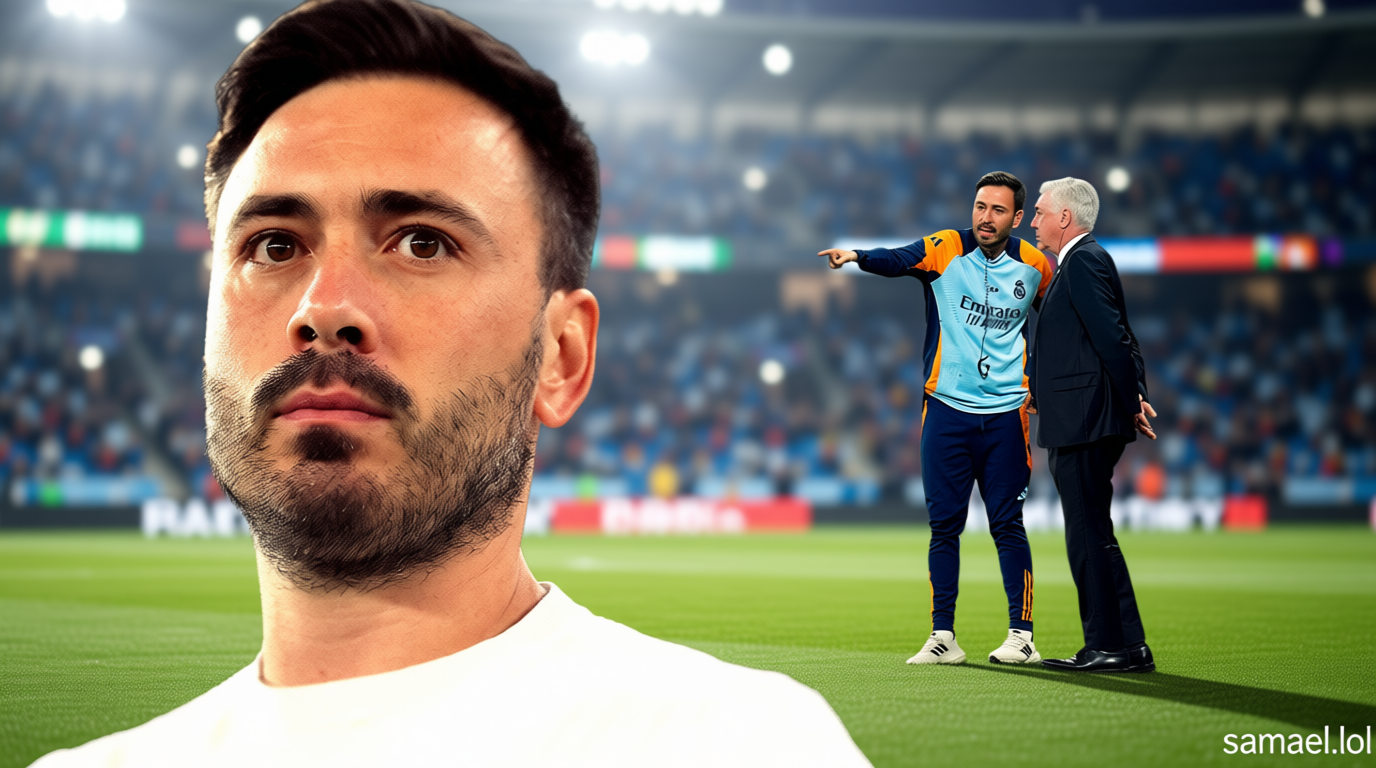
Davide Ancelotti: My game in my words
Upbringing in the World of Football
Samael.lol – Davide Ancelotti, currently Brazil’s assistant manager for the World Cup, has lived in the shadow of football from an early age. His father, Carlo Ancelotti, a five-time Champions League-winning manager, shaped his childhood with an environment where the sport was not just a pastime but a way of life. At just six years old, Davide accompanied his father to Parma’s training ground, where he first encountered Gianluigi Buffon, the legendary Italian goalkeeper. This early exposure to the game’s elite players sparked a lifelong fascination, as the young boy would often take goalkeeping shots against Buffon, who would later become one of the greatest in the history of the sport.
His father’s coaching philosophy also introduced him to defenders like Lilian Thuram and Fabio Cannavaro, both of whom were still in their developmental stages at the time. Davide would watch these players refine their techniques, unknowingly absorbing the habits that would eventually lead them to achieve historic success with France and Italy. This immersive experience was a foundation for his own understanding of football, shaping his perspective before he even earned his coaching badges.
As a child, Davide’s role was not just passive observation. He often played alongside his father, who was then the manager of Parma, and this close interaction allowed him to internalize the nuances of the game. The blend of learning and doing was unique, as his father’s reputation as a tactician meant Davide was constantly exposed to strategic discussions and real-time decision-making. By the time he began assisting his father at Bayern Munich, Napoli, Everton, and Real Madrid, he had already developed a keen eye for tactical patterns and the importance of adaptability.
Philosophy of a Modern Coach
Davide’s coaching journey took a new turn when he stepped into his first head coach role, leading Botafogo. This experience gave him a chance to explore his own identity as a manager, distinct from his father’s legacy. Reflecting on his evolution, he emphasized the diversity of managerial styles. “It is hard to name one manager who directly inspires me,” he said. “Each coach contributes different elements to my approach.”
“Pep Guardiola was cutting edge, a pioneer,” Davide remarked. “You cannot forget Jurgen Klopp for his high pressing, the triggers that define his style. If we speak about superiority, Roberto de Zerbi’s methods in finding the third man are crucial. His attention to small details has shaped how we think about possession and movement. I am also fascinated by Diego Simeone’s defensive discipline, Unai Emery’s structure, and, of course, my father’s influence.”
Carlo Ancelotti’s early work with Arrigo Sacchi’s zonal defence system left a lasting mark on Davide’s mindset. “My father came from Sacchi’s school,” he explained. “That approach, the 4-4-2 formation, taught me the value of positioning and collective organisation.” Yet Davide’s philosophy is not a direct replication. “My identity as a manager is always evolving,” he added. “While I share some characteristics with my father, I believe we are fundamentally different. I need to find my own voice, not just mirror his.”
When asked about his vision for a team, Davide described a desire for versatility. “My dream is to build a squad that can adapt to any situation at the highest level,” he said. He pointed to Paris St-Germain as an example of a modern team that excels in multiple aspects. “They are complete,” he noted. “They can transition from positional possession to free play seamlessly. When they have superiority, they look for the spare man. When they are under pressure, they switch to man-to-man marking with precision.”
He also highlighted the importance of organisation in defensive setups. “Defensively, I believe in zonal marking within the team’s own half,” Davide said. “The best way to defend is with two lines of four and a line of two. A 4-4-1-1 or a 4-4-2 shape can work, but principles matter more than rigid structures.” He explained that today’s teams often face challenges in defending the final line with just four players. “The shape may be 4-4-2, but it changes constantly. This flexibility is key. I learned this from Jose Mourinho, Diego Simeone, and Unai Emery—masters of defensive organisation.”
Exploring Tactical Innovation
Davide’s insights were further illustrated during a session with a tactics board. He adjusted the layout to demonstrate how a team might alter its structure to create a back five. “If the ball moves forward, you follow,” he said, drawing one opposition midfielder into the defensive line. “It all depends on where the ball is, but the idea is to create a five-man block with either the number six or a winger. This is my belief, and I still stand by it.”
During the discussion, Davide compared his approach to that of Pep Guardiola’s Manchester City and Luis Enrique’s PSG. “Guardiola’s teams are all about creativity and movement,” he said. “They find space with precision, using overlapping passes and quick transitions. Enrique’s teams, on the other hand, prioritise control and organisation, even in high-intensity situations.” Davide’s analysis reflected a synthesis of these ideas, blending innovation with tradition.
He also stressed the need for clear ideas as a manager. “You adapt to players and opponents, but you must also have a vision of what you want,” he said. “In the end, the team becomes what you prioritise. If you focus on possession, they will excel in that. If you stress discipline, they will tighten up in defence.” This philosophy is evident in the way he views teams like PSG, which he described as a model of completeness. “They are able to switch between systems effortlessly,” he said. “That’s the mark of a truly evolved squad.”
Looking ahead, Davide expressed confidence in his approach. “I believe in zonal marking, but I also know when to change,” he said. “The key is balance—structure without rigidity, and freedom without chaos. That’s what I aim for in my teams. Whether it’s a high build-up or a deep block, the principles remain the same: to create a system that works for the players and the moment.”
As Brazil prepares for the World Cup, Davide’s role as an assistant to his father will be pivotal. His ability to integrate diverse influences into a cohesive philosophy underscores his growth as a coach. From the early days of watching Buffon and Cannavaro to leading Botafogo and now shaping the tactical framework for Brazil, Davide Ancelotti has carved a path that is both personal and professional. His journey reflects the ever-evolving nature of football, where tradition meets innovation, and the past informs the future.