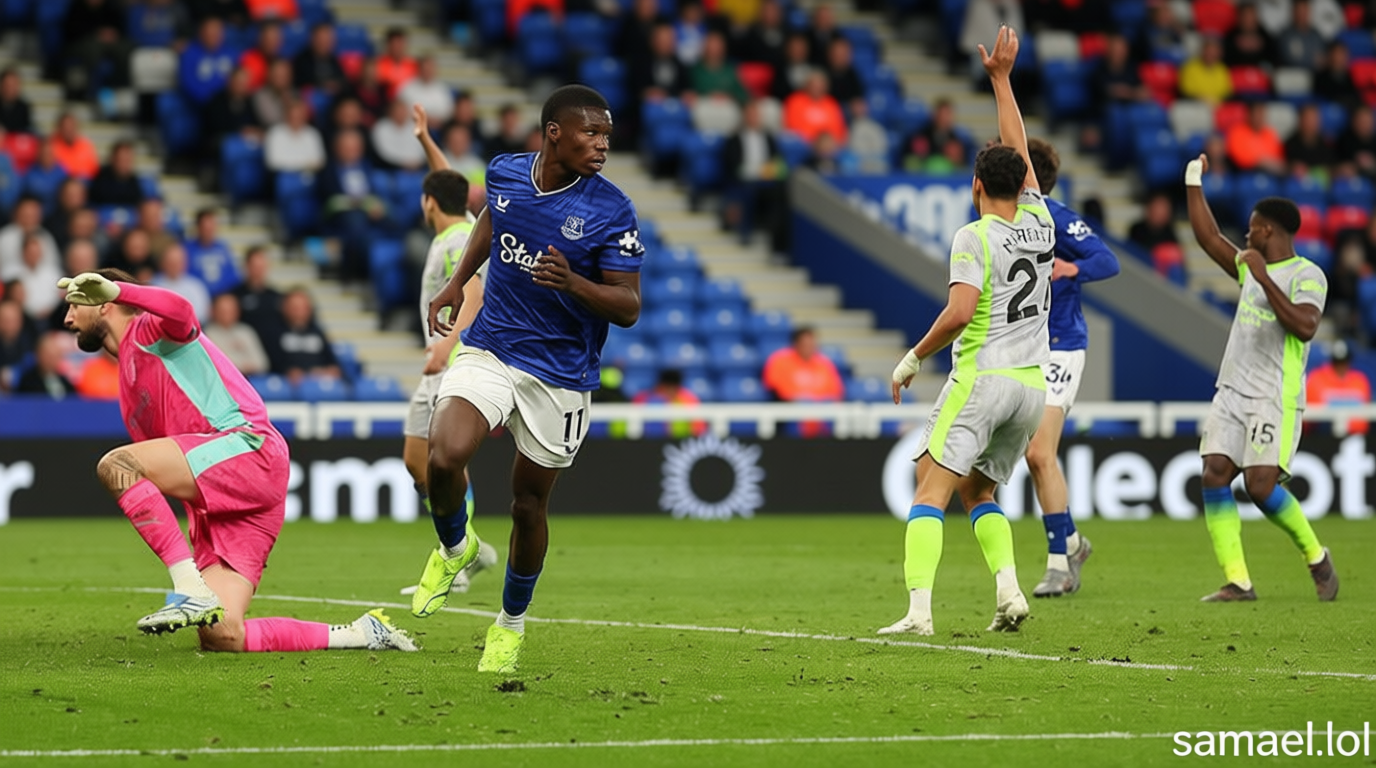
How did Guehi ‘assist’ allow Barry to score when offside?
Samael.lol – Everton’s 3-3 draw with Manchester City was a high-octane encounter marked by late goals, a defensive blunder, and a VAR-related controversy. The match, played at Hill Dickinson Stadium, featured moments of intense drama, including a contentious decision that allowed Thierno Barry to score despite being in an offside position. This unusual goal sparked debate about the application of the offside rule and the role of the video assistant referee in resolving such situations.
A Bizarre Offside Situation
The goal in question arose from a sequence where Manchester City’s Marc Guehi made a seemingly accidental pass that helped Barry score. At the time, the Everton striker was positioned beyond the last defender, yet the referee allowed the goal to stand. The assistant initially raised his flag for offside, but the on-field referee, Michael Oliver, overruled the decision. This raised questions about the criteria for determining whether an offside player’s movement influenced the defender’s actions.
“Barry is in an offside position when the ball is played but it’s down to Guehi,” said former Manchester City and Everton defender Andy Hinchcliffe on Sky Sports. “He is in control of his actions, so suddenly the attacker goes from offside to onside. That is why the goal rightly stands. That is disastrous from Guehi.”
Guehi’s back pass was not a deliberate attempt to assist Barry, yet it inadvertently provided the striker with a chance to score. The law requires that an offside player must have “caused” the defender to move or influence the play. In this case, Barry had started to move towards Guehi, but his actions did not press the defender, leaving the pass as a controlled outcome. This ambiguity highlighted the subjective nature of VAR decisions, which can hinge on interpreting subtle details in real-time.
VAR’s Role in the Decision
Paul Howard, the video assistant referee, was present for the decision but ultimately left the call to the on-field referee. Moyes, Everton’s manager, expressed frustration, stating he was “amazed” his team was not awarded a penalty when Bernardo Silva brought down Merlin Rohl in the final five minutes. The incident occurred during a corner, and Howard confirmed the foul happened before the ball was in play, denying Moyes the chance to request a free-kick.
Everton’s tactical struggles were evident throughout the match. The team’s defensive lapses led to a thrilling game, with multiple goals scored in the closing stages. However, the offside goal became the focal point of the evening’s controversies. The question remained: did Guehi’s pass directly lead to Barry’s goal, or was it a fortunate bounce that allowed the striker to capitalize on a defensive error?
Similar Controversies in Football History
This incident is not unique. Over the years, football has seen several cases where offside decisions have sparked heated discussions. For example, in the Manchester derby three years ago, Bruno Fernandes scored a goal while Marcus Rashford was in an offside position. Rashford had run after the ball but did not make contact, and Fernandes’ strike was ruled valid. Similarly, in April of last year, Luis Diaz was positioned offside behind James Tarkowski when the latter attempted to intercept a loose ball. This led to Diogo Jota scoring the decisive goal for Arne Slot’s side.
These situations underscore a common issue with the offside rule: it can inadvertently penalize defenders who are aware of an opponent’s position but do not realize they are offside. In Tarkowski’s case, would he have changed his approach if Diaz had not been there? The answer lies in the interpretation of the rule, which often leaves room for debate. The challenge is balancing fairness with the need to maintain the flow of the game.
VAR’s influence in these decisions has been a double-edged sword. While it aims to eliminate errors, its reliance on subjective judgment can lead to controversial outcomes. In the case of Guehi’s pass, the on-field referee’s decision to allow the goal reflected a lenient application of the rule. Moyes emphasized the need for clarity, stating: “If that doesn’t get given as a penalty, then it’s an absolute free-for-all from now on.” His comments highlight the growing pressure on referees to make precise calls, even in the most intricate scenarios.
Rules and Their Implications
The offside rule is designed to prevent players from gaining an unfair advantage by being in the wrong position. However, in cases where the offside player’s movement is minimal, the rule can be misapplied. For instance, if a defender underestimates the speed of an opponent’s run, the offside call might be justified. Yet, when the movement is slight and the play is unexpected, it creates confusion.
Everton’s defensive strategy was also called into question. Michael Keane, the team’s center-back, was shown a potential red card for a challenge on Jeremy Doku. This incident, along with the offside goal, showcased the team’s difficulties in maintaining structure. The VAR’s absence in these calls meant that referees had to rely on their own judgment, a factor that can lead to inconsistent rulings.
Another notable example occurred last season when Southampton’s Jack Stephens was sent off for pulling Chelsea’s Marc Cucurella’s hair during a moment when the ball was out of play. The restart was a corner, and the game continued without a penalty. This highlights the complexity of VAR decisions, where even the most blatant fouls can be adjusted based on timing and context.
The debate around offside rules extends beyond individual matches. Some argue that the current system allows for too many goals to be ruled out, especially in fast-paced situations. For instance, in February, Erling Haaland requested a spot-kick after being dragged down by Tottenham’s Radu Dragusin. The decision to allow the play to continue, despite the foul, further illustrates the challenges of applying the rule in real-time.
Calling the Final Whistle
Ultimately, the VAR’s role in these decisions remains a topic of discussion. While it provides a second chance to review key moments, its ability to correct every minor infraction is limited. Referees must navigate the fine line between strict adherence to the rules and maintaining the game’s rhythm. In Guehi’s case, the on-field call allowed the goal to stand, despite the offside position, raising questions about the fairness of such rulings.
For Everton, the outcome of the match left them with mixed emotions. The team had managed to secure a draw, but the controversies surrounding the goal and Keane’s potential red card cast doubt on their performance. Moyes, known for his tactical acumen, now faces the challenge of retraining his defenders to avoid similar mistakes. As he noted, the rules are evolving, and players must adapt to the nuances of modern refereeing.
These incidents also reflect the broader trend of VAR’s increasing impact on football. While it aims to reduce errors, it has also introduced new layers of complexity. The line between a fair decision and a controversial one becomes blurred, and fans are left questioning whether the rulebook is keeping pace with the game’s demands. As the sport continues to evolve, the balance between precision and flexibility in offside decisions will remain a critical topic for debate.