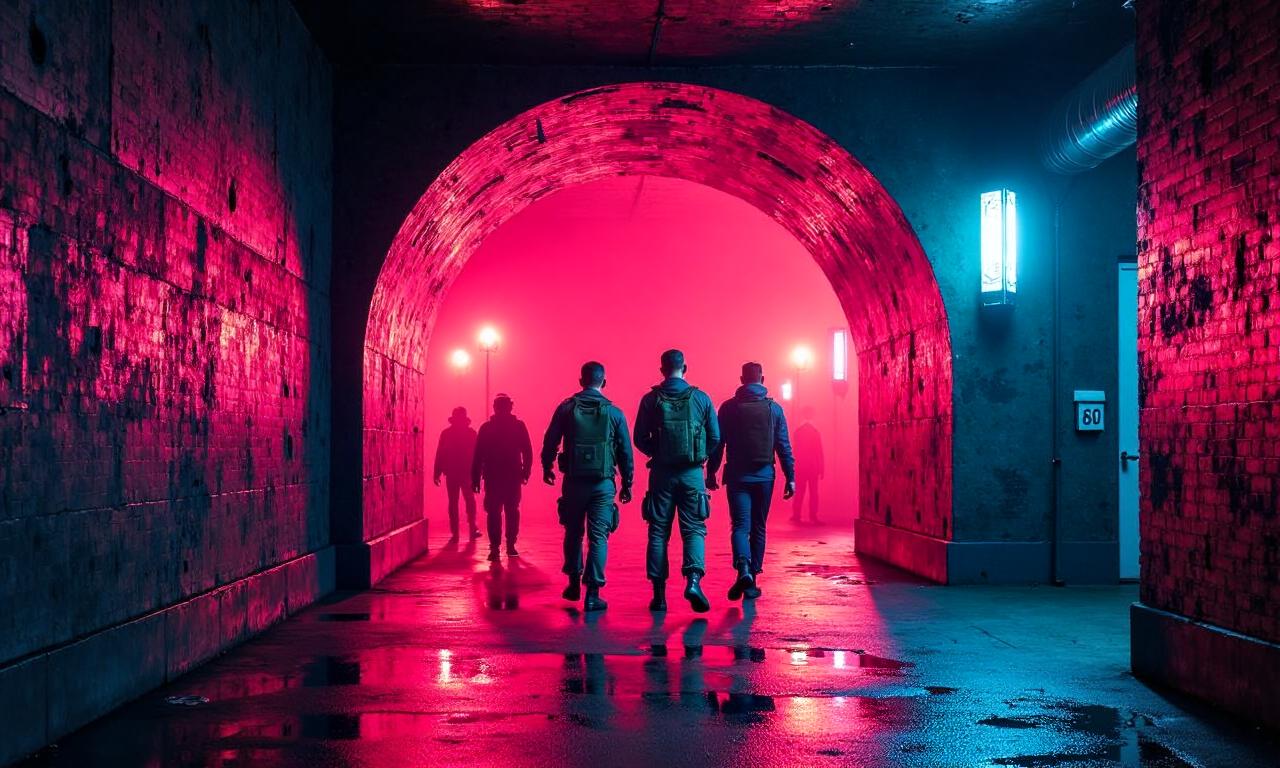
British Army Conducts Secret Wargames in Central London’s Underground
Samael.lol – The British Army has been secretly utilizing a forgotten section of the London Underground to simulate a NATO military operation against potential Russian aggression. This covert exercise, conducted in the depths of Charing Cross station, involved hundreds of soldiers testing the feasibility of operating in urban subterranean environments. The operation, named Arrcade Strike, aims to evaluate the Allied Rapid Reaction Corps (ARRC)—NATO’s deployable headquarters—under realistic conditions, showcasing its readiness to coordinate large-scale maneuvers in complex settings.
A Fictional 2030 Scenario
Arrcade Strike was designed around a hypothetical conflict set in the year 2030, a timeline military planners believe could mark the peak of Russian threat escalation. The scenario required participants to assume roles in a multi-domain operation spanning land, sea, air, space, and cyberspace. This approach reflects the evolving nature of warfare, where traditional combat zones merge with digital battlegrounds. The underground tunnels provided a unique setting, allowing the ARRC to practice command in an environment that mimics the challenges of real-world urban warfare.
“We have moved from operating in tents and open environments, to commercial buildings, to aircraft hangars, and now to underground locations,” explained a senior commander during the exercise. “Operating below ground significantly reduces our signature, makes us harder to find, and improves our chances of surviving an attack.”
Choosing the Perfect Location
The Charing Cross tunnels were selected for their strategic advantages. Disused for years, the station’s infrastructure offers ample space for a command post, while its central location in London demonstrates the practicality of subterranean operations in densely populated areas. “It’s a survival strategy,” said an army spokesperson. “The war in Ukraine has reminded the world of a hard truth: threats to peace in Europe are not distant or theoretical. Russia has mobilized its entire economy, industry, and military for war, and the security of every NATO country is at stake.”
The exercise’s secrecy was maintained through high-tech measures, ensuring that its activities remained undetected. Troops moved through the station as if navigating a labyrinth, using dim lighting and narrow passageways to simulate the challenges of hidden command operations. “It’s like being in an episode of Stranger Things,” said Corporal Ismaila Ceesay, a 28-year-old information management specialist from Stratford, east London. “The red lights and dark shadows make it feel like a different world—nothing seems quite as it should be.”
Blending In as a Commuter
Part of the simulation involved troops appearing as civilians to avoid detection. Ceesay described how his team adopted a London-inspired look, using hoodies and casual movements to mirror the city’s everyday commuters. “My family thought I was on leave,” he said. “I’ve got my hoodie on, changed my gait, and I try to blend in. It’s about staying invisible until the moment we’re needed.”
Major Joe Harris, tasked with establishing a full command post in the disused station, highlighted the unique logistical challenges. “The difference between being here and in an old warehouse is that a warehouse is a wide-open space, while this is a constrained layout with a warren of tunnels and platforms. It forces us to think creatively about how to use limited space effectively,” he noted. Harris also emphasized the psychological impact of the setting, adding, “In the future, when I travel by Tube, I won’t be able to stop myself imagining how a command post could fit into this hidden world.”
Preparing for Urban Warfare
The exercise underscores NATO’s focus on adapting to modern conflict scenarios. With Russia’s military capabilities and strategic ambitions expanding, the need for flexible command structures has never been greater. The ARRC’s ability to operate in urban environments is critical, as cities become increasingly likely targets in future wars. By simulating these conditions in London, the army demonstrates its capacity to function in the most unpredictable and challenging settings.
The Charing Cross tunnels, once a relic of the city’s transport system, now serve as a testbed for innovation. Their use highlights how infrastructure previously designed for civilian purposes can be repurposed for military operations. The underground location also allows for the integration of advanced technology, such as secure communication networks and surveillance systems, which are essential for modern command and control. “This proves the concept works even in the most complex urban environment imaginable,” the spokesperson said, underscoring the importance of the site’s central position.
Lessons from Ukraine
The exercise draws inspiration from the real-world conflict in Ukraine, where NATO allies have already applied similar tactics. The war has shown that hybrid warfare—combining conventional and unconventional methods—can quickly shift the balance of power. “The security of every NATO country is at stake,” the spokesperson reiterated. “We’re preparing for scenarios where visibility is key, and adaptability is survival.”
Arrcade Strike also tested the coordination of forces drawn from the UK and its NATO partners, involving approximately 100,000 personnel. The exercise required seamless integration across domains, from cyber operations to tactical maneuvers. This multi-faceted approach ensures that the ARRC can respond swiftly to threats, regardless of their origin or scale. The underground setting, while isolated, mirrors the high-stakes environment of real combat, where every decision must be precise and every movement deliberate.
Ensuring Covert Operations
To maintain the exercise’s secrecy, teams used measures such as secure barriers and restricted access to the station. This allowed them to operate without disrupting regular subway services or drawing attention. The ARRC’s focus on covert operations aligns with NATO’s broader strategy of maintaining a hidden, mobile force capable of rapid deployment. “Getting underground isn’t a novelty—it’s a survival strategy,” the spokesperson said, emphasizing the importance of such exercises in preparing for future conflicts.
As the world watches the ongoing war in Ukraine, the British Army’s efforts to simulate worst-case scenarios in London serve as a reminder of the ever-present threat to European stability. By leveraging the city’s underground network, the ARRC not only tests its operational capabilities but also reinforces the idea that even the most familiar spaces can become critical strongholds in times of war. The experience at Charing Cross is a testament to the ingenuity and preparedness of NATO’s military forces, blending technology, strategy, and secrecy to ensure readiness for any challenge.
For soldiers like Ceesay, the exercise is both a professional test and a personal challenge. “It’s about staying invisible until the moment we’re needed,” he said. “The tunnels feel like a hidden battlefield, and every detail matters.” As NATO continues to refine its response strategies, the lessons learned from these simulations will shape the way military forces prepare for the unpredictable conflicts of the future. The London Underground, once a symbol of everyday transit, now stands as a proving ground for global defense planning.
With the war in Ukraine highlighting the necessity of adaptable military strategies, the British Army’s secret wargames in central London represent a crucial step in modernizing NATO’s readiness. By conducting these exercises in a setting that mirrors real-world conditions, the army not only tests its capabilities but also demonstrates the versatility of urban infrastructure in times of crisis. The Charing Cross tunnels, with their mix of history and functionality, offer a unique environment for this purpose, proving that even the most mundane parts of a city can become vital in safeguarding national and collective security.
As the exercise concludes, the ARRC will analyze its outcomes to enhance future operations. The focus on subterranean command posts reflects a growing trend in military planning, where the emphasis is on minimizing exposure and maximizing efficiency. Whether in the depths of a subway system or the heart of a bustling metropolis, the ability to operate in the shadows is becoming a defining feature of 21st-century warfare. The British Army’s use of Charing Cross station underscores this shift, blending tradition with innovation to ensure NATO remains prepared for the challenges ahead.