Hungary: Orban’s election defeat sparks hope and relief
Hungary: Orban’s election defeat sparks hope and relief
Following a significant shift in Hungary’s political landscape, Viktor Orban’s Fidesz party faced a decisive loss in the parliamentary election. The outcome marked a turning point for global populists, including figures like Putin and Trump, who had long aligned with Orban’s autocratic governance. The new leader, Peter Magyar, has pledged transformative policies, signaling a new chapter for the nation.
A Defining Moment
The end of Orban’s era began with a brief yet powerful message on Facebook. At 9:11 p.m. CET on Sunday evening, the opposition’s leader, Peter Magyar, shared a post on a blue background: “Prime Minister Viktor Orban just congratulated me on the phone on our victory.” This simple statement, though concise, captured the gravity of the moment.
“Prime Minister Viktor Orban just congratulated me on the phone on our victory.”
Although only half the votes had been tallied, the scale of Fidesz’s defeat and Tisza’s historic triumph was evident. The opposition secured a two-thirds majority, the largest such margin since the fall of the communist regime in 1989/90, with an impressive 80% voter turnout.
The Road Ahead
Orban, despite his long-standing dominance, took the stage shortly after Magyar’s post and acknowledged the loss. Addressing a modest crowd of supporters, he declared, “Our party will serve the country and the Hungarian people from the opposition,” vowing, “never, never, never give up.”
“Our party will serve our country and the Hungarian nation from the opposition,” said Orban. “We will never, never, never give up.”
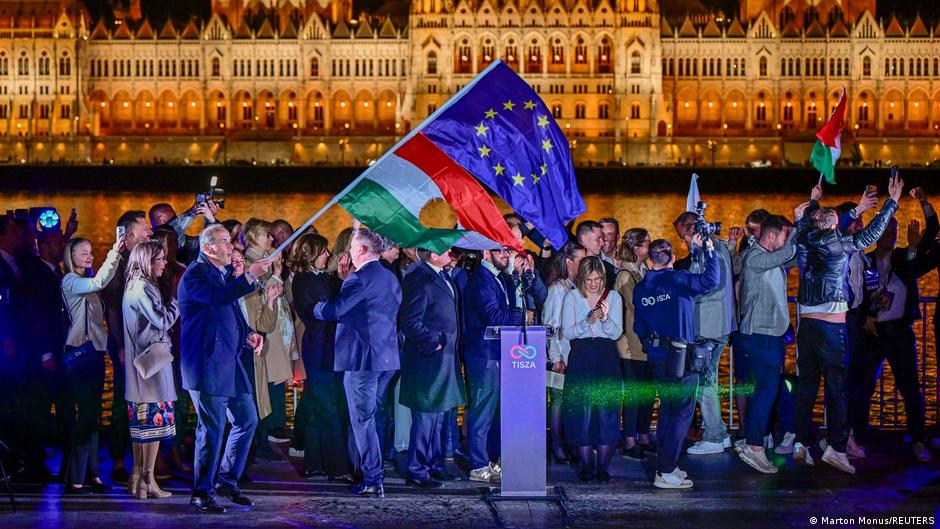
Meanwhile, jubilant crowds, mostly young, flooded the streets of Budapest and other cities. The celebration echoed the spirit of 1989/90, as the public chanted “Europe! Europe!” and hailed the “end of tyranny.” Major media outlets echoed the sentiment, declaring the “toppling of the Orban system” and “It’s over.”
A New Vision
Peter Magyar’s victory speech, delivered to thousands, emphasized unity and reform. He promised to rebuild a functional and humane Hungary, stating, “From today, our country is alive again.” His message blended bold commitments with gestures of reconciliation, addressing both Fidesz supporters and critics.
“We have been empowered to build a functioning and humane country. We will work every minute and every second to earn this trust,” Magyar declared.
Magyar called for the resignation of key officials, including the president, attorney general, and judiciary members, to restore balance in governance. He also extended an olive branch to Fidesz voters: “I will also be your prime minister and ensure we accept each other, even if we disagree.”
Legacy of Autocracy
Political analysts highlighted the significance of the result, linking it to Orban’s 16-year rule. “A new era” was anticipated, with some predicting the “demolition of the Orban regime.” Critics pointed to his systemic consolidation of power, where state institutions and media were brought under control.
Orban’s tenure, beginning in 2010, was marked by accusations of corruption and authoritarianism. His party’s rhetoric of patriotism often overshadowed dissent, with opponents branded as traitors. Recent claims against Ukraine further fueled public discontent, while his close ties with Putin were seen as a symbol of his alignment with global autocrats.
The election outcome reflected a deepening disillusionment with his governance, which critics argue combined democratic erosion with populist appeal. As Hungary’s political future unfolds, the nation now looks to Magyar’s promises with cautious optimism.