US strikes on drug boats spark legal controversy
US strikes on drug boats spark legal controversy
Recent US military operations against suspected drug vessels have ignited debates over their legal justification. While the administration frames these actions as necessary to combat narcotics trafficking, critics argue they serve more political than strategic purposes.
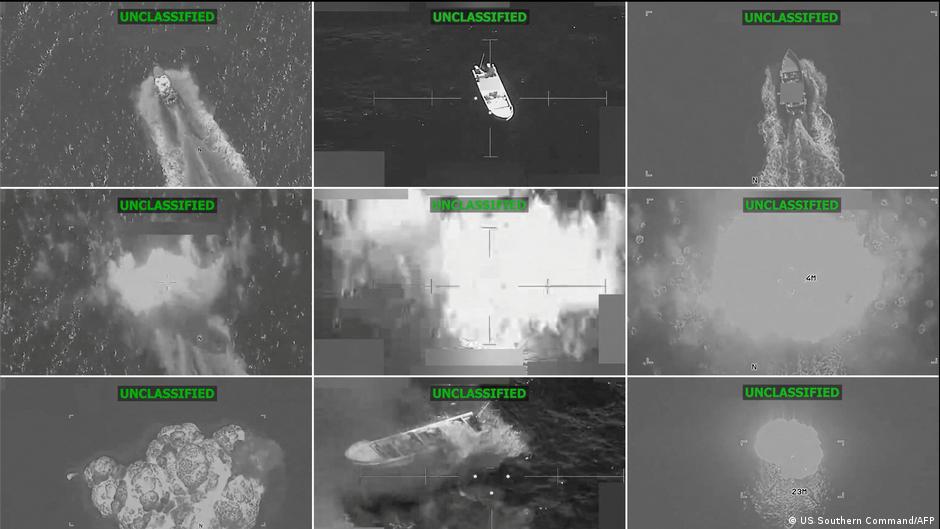
Under the Southern Command, the US Navy has intensified its efforts targeting “drug boats,” as claimed by the Trump administration. These vessels are believed to transport narcotics from South America to the United States, with media reports indicating over 50 ships have been sunk since September 2025.
“The strikes are not just ineffective; they also serve to rally Trump’s political supporters,” says Carlos Perez Ricart of Mexico’s Center for Economic Research and Teaching (CIDE).
Despite the scale of operations, the US government has not provided evidence confirming the illicit cargo on these vessels or disclosed identities of those killed. Legal observers question whether these actions meet international law standards, with some calling them extrajudicial killings.
During his second term, Trump classified drug cartels as foreign terrorist organizations, a move that gained traction after he abandoned the idea during his first term. This designation allows the US to label those killed in boat strikes as “unlawful combatants,” according to reports from October 2025.
Fentanyl, a drug largely produced in Mexico, has become the deadliest substance in the US. The National Institute on Drug Abuse (NIDA) notes it accounts for nearly 70% of fatal overdoses. Its potency was demonstrated in 2002 when Russian authorities used it to end a theater hostage crisis.
While some experts claim the attacks have disrupted Caribbean drug routes, others doubt their long-term effectiveness. “The cocaine doesn’t stop flowing,” says Alex Papadovassilakis of InSight Crime. “Cartels have many more options, especially as the US cannot sustain this level of military pressure.”
Former Southern Command lawyer Manuel Supervielle acknowledges the sunk boats likely carried drugs. However, he points out that non-lethal methods, like disabling engines from helicopters, were commonly used in the early 2000s. “The coast guard would then arrest crews and seize narcotics,” he recalls.