Women’s workwear: When proper fit becomes a safety issue
Women’s workwear: When proper fit becomes a safety issue
For years, women working in trades and industrial fields have faced a challenge: the lack of appropriately sized gear. As a result, many have had to adapt to men’s workwear, which often doesn’t align with their body shape. This mismatch can lead to discomfort and even pose safety risks. However, recent efforts by some companies have aimed to address these concerns by creating more tailored options.
A Shunting Attendant’s Experience
Jennifer Herb, a shunting attendant at DB Cargo, spends her days navigating railway tracks under varying weather conditions. Her duties involve checking brakes, inspecting undercarriages, and coupling freight cars. For her, workwear must be flexible enough to handle bending, climbing, and walking long distances on uneven surfaces. It also needs to be both visible and protective, shielding her from snow, wind, sun, and rain.
“The clothing works with me, like another colleague,” wrote Herb on the blog of Cologne-based workwear manufacturer Bierbaum-Proenen.
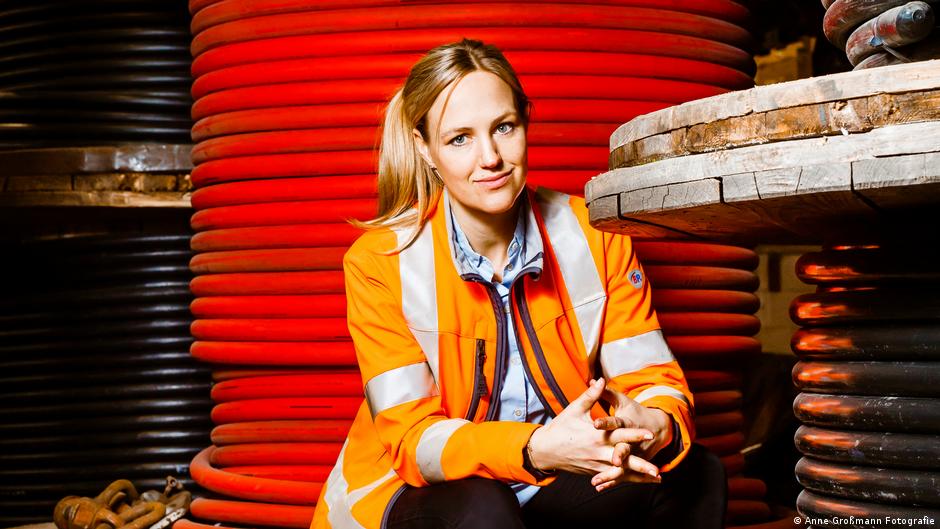
Herb typically wears a high-visibility jacket and trousers in bright orange, complete with reflective stripes. These pieces were specifically crafted for women, featuring a high stretch content for better mobility. Previously, high-visibility attire was rigid and bulky, especially for women who had to wear men’s designs in smaller sizes. The result was often clothing that didn’t fit well—tight around the hips, with jackets that couldn’t close properly and sleeves that were too long, requiring constant rolling.
Women also found it difficult to store tools in chest pockets, and trousers frequently pinched at the thighs or sagged at the waist. Even safety shoes, designed for men, often failed to accommodate women’s narrower feet. A 2010 study by the Women’s Engineering Society highlighted these issues, revealing that over half of participants felt their protective gear hindered rather than helped them.
Designing for Women
Larissa Zeichhardt, co-owner of LAT, a company specializing in railway cable installation, understands the struggle. Over a decade ago, she and her sister took over the family business. At the time, men’s protective clothing was the norm, and Zeichhardt recalls how it impacted her work. “It didn’t just look bad, it was impractical,” she said. “I was constantly cold, and the clothes snagged on things, which could be life-threatening in tunnels if a train approached.”
“I kept snagging on things. That can be life-threatening, especially in tunnels if a train approaches and you can’t slip into a safety niche fast enough because your jacket gets caught,” Zeichhardt explained.
Zeichhardt began seeking better-fitting workwear for her female employees and found solutions at Bierbaum-Proenen. She described the experience as “a liberation.” Heike Altenhofen, a product manager at Bierbaum-Proenen, noted that women’s cuts have long existed in the medical sector, where female workers were more common. However, in male-dominated industries, women often accepted ill-fitting gear as a given.
Founded in 1788 and family-owned for seven generations, Bierbaum-Proenen has been crafting workwear since the late 19th century. Today, the company recognizes that women expect comfort comparable to their leisure clothing, given the hours spent in workwear each week. Around 15 years ago, Bierbaum-Proenen partnered with Deutsche Bahn to tailor high-visibility gear for the female body. “Some of the women told us they weren’t taken seriously when wearing men’s clothing,” Altenhofen said.
Through this collaboration, small adjustments like bust darts, two-way zippers, and elastic waistbands made a significant difference. Altenhofen emphasized that the goal was to maintain the same materials and durability as men’s versions while improving fit. “Our female customers still want the clothes to look like the men’s versions,” she added. Personal protective equipment must meet specific workplace demands: visibility, movement, temperature control, and resistance to wear or fire. Today, Bierbaum-Proenen provides such gear for companies across various industries.