What we call sex work — and what it says about society
What We Call Sex Work — and What It Says About Society
A Bonn exhibition delves into the evolution of sex work across cultures and eras, illustrating how terminology has influenced societal attitudes, legislation, and the lived realities of those engaged in the profession. One pivotal moment in shaping modern perceptions comes from Rudyard Kipling’s 1888 short story “On the City Wall,” where he introduced the phrase “Lalun is a member of the most ancient profession in the world.” This line helped popularize a enduring euphemism for sex work, though its meaning has shifted over time. By avoiding direct reference to the act, such language reflected the moral priorities of the 19th century, where indirect terms made the subject more palatable while keeping it socially distant.
Language as a Tool of Framing
The Bundeskunsthalle’s exhibition “Sex Work: A Cultural History” examines how sex work has been depicted, controlled, and experienced globally. Curators emphasize that the topic is deeply entwined with moral and political debates, often serving as a battleground for societal values. By combining visual art, historical records, legal texts, and contemporary perspectives, the display reveals how terms have both defined and obscured the nature of sexual labor.
“Sex work history is challenging to research because what we’re called varies by era, and historical documents often rely on vague euphemisms,” says Ernestine Pastorello, a co-curator and sex worker activist. She adds, “In the 19th century, ‘prostitute’ could apply to any woman seen as too prominent in public life, regardless of whether she sold sex.”
Labels have long carried assumptions about class, gender, and societal value. Some, like “Stricher” in German, explicitly marginalize by associating the term with men engaged in street-level sex work. Derived from the phrase “auf den Strich gehen” (to walk the beat), it became linked to Berlin’s Bahnhof Zoo area in the 1990s and 2000s, symbolizing a specific form of urban stigmatization. Meanwhile, terms like “porn performer” reflect modern shifts in how sexual labor is structured, from subscription-based platforms to self-directed content creation on sites like OnlyFans.
Historical Contexts and Political Language
In the former Soviet Union and other Communist Bloc nations, sex workers were often labeled “social parasites,” a term used to justify legal action against those deemed to live off the system without contributing to society. This classification tied sex work to a lack of productivity, reinforcing its association with moral failure. The exhibition highlights how such language allowed authorities to enforce norms and define who was considered a “legitimate” worker.
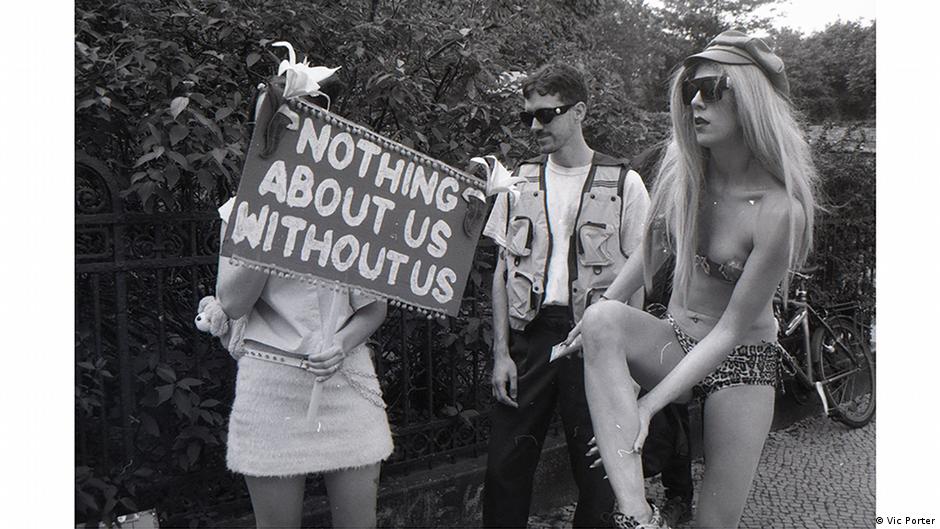
The display also underscores the power of reclamation. Sex worker movements have increasingly adopted terms like “escort” or “stripper”, challenging outdated labels that carry negative connotations. The term “sex work” itself was coined in the late 1970s by US activist Carol Leigh, who sought a neutral descriptor for the activity rather than a moral judgment. Pastorello explains, “The phrase suggests nothing more and nothing less than what is being discussed — the exchange of sexual services for financial support.”
Shaping Discourse and Identity
By using precise language, the exhibition fosters clearer dialogue about sex work. It invites visitors to consider how their own views are shaped by media, societal expectations, or the words they learned growing up. The glossary of terms included in the exhibit serves as a lens to see what has been emphasized or overlooked in different periods. From the moralizing tones of the 19th century to the digital redefinition of the 21st, the evolution of language mirrors broader cultural shifts in understanding labor, gender, and autonomy.