Electronic line-calling in Madrid wrong – Rybakina
Elena Rybakina Calls Electronic Line-Calling at Madrid Open “Wrong”
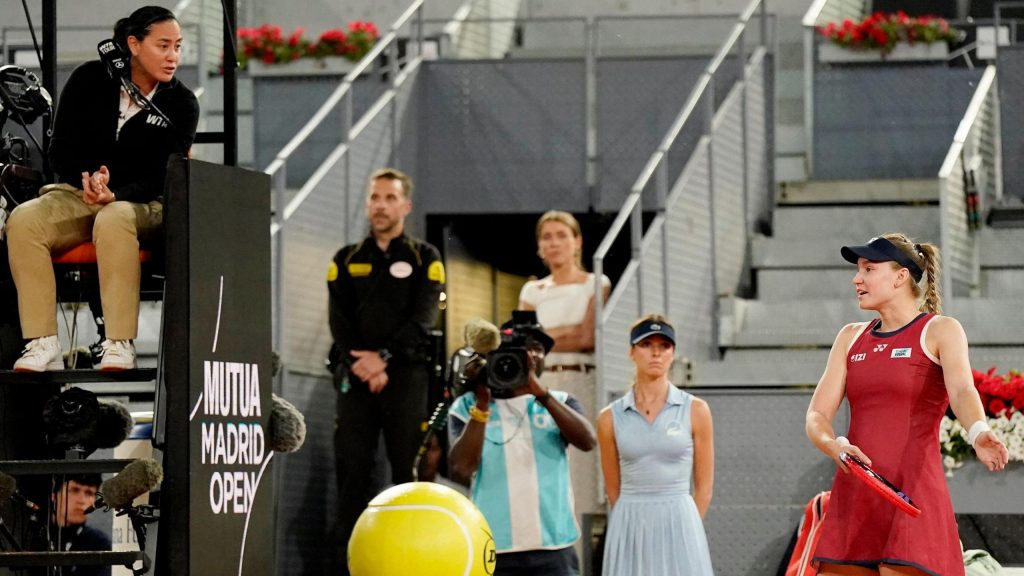
Electronic line calling in Madrid wrong – Elena Rybakina, the Kazakh tennis player, voiced her concerns about the electronic line-calling system during her three-set victory at the Madrid Open. The incident occurred in the second set when Zheng Qinwen, the Chinese opponent, was awarded an ace on a serve that Rybakina believed had been incorrectly judged. Despite the scoreline favoring Zheng Qinwen, 30-0 in the set and 4-3 down in the second set, the disputed call sparked Rybakina’s protest. The player requested that the umpire, Julie Kjendlie, descend from her position to examine the mark on the clay court, but the official maintained her stance and declined the request.
Rybakina’s frustration was evident as she pointed to the line on the court, emphasizing her belief in the system’s error. The tennis star insisted that the electronic system had failed to capture the correct mark, stating, “The system is wrong, this is not a joke.” She added that the call was so glaringly incorrect that she would no longer trust the technology. “Well with this thing, I won’t trust it at all, because there was no mark even close to what the TV showed,” Rybakina declared. Her comments underscored the growing tension between players and the automated systems used to enforce rules in professional tennis.
Controversy and Context
The incident unfolded during a high-stakes moment in the match, with Zheng Qinwen poised to take control of the second set. Rybakina, however, felt the electronic system had made a critical mistake, potentially altering the outcome of the game. Her reaction was not isolated; it echoed a similar controversy that occurred the previous year involving Alexander Zverev, the German men’s player. In 2023, Zverev had been warned for taking a picture of a contested ball mark during a line-calling dispute at the same tournament. The player argued that the ball had gone wide, but the system called it in, leading to a warning for unsportsmanlike conduct.
Zverev’s incident became a notable example of how electronic line-calling can spark disagreements. He had retrieved his phone from his bag to capture the mark, which he believed was clear evidence of a system malfunction. Rybakina referenced this past event, noting that the situation had been “similar to what Zverev had last year because it was in front of her nose.” She pointed out that the mark was so visible that it was impossible to ignore, adding, “You can’t not see it. It was pretty frustrating.” This comparison highlighted the recurring nature of the issue and the pressure on players to accept calls that may seem questionable.
Rybakina’s comments reflect a broader debate about the reliability of electronic line-calling systems. While the technology is designed to improve accuracy, it has occasionally faced criticism for missing calls or misjudging lines. The player’s frustration was palpable, as she described the decision as a “stolen point” and questioned the fairness of the system. “It’s kind of a stolen point,” she said, “I understand it was her serve and she was serving really well, but it’s really frustrating.” Her words captured the emotional impact of such errors on both players and fans.
Technology in Modern Tennis
The Madrid Open, like many Grand Slam tournaments, has embraced electronic line-calling as part of its efforts to enhance precision in match decisions. This system uses sensors and cameras to detect whether a ball lands in or out of bounds, reducing the need for human judgment. However, the incident involving Rybakina revealed that even with advanced technology, disputes can arise. The player’s confidence in the system was shaken by the clear discrepancy between the electronic read and the visual mark on the court.
Electronic line-calling has been a topic of discussion in tennis circles for years. While proponents argue that it minimizes human error and provides consistency, critics like Rybakina highlight its limitations. The player’s experience at the Madrid Open underscores the importance of transparency in how these systems operate. “The system is wrong, this is not a joke,” she reiterated, emphasizing that the error was not just a minor oversight but a significant miscalculation. Her remarks suggest that players are increasingly vocal about their trust in technology, especially when it affects the flow of the game or the outcome of a match.
Rybakina’s win, 4-6 6-4 6-3, demonstrated her resilience despite the controversy. The three-set victory showcased her ability to adapt and push through moments of doubt. However, the incident left her questioning the reliability of the system. “Well with this thing, I won’t trust it at all,” she said, indicating a potential shift in her approach to future matches. The player’s frustration also resonated with the audience, who watched the decision unfold in real-time and were left to interpret the validity of the call based on their own observations.
The Madrid Open’s use of electronic line-calling has been a subject of scrutiny in recent years, with several players raising concerns about its accuracy. Rybakina’s case is a prime example of how even a single incorrect call can create a ripple effect, influencing a player’s confidence and the overall perception of the tournament’s fairness. Her comments added to the growing conversation about the need for technological improvements and human oversight in tennis. “It was similar to what Zverev had last year,” she noted, drawing a parallel between the two incidents and suggesting a pattern of system-related disputes.
As the tournament progressed, Rybakina’s resolve to challenge the system became a focal point for discussions about its role in modern tennis. The incident served as a reminder that while technology can streamline the game, it also requires players to navigate moments of uncertainty. Her insistence on verifying the mark, even when the umpire refused, highlighted the importance of human involvement in critical decisions. The player’s actions at the Madrid Open may influence future rule changes or adjustments to the electronic system, ensuring that it meets the high standards expected in professional sports.
Overall, Rybakina’s experience at the Madrid Open illustrated the challenges of integrating technology into traditional sports. While the electronic line-calling system aims to provide objective rulings, it remains vulnerable to errors that can disrupt the natural flow of competition. Her comments, backed by a clear visual discrepancy, added weight to the argument that the system needs refinement. As tennis continues to evolve, the balance between human judgment and technological precision will remain a central theme in the sport’s development. Rybakina’s frustration, though specific to the Madrid Open, reflects a wider sentiment among players who rely on the accuracy of their decisions to succeed in high-pressure matches.