Germany debates rape law to tackle AI and online abuse
Germany debates rape law to tackle AI and online abuse
A push for reform in Germany’s rape laws has intensified following a high-profile case involving deepfake technology. Actress and presenter Collien Fernandes recently accused her ex-partner, actor Christian Ulmen, of orchestrating the spread of hundreds of AI-generated pornographic images featuring her online. This incident has sparked broader discussions about the adequacy of current legal frameworks in addressing modern forms of sexualized violence.
Fernandes, speaking to German weekly magazine Der Spiegel, claimed that Ulmen was responsible for creating and distributing deepfake videos that impersonated her on social media. “You virtually raped me,” she stated in the interview. Ulmen is disputing the allegations, challenging the specifics of the reporting. The case has drawn attention to a key legal question: whether AI-generated content qualifies as a form of rape under existing statutes.
“You virtually raped me,” Fernandes said in her interview with Der Spiegel.
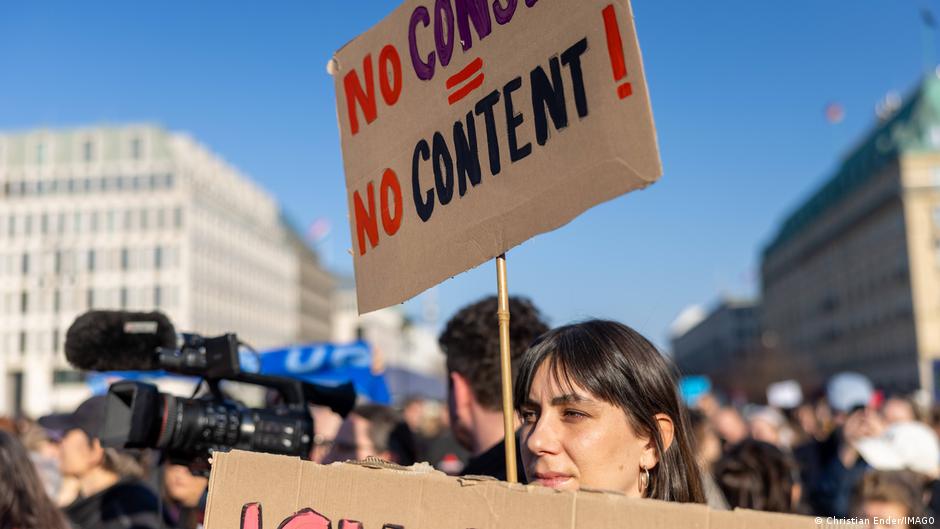
Thousands of supporters gathered at Berlin’s Brandenburg Gate on March 22 to demand stronger protections against sexualized violence. Organizers reported approximately 13,000 participants, while police estimated the number at around 6,700. Meanwhile, Fernandes highlighted her decision to file the case in Spain, citing better women’s rights protections there. She noted that the alleged perpetrator’s primary residence in Spain initially allowed the case to be heard in that country.
However, Spain’s Supreme Court in Mallorca ruled that German authorities have greater jurisdiction to investigate the matter, describing the connection to the country as “obvious.” The court’s decision, which is not yet binding, could be appealed. Fernandes had previously submitted a complaint in Berlin at the end of 2024 about a fake profile mimicking her. The case was later handed to the prosecutor’s office in Itzehoe, which dismissed it. A recent review led to the investigation’s reopening, with plans to transfer it to Potsdam, where Ulmen and Fernandes once resided.
Legal Challenges and Proposed Reforms
Germany’s criminal code (StGB) currently penalizes physical contact in sexual offenses. Section 184k addresses violations of the intimate sphere via image-based recordings, while Section 201a covers breaches of personal life and personality rights through such content. Legal experts are divided on whether these provisions extend to AI-generated images or fictional depictions like deepfakes.
In response, a coalition of political and societal figures unveiled a 10-point plan to safeguard women from digital sexual violence. The proposals include criminalizing deepfake pornography, banning AI-based “nudify” apps, and requiring online platforms to swiftly remove such content. Victims would also gain clearer rights to demand deletion, information, and identification of offenders.
Green Party representative Lena Gumnoir emphasized that Germany’s current laws fail to protect sexual self-determination. “There are glaring gaps in criminal liability when it comes to deepfake pornography,” she noted. Gumnoir pointed out that Fernandes’ lawyer advised filing the complaint in Spain due to the perceived lack of legal support in Germany, calling it a “wake-up call” for the federal government.
To view the accompanying video, ensure JavaScript is enabled and consider upgrading to a browser that supports HTML5 video. The legal definition of “image-based recordings” remains unresolved, with the supreme court yet to definitively clarify its scope in this context.