Is To Lam’s Vietnam turning into Xi Jinping’s China?
Is To Lam’s Vietnam Turning into Xi Jinping’s China?
Vietnam’s legislative body recently approved To Lam as its president, sparking discussions about the country’s political trajectory. Analysts now question whether Vietnam is adopting a model similar to China’s, where power is centralized under a single leader. To Lam, who assumed the role this month, received full support from the National Assembly, marking a departure from traditional practices in Hanoi’s political elite.
A Shift in Power Dynamics
Historically, the Vietnamese Communist Party (VCP) favored a collective leadership structure, divided among four key roles: party chief, state president, prime minister, and National Assembly. This system, often called the “four pillars” model, allowed for a balance of authority within the one-party framework. However, recent changes suggest a move toward greater concentration of power, akin to China’s system since the 1990s, where the top party leader typically also holds the presidency.
“The Vietnamese political system is becoming more aligned with China’s model, dominated by Xi Jinping,” said Alfred Gerstl, an Indo-Pacific relations expert at the University of Vienna. “While this could accelerate reforms, it risks diminishing internal checks and reducing space for dissent within the party.”
Vietnam’s political system has long relied on informal traditions as much as formal rules. Retirement norms, once a key mechanism to manage leadership transitions, have weakened in recent years. The VCP now appears more flexible in extending leaders’ tenures, as seen with Nguyen Phu Trong, who defied the two-term tradition in 2021 and later became the party chief until his passing in 2024. To Lam, a former public security minister, rose to prominence through Trong’s anti-corruption drive, which reshaped the political hierarchy.
Embracing China’s Security Model
Under To Lam, Vietnam is increasingly adopting elements of China’s security and surveillance framework. Gerstl notes this aligns with recent bilateral agreements and could further limit freedom of expression. The country already ranks 173rd out of 180 in Reporters Without Borders’ World Press Freedom Index, indicating a trend toward stricter control over media and public discourse.
Recent initiatives include plans for state-controlled data-trading platforms, managed by the public security ministry, a move described as mirroring China’s centralized approach. Vietnam is also expanding its national electronic ID system, using AI-driven camera networks to monitor citizens—a practice increasingly seen in China. Additional legislation has bolstered the government’s ability to collect personal data from internet users, reinforcing a growing emphasis on surveillance.
Strengthening Ties with China
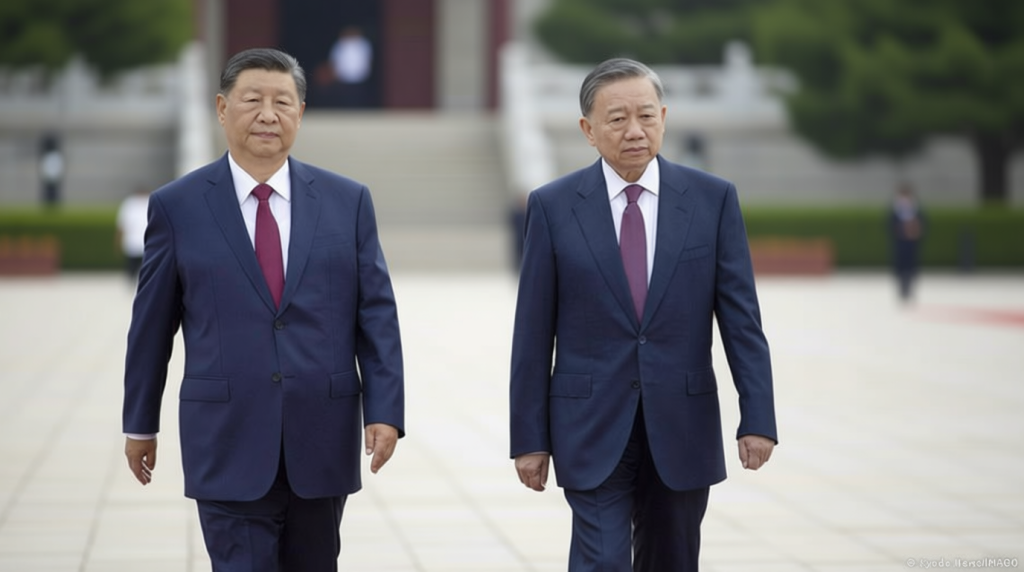
To Lam’s first official visit to China highlighted the nation’s continued alignment with its northern neighbor. The trip followed a pattern set by past Vietnamese leaders, reflecting Hanoi’s view of the two countries as socialist “comrades and brothers.” During the visit, Xi Jinping emphasized ideological unity and strategic cooperation, reinforcing the idea of shared political goals between the nations.
While Vietnam’s system still differs from China’s in some aspects, the increasing consolidation of authority under To Lam signals a potential transformation. Analysts suggest this shift could redefine the country’s governance, blending elements of centralized control with its existing one-party structure.